
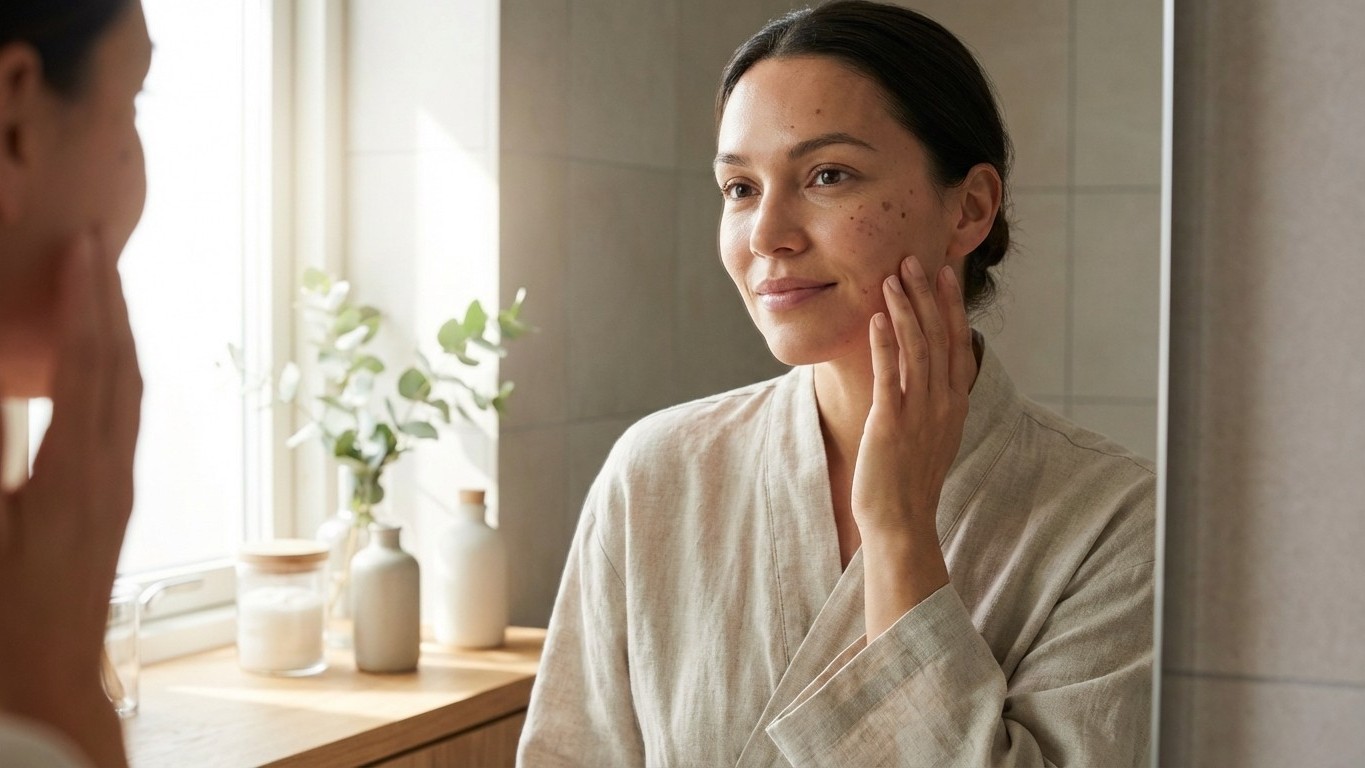
The bathroom mirror catches everything: the faint ghost of a pimple from last month, that stubborn brown dot on the cheekbone, the “why is it darker today?” patch on the forehead when the winter sun hits at the wrong angle. Dark spots feel personal because they look like a memory your skin refuses to delete.
If you’re searching for natural skincare tips for dark spots, you’re probably not looking for miracles. You want something that fits real mornings, real budgets, real skin moods. And you want it to be safe, because the hard truth is simple: plenty of “natural” hacks don’t fade hyperpigmentation, they make it worse. The result. Disappointing.
This page is an honest, evidence-leaning guide to what can actually help at home, what belongs in the “do not try” drawer, and how to build a natural Routine-adaptee”>routine that plays the long game without punishing your barrier.
Understanding dark spots: where hyperpigmentation really comes from
Dark spots are not dirt, not “toxins,” not a lack of scrubbing. They’re pigment, specifically melanin, produced by melanocytes as a response to signals like UV exposure and inflammation. Think of melanin as your skin’s ink. Once it’s deposited unevenly, you need time and smart signals, not aggression, to even things out.
Types of spots: brown spots, post-inflammatory marks, acne scars
Brown spots (often called sun spots or age spots) tend to appear where light hits most: cheekbones, forehead, hands. They’re usually tied to cumulative sun exposure, and they don’t care whether it’s February or August, UVA is still present.
Post-inflammatory hyperpigmentation (PIH) is the Classic “spot after the spot.” A breakout, a scratch, a rash, even over-exfoliation can leave a flat brown or gray-brown mark that lingers. PIH is especially common, and often more persistent, in deeper skin tones.
Acne scars are a different conversation. True scars are texture changes, not just pigment. Natural routines can support the look of tone and calm ongoing inflammation, but they won’t “erase” indented scarring. That’s where expectations matter, and where people waste months chasing the wrong target.
Aggravating factors: sun, hormones, inflammation
Sun is the headline. UV exposure triggers melanin production, and it also makes existing spots darker. Even worse, some pigment conditions can be influenced by visible light too, which is why tinted protection often makes sense for people prone to discoloration. An annoying detail, but one that changes outcomes.
Hormones play their own game. Pregnancy, birth control, thyroid shifts, perimenopause, these can influence melasma-like patches that look symmetrical and “masky.” They can improve, but they also relapse easily if you treat them like a simple stain.
Inflammation is the underestimated villain. Friction, harsh cleansers, “tingly” DIY acids, picking at pimples, all of it sends pigment-producing signals. Counter-intuition: the gentler you treat reactive skin, the faster the marks often fade, because you stop feeding the cycle.
Natural strategy: prevention first, correction second
Natural doesn’t mean passive. It means you prioritize barrier health, anti-inflammatory habits, antioxidants, and consistent photoprotection, then you add targeted brightening ingredients that have a decent safety profile.
Prevent new spots naturally
Prevention is unglamorous, but it’s the reason some people “suddenly” have clearer tone after a few months. They didn’t find a secret serum, they stopped triggering melanin every day.
- Daily sun protection as a non-negotiable, even on cloudy days and even if you “don’t burn.” Broad-spectrum SPF 30+ is a practical baseline for pigment-prone skin, with reapplication when you’re outdoors.
- Reduce friction: avoid rough towels, harsh scrubs, tight mask rubbing, and repetitive rubbing at the same areas.
- Inflammation control: fewer “active” experiments at once, fewer strong fragrances, and no compulsive spot-picking.
- Support sleep and stress regulation. Not because stress “causes spots” directly, but because stressed skin heals slower and breaks out more, which sets up more PIH.
Natural vs dermatologic treatments: why choose natural?
Dermatology treatments can be faster. Prescription actives, professional peels, lasers, they exist for a reason. Choosing a natural route makes sense if your spots are mild to moderate, if your skin is reactive, if you’re pregnant or breastfeeding and want a conservative plan, or if you simply want something sustainable long-term.
But don’t romanticize it. Natural routines are slower, and they require consistency. They also work best when paired with the one “clinical” step that isn’t really negotiable for hyperpigmentation: sunscreen.
The best natural ingredients for dark spots, with a reality check
The internet loves a kitchen remedy because it feels immediate. The skin loves ingredients that are stable, tested, and gentle enough to use repeatedly without causing inflammation.
Aloe vera, lemon juice, apple cider vinegar: what does science suggest?
Aloe vera is the calm friend. It’s widely used for soothing, barrier support, and post-sun Comfort. Some components have been studied for pigment pathways, but the takeaway is practical: aloe can help reduce irritation, and less irritation often means less PIH over time. It’s supportive, not a bleach.
Lemon juice is the dramatic cousin that ruins the party. Citrus contains compounds that can trigger a phototoxic reaction when combined with sunlight, a phenomenon known as phytophotodermatitis. That reaction can lead to inflammation and then long-lasting hyperpigmentation, exactly what you’re trying to avoid. If someone swears it “worked,” they may simply be seeing temporary exfoliation or placebo, while quietly risking burns and rebound pigmentation.
Apple cider vinegar falls into the same trap as many DIY acids: unpredictable concentration, unpredictable pH, and a high chance of barrier disruption. Dark spots don’t fade faster on irritated skin. They anchor.
My opinion, and I’ll stand by it: kitchen acids are a false economy. If you want gentle exfoliation, choose a product formulated for skin, even if you keep the rest of your routine “natural-adjacent.”
Plant oils: rosehip, black seed, argan
Oils don’t “lighten” pigment in the way a dedicated depigmenting active can. Their power is indirect: they support the barrier, reduce transepidermal water loss, and can make skin less reactive. Less reactivity usually means fewer new marks.
Rosehip oil is popular for uneven tone and post-blemish marks. The evidence in humans is not robust, and you should treat it as a supportive oil, not a guaranteed spot corrector. That said, when people switch from harsh routines to a calmer oil-based support at night, they often see gradual improvement because the skin finally stops inflaming itself.
Black seed oil (Nigella sativa) has interesting anti-inflammatory and antioxidant signals in research, with more depth in oral supplementation and experimental models than in high-quality topical hyperpigmentation trials. If you try it topically, patch test and keep the rest of your routine simple, so you can actually tell what your skin tolerates.
Argan oil is a classic: comforting, barrier-friendly, generally well tolerated. On its own it won’t erase sun spots, but as part of a barrier-first routine, it can reduce the “I overdid it and now everything looks darker” effect.
Natural vitamin C: sources, benefits, precautions
Vitamin C is one of the most useful brightening ingredients, because it’s an antioxidant and it can interfere with steps in melanin formation. The catch is stability and irritation potential. “Natural vitamin C” from fruit juices is not the same as a stable topical formula, and fruit acids can irritate.
If you want a natural-leaning approach, look for gentle vitamin C derivatives in skincare, or formulations paired with soothing ingredients. Start low, go slow, and never use a strong vitamin C product on compromised skin after an aggressive scrub night. That combo is how people end up with more PIH, not less.
A simple daily routine for dark spots, built for real life
Consistency beats intensity. A routine that you can repeat for 12 weeks will outperform a “perfect” plan you abandon after five days because your face is stinging.
Gentle cleansing that respects the microbiome
Morning cleansing can be minimal. If your skin isn’t oily, lukewarm water or a very gentle cleanser is enough. At night, remove sunscreen properly, because leftover film can trap irritation and trigger breakouts, which then trigger PIH.
- Choose a fragrance-light, non-stripping cleanser.
- Avoid hot water and long cleansing sessions.
- Pat dry, don’t rub.
If you’re also dealing with active breakouts, cross-check your plan with a targeted acne guide. The best anti-spot strategy often starts with fewer new pimples. See: natural skin care tips for acne and also natural skin care tips for acne for a deeper routine and ingredient approach tailored to acne-prone skin.
Natural hydration and barrier support
Hydration is not just comfort, it’s pigment management. When your barrier is leaky, your skin is inflamed. When your skin is inflamed, melanocytes get the message.
- Use a simple moisturizer, ideally with barrier-supporting lipids if your skin tolerates them.
- Seal dry areas with a few drops of a well-tolerated oil at night.
- Introduce one new product at a time, with at least 10 to 14 days before adding another.
For people who also notice texture and visible pores alongside dark spots, it’s worth adjusting routine steps to avoid over-cleansing and over-exfoliating. A dedicated read: natural skin care tips for large pores.
Weekly targeted care: masks and gentle exfoliation
Exfoliation helps dark spots fade by improving the turnover of pigmented cells, but “more” is not “better.” Over-exfoliation is a direct route to inflammation and rebound hyperpigmentation.
- Stick to gentle exfoliation 1 to 2 times per week at most, depending on sensitivity.
- Avoid harsh physical scrubs with sharp particles.
- If you use a clay mask, don’t let it crack completely dry, that’s dehydration dressed up as detox.
Nominal truth: calm skin fades faster.
Natural sun protection: best practices that actually move the needle
This is the hinge. Without consistent photoprotection, brightening steps are like mopping with the tap still running.
- Use broad-spectrum SPF 30 or higher daily, and consider SPF 50 if you’re actively treating spots.
- Reapply when outdoors, and pair sunscreen with hats, sunglasses, and shade whenever possible.
- If you’re prone to melasma or stubborn PIH, tinted protection can be worth exploring because visible light can contribute to pigment issues for some people.
- Keep sunscreen near your toothbrush. Habit beats intention.
Seasonal tweak: summer demands strategy. Heat, sweat, more daylight hours, more outdoor meals. A cross-cluster guide, adapting your natural routine against dark spots during summer, can help you adjust without triggering flare-ups.
What to avoid in “natural” dark spot care
Some Recipes are popular because they’re dramatic. Skin doesn’t reward drama.
Irritation and photosensitization risks
Avoid applying directly to skin:
- Pure lemon or lime juice, or citrus essential oils, especially before sun exposure. Phototoxic reactions can lead to burns and later hyperpigmentation.
- Undiluted apple cider vinegar.
- Baking soda, toothpaste, harsh alcohol-based mixtures.
- Abrasive scrubs made of sugar or salt, especially on inflamed acne marks.
Fragrance-heavy essential oil blends deserve caution too. “Natural” doesn’t mean non-allergenic. Irritation today is a brown mark tomorrow.
Why full DIY can worsen spots
Home mixing makes dosing unpredictable. pH can be wrong. Preservation can be nonexistent. You can end up with a jar of microbes and a compromised barrier, which is the opposite of what hyperpigmentation needs.
Counter-intuition again: the more you try to “attack” pigment, the more likely you are to create inflammation that tells your skin to make more pigment. A slow routine is often the fastest safe route.
Results, patience, and the limits of natural solutions
Dark spots fade on a schedule your skin controls, not one your calendar wants. Setting realistic expectations is how you stay consistent long enough to see change.
How long before you see improvement?
For fresh PIH from acne, you might see subtle brightening in 6 to 12 weeks with consistent sun protection and a gentle routine. Older sun spots and melasma-like patches often take longer, and they may not fully disappear without dermatologic help.
Track progress like a grown-up: take the same-angle photo every two weeks in the same light. Your eyes adapt daily, cameras don’t.
When to see a dermatologist
Natural care is not a substitute for medical evaluation. Consult a dermatologist if:
- A spot changes rapidly, bleeds, crusts, or looks very different from others.
- You suspect melasma and it’s spreading, or it impacts your quality of life.
- You’ve tried consistent photoprotection and gentle care for 3 to 4 months with no improvement.
- Your skin is repeatedly irritated, burning, or peeling from “natural” experiments.
If you want to build a full framework beyond dark spots, including order of steps and common mistakes, connect this page with natural skincare routine skin care tips. A routine is a system, not a shopping list.
FAQs: natural solutions for dark spots
Which natural ingredients are truly effective for fading dark spots?
“Effective” in natural care usually means: supporting barrier health, reducing inflammation, and adding gentle antioxidants. Aloe-based soothing, well-tolerated oils that support the barrier, and carefully chosen vitamin C products can help. The biggest proven daily lever remains sun protection, because it prevents darkening and relapse.
What mistakes should you avoid with DIY dark spot remedies?
Skip citrus juice, undiluted vinegar, and abrasive scrubs. Avoid stacking too many actives at once. Don’t chase tingling as a sign of progress. Dark spots love irritation, and that’s not a metaphor.
How long does it take to see results with a natural routine?
For many people, noticeable improvement starts around 6 to 12 weeks if sunscreen is consistent. Older spots can take longer, and melasma-like pigmentation may fluctuate with sun and hormones even with good habits.
Can plant oils Replace a depigmenting cream?
No, not in the strict sense. Oils can support the barrier and reduce dryness-related irritation, which indirectly helps prevent PIH. They usually don’t have the same targeted pigment-fading action as dedicated depigmenting ingredients. They’re support players, not the entire team.
Is a lemon mask actually good for hyperpigmentation?
It’s risky. Citrus can contribute to phototoxic reactions when combined with sun exposure and may lead to irritation and post-inflammatory hyperpigmentation. If your goal is fewer dark spots, lemon belongs in your water, not on your face.
Closing: make “natural” mean steady, not reckless
Soft light on clean skin, the kind that doesn’t look like it’s fighting itself, tends to come from routines that are boring in the best way: gentle cleansing, barrier support, antioxidant help when tolerated, and daily sun protection with real discipline.
If you want one next step, choose it based on your weak point: sunscreen consistency, irritation control, or acne prevention. Pick one, commit for 30 days, then reassess. The question That Changes Everything is simple, and slightly uncomfortable: are you treating dark spots, or are you creating them without realizing it?