
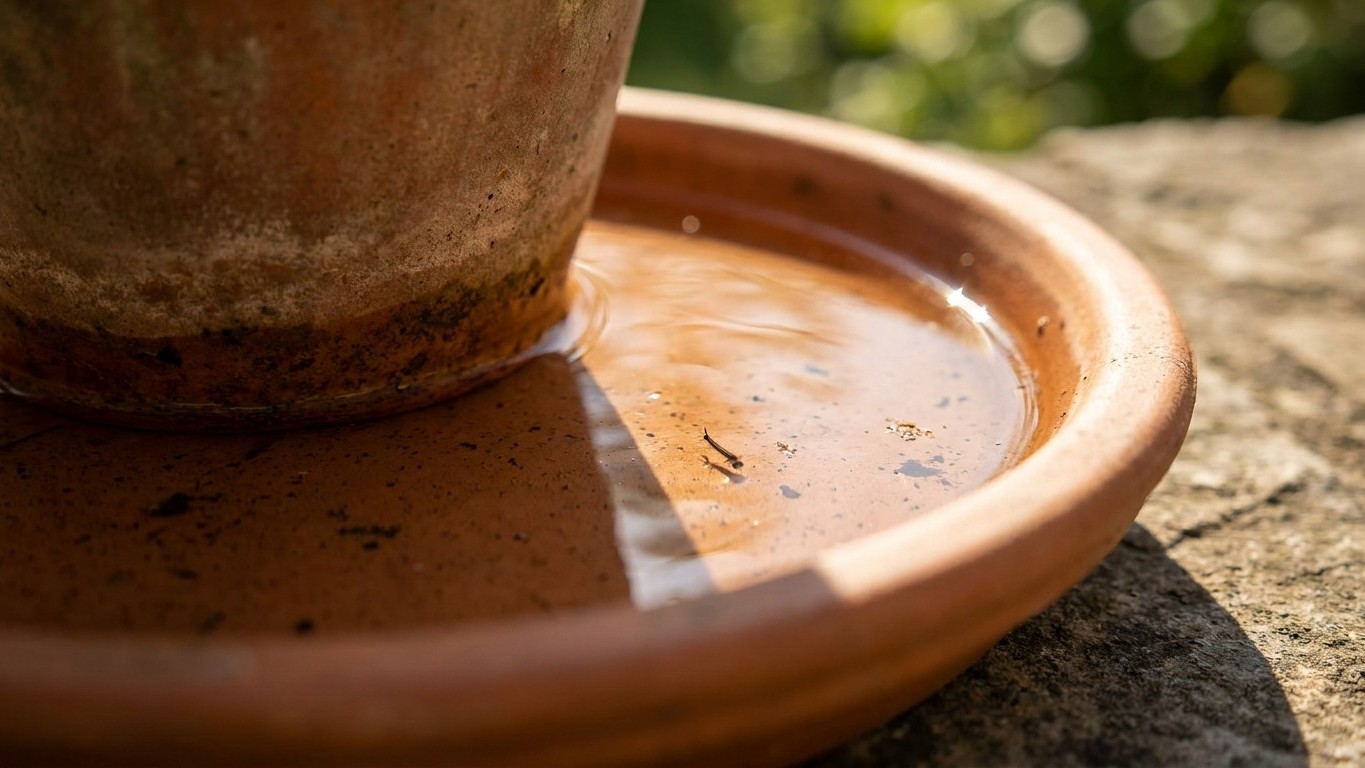
Water pooling in a terracotta saucer looked harmless enough. I’d been sliding those little dishes under every pot on my terrace since early June, convinced I was being smart about the drought, letting rainwater and runoff sit there instead of vanishing straight into the gravel below. Then came a sticky evening in mid-July, tipping over a saucer under the fig tree to refill a watering can, when a small cloud of wriggling shapes spilled out with the water. Mosquito larvae. Dozens of them, thriving in what I’d assumed was a clever conservation trick.
Key takeaways
- A single saucer can start producing mosquitoes in as little as three to five days under the right conditions
- What looked like a smart drought solution turned into fourteen simultaneous breeding sites without anyone noticing
- The fix exists, but it requires rethinking the container—not abandoning water conservation entirely
How a few tablespoons became a nursery
The math is almost embarrassing once you see it. Even very small amounts of water, in a space as small as a bottle cap, can serve as a breeding ground. A saucer holding half an inch of standing water isn’t a minor oversight. It’s a fully functional maternity ward.
Water collects in plant saucers after every rain or watering session, and because the saucer is shaded by the pot itself, the water evaporates slowly, giving mosquitoes ample time to breed. That shade is exactly what I liked about my setup. It kept the water from disappearing in the afternoon sun, which felt efficient. Mosquitoes apparently agreed.
Once a female lands, things move fast. An entomologist at LSU AgCenter noted that within three to five days, saucers like these can start to produce mosquitoes in the area, and those mosquitoes could potentially be biting you and acting as a disease vector. Under the right heat, the timeline shrinks even further. The full life cycle typically takes about two weeks, but depending on conditions, it can range from four days to as long as a month. Four days. That’s shorter than most people’s laundry cycle.
The stages themselves happen almost entirely out of sight. The life cycle of all mosquitoes consists of four distinct life stages, egg, larva, pupa and adult, and the first three stages occur in water, while the adult is an active flying insect that feeds on blood. By the time you notice adults hovering near your ankles at dusk, the saucer has already done its job several times over.
The water-saving instinct that backfires
Here’s the part that stings a little. Saving water on a terrace isn’t a bad instinct, it’s a reasonable one, especially in regions where summer restrictions are becoming routine. The problem isn’t the intention. It’s the container. A saucer under one pot is a curiosity. A terrace lined with a dozen pots, each with its own saucer, is something else entirely. A patio lined with 12 pots, each sitting in a saucer, could be hosting a dozen individual breeding sites simultaneously. I counted mine. Fourteen.
None of this is theoretical for public health, either. West Nile virus remains the country’s most common mosquito-borne illness, and the numbers aren’t shrinking. As of mid-January 2026, CDC ArboNET reported 1,862 total West Nile cases and 134 deaths across 42 states for the 2025 season, with Colorado, Illinois, and Texas among the hardest hit. Most infections stay mild, but roughly 20% of infected people develop a febrile illness, and about 1% develop neuroinvasive disease such as encephalitis or meningitis. A saucer isn’t just an inconvenience. It’s a link in a chain that occasionally ends badly for someone.
What actually breaks the cycle, without wasting water
The fix isn’t giving up on water conservation. It’s changing the container logic. Terracotta saucers, left unglazed, behave differently than the glazed or plastic ones most of us default to. Unfinished, unpainted terra cotta naturally soaks up water over time and shouldn’t hold standing water for seven days. Swapping in unglazed saucers alone cut my problem noticeably.
For pots where drainage still pools, timing matters more than intention. Dumping saucers under pots at least every two days during peak season interrupts the cycle before larvae mature. New York City’s own guidance lands in a similar window: dump and clean saucers every three or four days, and avoid overwatering plants.
If you genuinely want to hold water for the plant’s benefit without breeding anything, gravel-lined trays or sand-filled saucers work better than open water ever will. And for the water gardens, rain barrels, or decorative features you can’t simply tip over, biological larvicide is the least fussy answer. The EPA has concluded that Bti poses no health risks to people and has approved it for use in residential, commercial, and organic farming settings. It targets mosquito larvae specifically and leaves fish, birds, pets, and pollinators alone.
Airflow helps too, in a way I hadn’t considered until a gardener mentioned it. Oscillating fans create irregular airflow that mosquitoes cannot navigate, while a fixed fan is less effective at breaking the calm-air zone they need to land in. I moved a small fan near the seating area instead of relying purely on citronella, and evenings on the terrace got noticeably calmer.
My saucers are still there, mostly unglazed terracotta now, dumped every other evening whether they look full or not. The plants haven’t suffered. The water bill hasn’t spiked. What changed is the fifteen seconds it takes, watering can in hand, to actually look at what’s floating before pouring it back into the soil.
Sources : stacks.cdc.gov | stacks.cdc.gov