
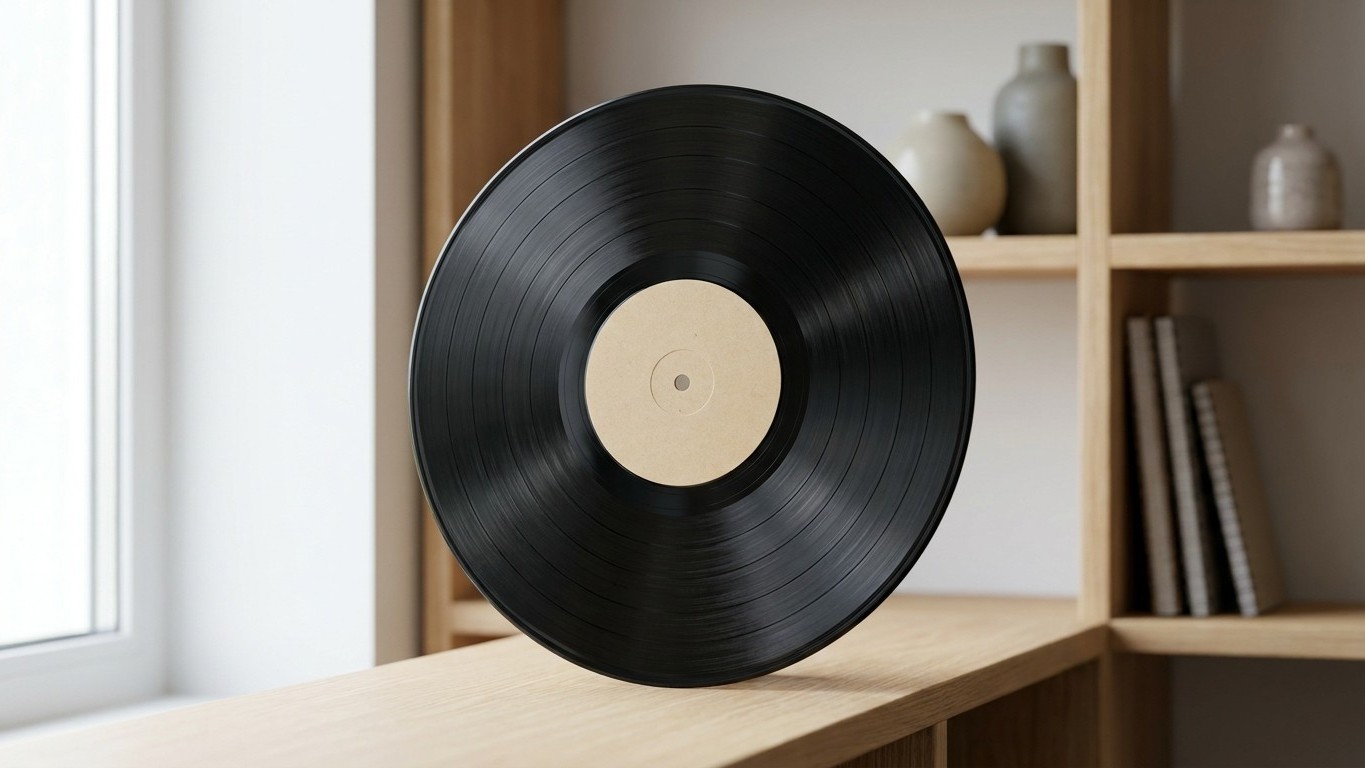
Ring wear. That faint halo etched into the cardboard where the record’s edge presses through the sleeve, over and over, for years. Collectors know the mark the second they see it. What they don’t always know is that the damage doesn’t stop at the cover. Once vinyl has spent a decade lying flat in a stack, the deformation inside the groove is often permanent, and the sleeve itself can leave a chemical residue on the label that no amount of cleaning will fully erase.
Here’s the part nobody tells you at the record store: a stack of twenty LPs weighs close to ten pounds, and every bit of that weight lands on the record at the very bottom. Vinyl is surprisingly heavy, and stack 20 records flat and the bottom one carries nearly 10 pounds of weight. That’s not a design flaw. It’s just physics doing what physics does when you ignore it for long enough.
Key takeaways
- What happens inside a stack of 20 vinyl records that most collectors never discover
- Why heating and flattening won’t fix a warped record—the science behind permanent deformation
- The hidden chemical attack coming from your record sleeves right now
The Weight Nobody Accounts For
Flat stacking feels intuitive. Books stack. CDs stack. Why wouldn’t records? Except records aren’t flat rectangles with uniform thickness, they have a raised label in the center and a slightly domed profile, which means the pressure in a stack never distributes evenly. Because record labels protrude slightly from the surface, this pressure can make the record “bow” over time. That subtle bulge becomes the fulcrum for every pound stacked above it.
The damage compounds in ways that feel almost unfair. Over time, that pressure presses the vinyl into the sleeve, causing ring wear, those circular marks that appear on album covers, and even worse, the weight can cause the records themselves to warp, especially if room temperatures fluctuate. Once a record is warped, it is often impossible to restore. Two forms of damage, one careless habit. A collection that looked pristine at purchase can look tired within a single humid summer.
Temperature is the accelerant nobody watches closely enough. PVC records warp at 60°C and permanently deform at 70°C, temperatures easily reached in attics, cars, or near radiators. A stack near a sun-facing window, or forgotten in a garage during August, doesn’t need years to suffer. It needs one hot afternoon.
Why Warping Never Comes Back
The grooves that carry the actual music are almost absurdly small. The grooves that contain your music are microscopic, measuring just 0.04-0.08mm wide. Once pressure or heat flattens or distorts that geometry, the polymer chains in the PVC don’t spring back into place the way a bent paperclip might. The plastic has been reshaped at a molecular level, and reshaping it back would require reheating it under precise, even conditions, essentially remaking the disc’s surface tension from scratch.
There are DIY fixes floating around forums, heat guns, glass sheets, even home ovens, but professionals treat these as last resorts rather than reliable cures. Collectors have over the years contrived many DIY methods designed to fix a warped record, including placing the record between two sheets of glass and applying heat using a conventional home oven, though more specialist products, such as purpose-designed vinyl flatteners, are a safer option. Even then, a flattened record rarely tracks quite as cleanly as one that was never warped in the first place. Prevention isn’t just cheaper. It’s the only method That Actually Works every time.
The Sleeve Is Not an Innocent Bystander
Here’s the twist most people never see coming: it’s not only the pressure that damages a record in storage. Sometimes the sleeve itself is quietly attacking the vinyl through chemistry, not weight. Older PVC outer sleeves, once popular for their thick, protective feel, contain plasticizers that were never chemically bonded to the plastic. Under heat or humidity, those plasticizers migrate.
Over time, these plasticizers can migrate out of the sleeve, especially in warm or humid environments, and when this happens, they come into contact with the surface of your vinyl record, causing a reaction between the two materials, the result being a hazy, sticky residue. That’s the ghost image collectors sometimes find on a label or run-out groove: a faint, tacky fog that wasn’t there when the record was new. Once this damage occurs, it’s nearly impossible to reverse, and even Professional cleaning methods often fail to fully restore records affected by PVC sleeve damage.
A vinyl chemistry researcher put it bluntly on a UK collector forum: the problem with PVC sleeves is the plasticiser in them, it will migrate out and become sticky on the surface, hence why it can peel off the paint. Cardboard doesn’t stop this transfer either, and thin paper inner sleeves offer little resistance. It doesn’t stop the process; if you have a PVC cover next to a record in a thin paper or card cover, the PVC gas will travel through to the vinyl inside and mist it up.
What Actually Protects a Collection
The fix isn’t complicated, but it does require breaking a habit. Records need to stand on edge, not lie flat, and they need breathing room rather than a tight, leaning row. Even stored vertically, records that lean at steep angles of 30 degrees or more from vertical will gradually bow under their own weight, so the ideal lean is 5-10 degrees from perfectly upright, supported by bookends or shelf dividers every 15-20 records. Density matters too. Pack too loosely and records tilt and warp; pack too tight and you scuff sleeves pulling records out.
Sleeve material deserves the same attention as shelving. Archivists have settled on a short list of safe options:
- Polypropylene (PP) sleeves, prized for clarity and chemical stability
- Polyethylene (PE) sleeves, inert and widely used for inner protection
- Anti-static inner sleeves, which also cut down on dust-related surface noise
They don’t contain plasticizers and are chemically inert, meaning they won’t react with your records. Swapping out old PVC jackets for these isn’t nostalgia-killing. It’s the single cheapest insurance policy a collection can get.
One detail worth remembering the next time you’re tempted to leave a stack “just for a few days”: humidity above 65 percent brings mold into the equation, and below 35 percent, static builds up and grinds dust straight into the grooves. Humidity above 65% causes mold, below 35% creates static that grinds dust into grooves, and ideal storage conditions sit at 18-21°C (64-70°F) and 45-50% relative humidity. The window for “safe” is narrower than most living rooms naturally provide, which is exactly why so many collections quietly degrade without anyone noticing until the needle starts to skip.
Sources : vinylbro.com | musicrecordshop.com