
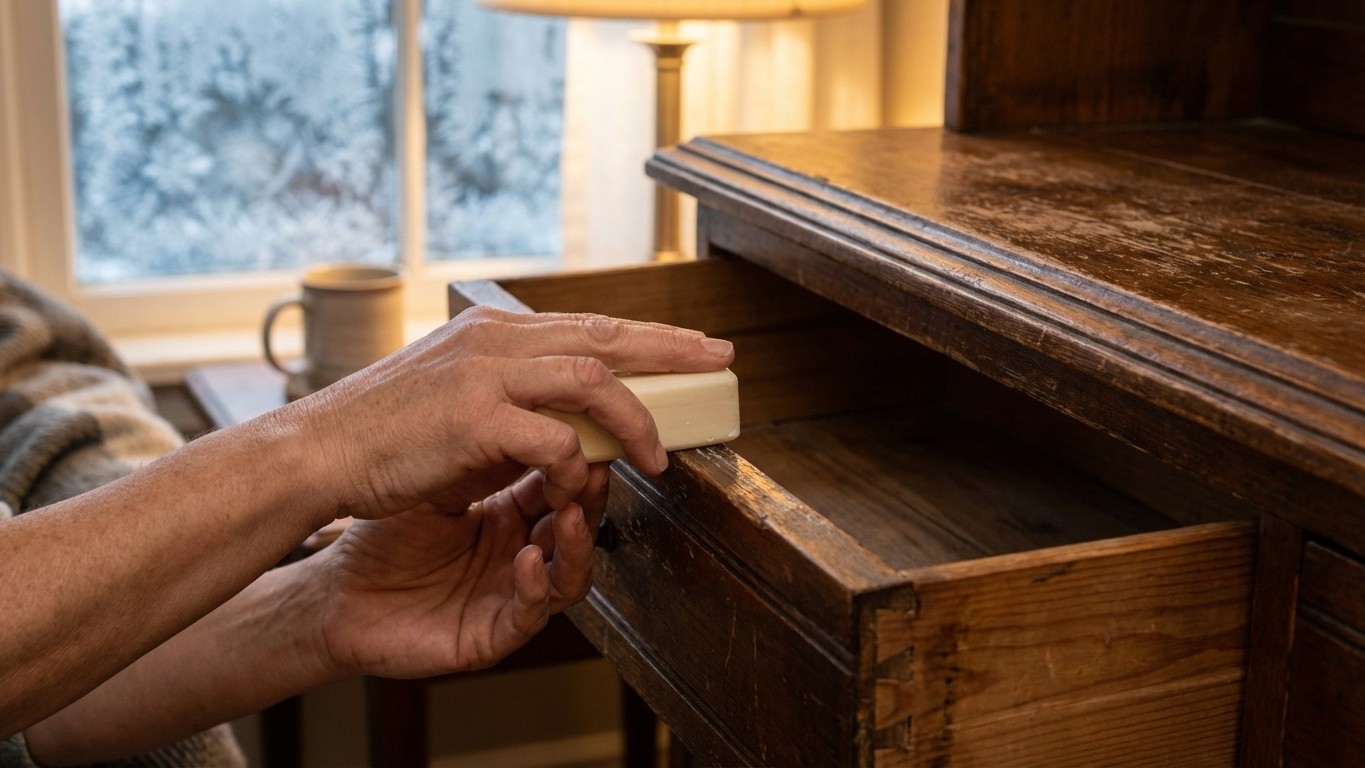
The first frost always brought the same frustration — kitchen drawers that glided effortlessly through summer suddenly turned stubborn, sticking and jamming with every attempt to retrieve a spatula or tea towel. Year after year, I’d wrestle with these rebellious pieces of furniture, assuming it was just another winter inconvenience I’d have to endure.
That changed when Tommy, a seasoned carpenter with four decades of experience, was installing new shelving in my pantry. He watched me struggle with a particularly stubborn drawer, chuckled, and said something that would revolutionize my relationship with wooden furniture: “Wood breathes, and winter makes it thirsty.”
Key takeaways
- A carpenter’s offhand observation unlocks the mystery behind seasonal drawer jamming
- The science of wood is more complex than it appears—and winter is the culprit
- An ancient solution outperforms modern products and costs almost nothing
The Science Behind Seasonal Drawer Drama
Wood is hygroscopic — a fancy term meaning it absorbs and releases moisture from the surrounding air. During humid summers, wood fibers swell with absorbed moisture, creating a snug but functional fit within drawer frames. But winter changes everything.
When heating systems kick in, indoor humidity plummets. Wood responds by contracting as it loses moisture, but here’s the catch — it doesn’t shrink uniformly. The grain pattern determines how each piece responds, creating uneven gaps and pressure points that make drawers bind and stick.
Tommy’s revelation made perfect sense. “Your drawers aren’t broken,” he explained while running his weathered hands along the drawer slides. “They’re just reacting to their environment.”
The Old-School Solution That Actually Works
His fix was elegantly simple: a bar of soap. Not the fancy artisanal kind gathering dust in guest bathrooms, but plain, unscented soap — the more basic, the better.
Tommy demonstrated the technique with practiced ease. He removed the problem drawer completely, then rubbed the soap directly onto the wooden runners and slides where metal met wood. The soap created an invisible lubricating layer that would last months, not days like spray lubricants.
“Paraffin wax works too,” he mentioned, “but soap’s what your grandmother used, and she never had to buy special products.” The technique works because soap contains natural lubricating compounds that reduce friction without attracting dust and debris like oil-based solutions.
The transformation was immediate. The drawer that had required two hands and considerable force suddenly glided with finger-tip pressure. More impressive? Three winters later, those same drawers still operate smoothly with just an annual soap treatment.
Beyond Drawers: Where This Magic Works
Tommy’s wisdom extended beyond kitchen storage. The same soap technique transforms other winter furniture frustrations. Sticky cabinet doors respond beautifully to soap rubbed along hinges and contact points. Windows that resist opening get new life when their tracks receive the soap treatment.
Even sliding closet doors benefit from this approach — though Tommy cautioned against overdoing it on painted surfaces, where soap residue might become visible over time.
The beauty lies in the accessibility. Every household has soap, making this solution both immediate and economical. No special trips to hardware stores, no researching product specifications, no wondering if the lubricant will damage finishes.
Professional Wisdom Meets Practical Reality
What struck me most was Tommy’s matter-of-fact approach to furniture maintenance. He didn’t see sticking drawers as problems requiring expensive solutions — just natural material behavior that needed gentle management.
“Furniture should work with you, not against you,” he said while cleaning soap residue from his hands. “Most people fight their environment instead of understanding it.”
This philosophy extends beyond drawer maintenance. Accepting that wood responds to seasonal changes — rather than viewing it as defective behavior — transforms how we interact with our living spaces. Winter humidity control becomes less about perfection and more about harmony.
The soap technique also reveals something profound about traditional craftsmanship knowledge. Before specialized products filled hardware store shelves, craftspeople developed elegant solutions using available materials. Tommy’s approach represents generations of accumulated wisdom about living with natural materials.
Three years since learning this trick, I approach winter furniture maintenance differently. That first application of soap became an annual ritual, performed as deliberately as changing furnace filters or testing smoke detectors. It takes perhaps fifteen Minutes-since-i-started-this-nightly-habit”>Minutes to treat every drawer in the house — a small investment for months of smooth operation.
The ripple effects surprised me. Smooth-functioning drawers reduced daily frustrations I hadn’t realized were accumulating. Cooking became more efficient when utensil access wasn’t a wrestling match. Morning-stretch-routine-for-drug-free-back-pain-relief”>Morning routines flowed better when bedroom drawers responded obediently.
Sometimes the most transformative solutions hide in plain sight, carried in the calloused hands of someone who’s spent decades understanding how materials behave in the real world. Tommy’s soap trick didn’t just fix my drawers — it reminded me that the best answers often come not from product innovation, but from patient observation of how things actually work.
Next time winter arrives and your drawers start their annual rebellion, remember that you already have the solution. The question isn’t whether this old trick works — it’s whether you’re ready to trust wisdom that’s been solving problems since long before furniture stores started selling specialized solutions.