
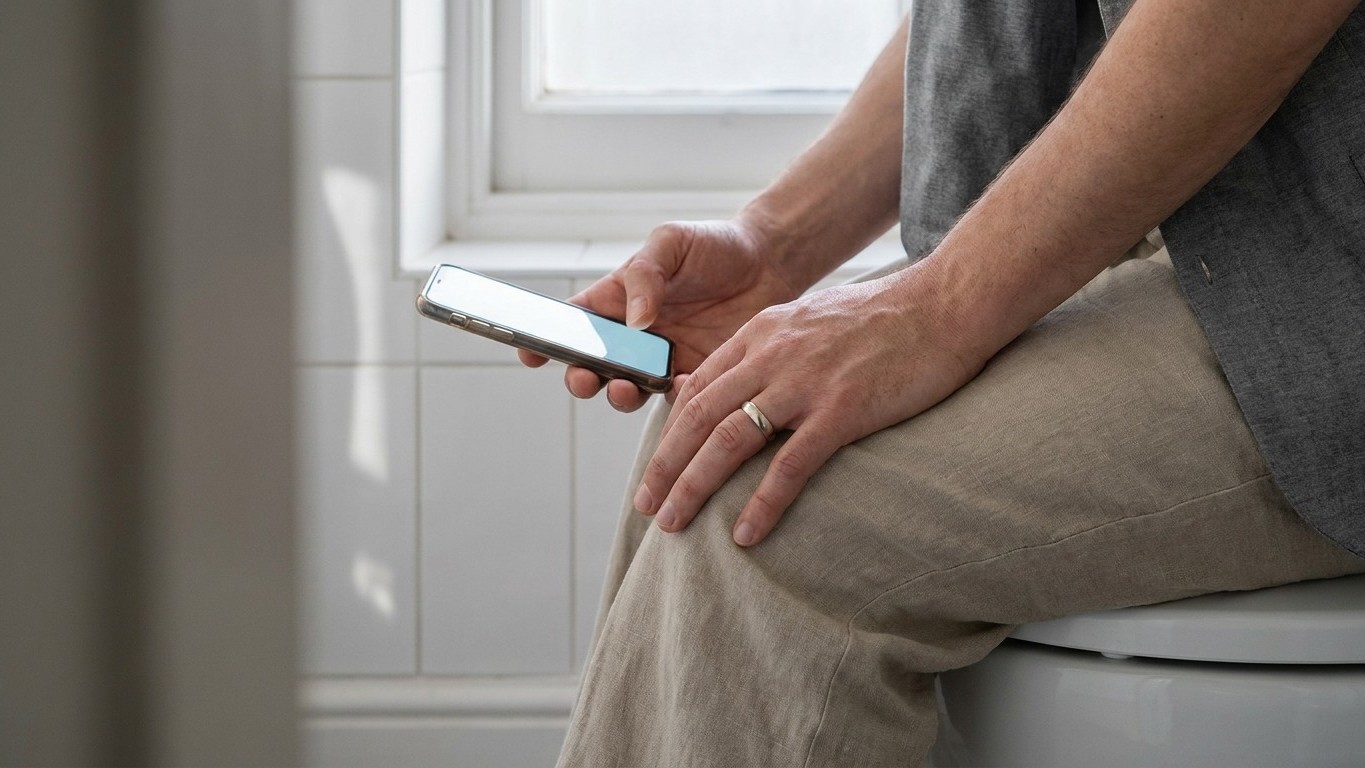
The number is blunt: 46%. That’s how much higher your risk of hemorrhoids is if you regularly scroll on your phone while sitting on the toilet, according to a study published in PLOS One in September 2025 by researchers from Beth Israel Deaconess Medical Center and Harvard Medical School. Not a vague correlation. A statistically significant one, confirmed by actual colonoscopy imaging on 125 adult participants. The scientists didn’t just ask people about their habits, they looked inside.
Nearly 75 percent of Americans admit to scrolling on their phones in the bathroom. Most of us consider those five or ten minutes a private, harmless ritual. The bad news is that the body has a very different opinion about what’s happening down there.
Key takeaways
- A major study found smartphone users on toilets have a 46% higher hemorrhoid risk—but straining wasn’t the culprit
- Your posture while scrolling creates dangerous pressure on rectal veins that builds up silently over time
- The solution is simpler than you think, and it starts with a five-minute rule
A toilet seat is not a chair, and your veins know the difference
Here’s the part nobody explains. The anatomy of toilet sitting creates a unique physiological situation. Unlike sitting in a chair, where your weight is distributed across the thighs and buttocks, perching on a toilet seat concentrates pressure on the pelvic floor and anal region. The circular opening of the seat allows the anorectal area to protrude slightly downward, which increases venous pressure in hemorrhoidal tissues.
Without support, the pelvic floor muscle relaxes, and gravity adds pressure to the rectal veins. Over time, this pressure can cause hemorrhoids to swell and start to bleed. A physician at Houston Methodist described it with a refreshingly honest analogy: “Blood tends to pool, and that swelling makes hemorrhoids more likely. Think of it like kinking a garden hose; the longer you do it, the more backpressure builds up.”
The posture problem makes it worse. “When you’re hunched over your phone, you’re changing the angle at which the rectum meets the anus,” explains Dr. Kalakota, a gastroenterologist at Houston Methodist. “An abnormal anorectal angle increases the pressure on blood vessels in the rectum. If this pressure is maintained for a long period of time, it could increase the risk of symptomatic hemorrhoids.” So the leaning-forward scrolling position, the universal posture of every person reading Instagram in a stall — is compounding the damage in real time.
Fifteen minutes in, the damage is already underway
A little more than 37% of smartphone users stayed more than five minutes per toilet visit, compared to just about 7% of people who did not use a smartphone while toileting. The fact that smartphone users stayed longer on the toilet is significant: participants who checked their phones while using the bathroom had a 46% higher risk of hemorrhoids, even after controlling for other risk factors.
The counterintuitive part? Straining wasn’t the culprit. Interestingly, the study did not find a connection between straining during bowel movements and hemorrhoid risk, which differs from conclusions drawn in some earlier studies. The people scrolling their phones weren’t straining more than anyone else. The lead researcher’s hypothesis: “it’s passive smartphone use that causes these hemorrhoidal cushions to become engorged and bulge, and that’s what leads to hemorrhoids.” Sitting still, doing nothing but watching Reels, is enough.
As you sit, blood pools into the veins in your anorectal area, causing further stretching of protruded blood vessels. If the blood vessel gets too big, it could break and cause bleeding. And the damage is cumulative. Sustained downward pressure on rectal veins impedes blood return to the heart, causing blood to pool in the hemorrhoidal cushions. Over time, this repeated engorgement weakens vessel walls and supporting connective tissue, allowing the veins to swell and protrude.
There’s also a generational angle worth noting. Participants who reported spending more time on the toilet skewed a bit younger, suggesting hemorrhoids may become a bigger concern among future generations. A survey found that Gen Z respondents spend the most time scrolling through their phones on the toilet, at about 54 hours per year.
What actually protects your veins
The five-minute rule is the clearest takeaway from the research. Specialists recommend limiting your time to five minutes or less; minimizing the duration of sitting reduces the prolonged pressure that triggers vein inflammation. If nothing is happening within that window, the 5-Minute Rule says: if a bowel movement does not occur within five minutes, it is best to exit the bathroom and try again later.
Beyond timing, posture matters more than most people realize. Using a toilet stool can help straighten your anorectal angle, which can make bowel movements easier and reduce straining. By promoting a more natural squatting position, it minimizes pressure on the rectal veins and supports overall digestive health. Populations that historically squatted rather than sat on elevated toilets had significantly fewer hemorrhoid issues, a fact that says a lot about how much the standard Western toilet seat works against us.
Diet plays a direct role too. “Adding more fiber to your diet is the number one treatment for hemorrhoids, diverticulosis, constipation and diarrhea,” says Dr. Frankel, a colorectal surgeon. “There’s a simple reason why, fiber decreases pressure inside your colon.” He also suggests drinking more water and reminding yourself not to strain when you’re on the toilet. Gastroenterologists recommend aiming for 25 to 35 grams of fiber daily.
One more thing the study flagged: toilet phone users also reported getting less physical activity overall, suggesting that both toilet and lifestyle habits may increase hemorrhoid risk. Exercise supports digestion and reduces pressure on veins, especially if you sit or stand for long periods. Physical activity helps prevent constipation and can also aid in weight management, which is another factor in hemorrhoid risk.
The signs people miss, and when to actually see a doctor
Hemorrhoids are already staggeringly common. Hemorrhoids are extremely common in the United States. Each year, they account for nearly 4 million visits to doctors or emergency rooms and generate more than $800 million in healthcare costs. And yet they remain one of the most under-discussed conditions in women’s health, partly because the symptoms are easy to rationalize away.
“Most people notice itching, some discomfort, or swelling around the anus, and at times some blood after a bowel movement,” said one physician. “Some patients also develop a sore lump that can easily be felt.” Because internal hemorrhoids are not always painful, many people ignore early warning signs such as light bleeding during bowel movements. That’s a mistake worth correcting.
You should talk to your doctor if your hemorrhoids don’t stop hurting after one to two weeks or if you’re often bothered by them, says the American Academy of Family Physicians. And if the conversation with your physician feels awkward, consider that bearing down weakens the connective tissue in your pelvis, potentially leading to problems like rectal or vaginal prolapse. Which is considerably more awkward to deal with than a frank five-minute conversation.
The study researchers themselves suggested a practical intervention: timers. The implementation of educational interventions aimed at promoting healthier toilet habits, including limiting prolonged sitting during smartphone use with timers, may represent a promising avenue for reducing the prevalence of hemorrhoids in the population. A phone timer, set by your phone, to stop you from using your phone. The irony is almost poetic, but the vascular logic is sound.
Sources : how2shout.com | healthline.com