
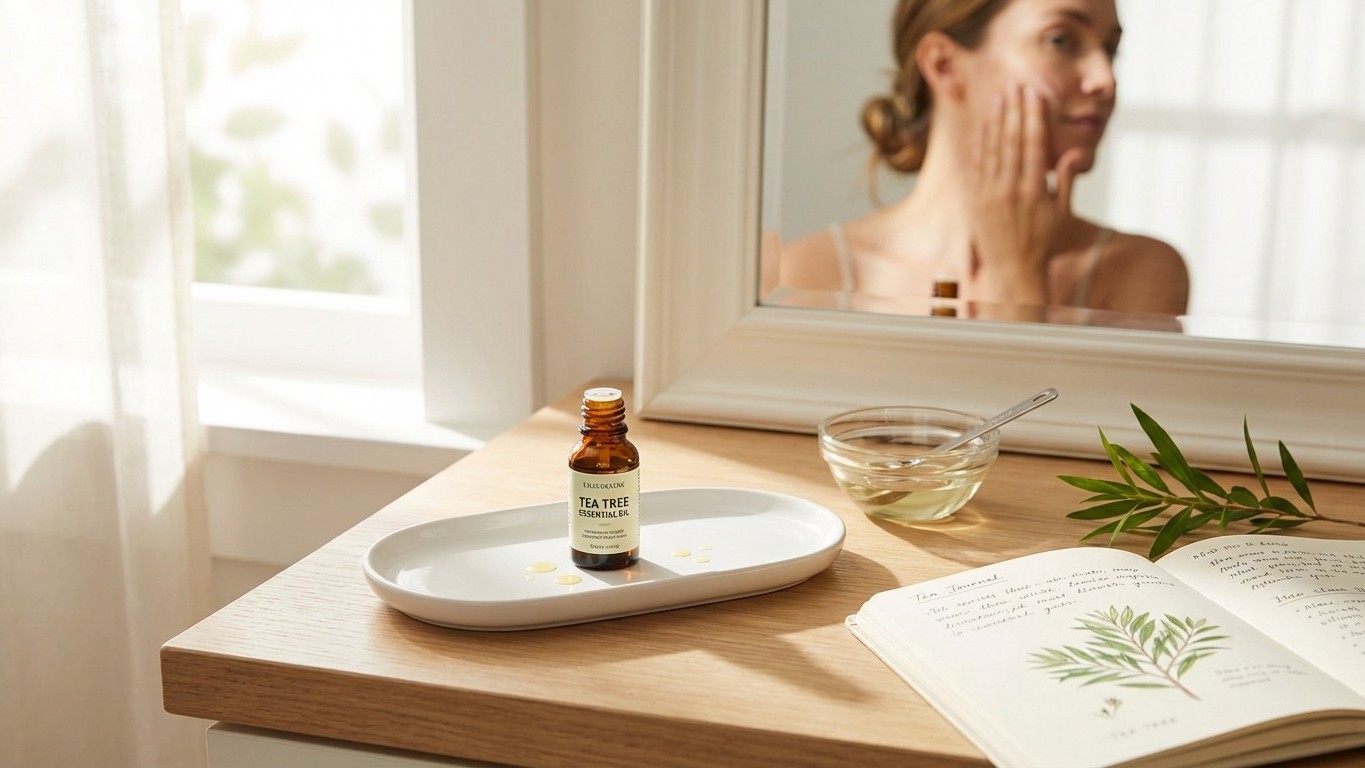
The bathroom mirror tells the truth in high definition: one red, tender bump that wasn’t there last night, a shiny T-zone that refuses to behave, and that familiar urge to “dry it out” with something strong. Tea tree oil sits on the shelf like a tiny bottle of confidence, all sharp, green scent and clean-label promise. The trick is that this is not a casual ingredient. It’s an essential oil, which means it can help, and it can also irritate, sensitise, and backfire if you freestyle it.
This practical guide is built for exactly that moment when you want action without drama: how to use tea tree safely on acne-prone skin, what dilution actually looks like in real-life measurements, what types of breakouts respond best, and what to avoid if you don’t want a stressed barrier and more inflammation. Tea tree can earn a place in a natural Routine. It just needs boundaries.
What is tea tree oil?
Tea tree oil is the essential oil distilled from the leaves of Melaleuca alternifolia, a plant native to Australia. “Essential oil” is the key phrase here: it’s a concentrated mix of volatile compounds, not a gentle plant extract, not a face oil, not a toner. It’s potent by design.
In skincare, tea tree oil is mostly used for its antimicrobial and soothing profile, especially on blemish-prone skin. But the same chemistry that makes it effective can make it reactive, particularly when it’s applied undiluted or when the bottle has degraded after too much light, air, or heat exposure. A harsh reality: “natural” does not automatically mean “low risk.”
One more practical point: tea tree oil Changes over time. Oxidation, poor storage, or an old bottle can increase the risk of skin reactions. If yours has been sitting uncapped, near a window, or for years in a steamy bathroom, treat it like you would expired sunscreen. Replace it.
Why use tea tree oil for acne?
Acne is not one single problem. It’s a mix of clogged pores, inflammation, bacteria involvement, hormones, barrier health, and sometimes irritation caused by products that are supposed to “help.” Tea tree oil is interesting because it can target more than one of those levers, but it’s not a universal fix.
What tea tree can do: in topical form and at an appropriate concentration, it may help reduce inflammatory lesions and support clearer-looking skin. A small body of research, including a placebo-controlled trial using a 5% tea tree oil gel, suggests benefit for mild to moderate acne, though overall evidence remains limited and not definitive. Tea tree is often described as antimicrobial and anti-inflammatory, which is exactly the combination that makes sense for red, angry breakouts.
Counter-intuition time: the goal is not to “burn” a pimple away. Over-drying and over-sanitising can push acne-prone skin into rebound oiliness and irritation, which looks like “more acne” but behaves like a compromised barrier. Tea tree works best when it’s treated as a measured, targeted tool, not a punishment.
Is it useful for hormonal acne?
Hormonal acne is usually deeper, more cyclical, and often concentrated around the jawline and chin. Tea tree oil won’t change hormones. What it can do is support the surface-level inflammation and the visible lifespan of a breakout, especially when used early, at the first tender “under-the-skin” feeling.
If your acne is severe, scarring, or persistently painful, tea tree is not the moment to go solo. Consider it a complement to a clinician-guided plan, not a substitute.
Is it effective for all types of pimples?
No. Tea tree tends to make more sense for:
- Inflammatory pimples: red bumps, papules, and some pustules.
- Occasional flare-ups: stress breakouts, cycle-related breakouts, mask friction zones.
It’s less convincing for:
- Blackheads and closed comedones: these are more about keratin buildup and pore congestion than surface microbes.
- Cystic acne: deeper lesions often need medical-grade anti-inflammatory or hormonal approaches.
- Acne that is actually irritation: if your skin is stinging, tight, and peeling, tea tree can be gasoline on that fire.
How to use tea tree oil on acne-prone skin
Think “micro-dose.” Think “routine integration.” Tea tree oil is not a full-face oil cleanse, not a DIY leave-on perfume, not an essential-oil cocktail.
The simplest safe approach: dilute it properly, then use it as a spot treatment or in a short-contact method, and only increase frequency if your skin stays calm.
Preparing and diluting tea tree oil: the non-negotiable rules
Rule one: do not apply neat (undiluted) essential oil to facial skin. Irritation and allergic contact dermatitis are real risks, and reactions can be more likely with older or poorly stored oil.
For facial use, a conservative dilution range is usually the smartest place to live. If you want ultra-actionable measurements, here are practical options:
- 0.5% dilution (very cautious, good for sensitive skin): 1 drop tea tree oil in 10 mL carrier oil.
- 1% dilution (balanced starting point): 2 drops tea tree oil in 10 mL carrier oil.
- 2% dilution (only if your skin tolerates it): 4 drops tea tree oil in 10 mL carrier oil.
Why these numbers? Because safety is mostly about concentration and exposure. In late 2025, the EU Scientific Committee on Consumer Safety concluded tea tree oil is a moderate skin sensitiser and assessed specific maximum concentrations as safe in certain cosmetic product types, including very low levels for leave-on face cream. That doesn’t mean your DIY is “forbidden,” but it should change your mindset: respect the dose.
Choosing a carrier oil that won’t clog you
A carrier oil is the buffer that turns “too strong” into “usable.” For acne-prone skin, the carrier matters. Heavy, occlusive oils can feel soothing for dryness but may be a bad match for congested pores.
Options many acne-prone people tolerate well include lighter-texture plant oils. If you know your skin breaks out from oils easily, choose the lightest carrier you already tolerate in your routine, and keep application localised rather than full-face.
Small but useful detail: mix in a clean glass bottle, ideally dark/amber, cap it tightly, and store away from heat and light. If it starts smelling “off” or harsher than usual, retire it.
Application methods: spot, mask, and short-contact options
1) Localised spot treatment (the classic)
Best for: one to five inflamed spots, early-stage hormonal bumps, emergency redness.
- Cleanse gently and pat skin dry.
- Dip a clean cotton swab into your pre-diluted tea tree blend.
- Apply only on the blemish, not the whole area around it.
- Leave on, then follow with a simple moisturiser if you’re prone to dryness.
Frequency: start once daily for three days. If there is no stinging, peeling, or increased redness, you can consider twice daily. If irritation appears, stop and reset.
The result. Often calmer. Sometimes nothing. If nothing changes after a couple of weeks, don’t escalate endlessly, switch strategies.
2) Short-contact “micro mask” (safer for reactive skin)
Best for: people who want the benefit but fear leave-on irritation.
- Mix a small amount of your diluted blend into a bland, fragrance-free moisturiser in your palm.
- Apply to the breakout zone for 10 minutes.
- Rinse with lukewarm water and moisturise.
This method keeps exposure time limited, which can be a surprisingly elegant way to use essential oils without letting them sit on skin all day.
3) Tea tree with a soothing base (aloe-style layering)
If you love the “cooling” feel after a breakout, aloe can be a friendly partner, but don’t treat aloe like a carrier oil. Essential oils do not reliably dilute in water-based gels without proper formulation, so you still need an oil phase or a pre-formulated product designed for it.
If aloe is already part of your routine, use it separately as a calming step and keep tea tree properly diluted in a carrier oil for spot use. For deeper guidance, see aloe vera in natural skincare routine.
Precautions and common mistakes
Tea tree oil is easy to romanticise. Crisp scent. “Clean” vibe. The problem is that skin doesn’t care about vibes. It cares about barrier integrity, concentration, and your personal sensitivity profile.
Irritation, allergy risk, and how to patch test
Some people can use topical tea tree oil without problems. Others develop redness, burning, itching, or a rash consistent with contact dermatitis. Reactions may be more likely if the oil is old or has been exposed to heat, light, or air. Also: never ingest tea tree oil, it can cause serious toxic effects.
Patch test Protocol (simple, realistic):
- Use the same diluted mixture you plan to use on your face.
- Apply a tiny amount to the inner forearm or behind the ear.
- Leave it on and monitor for 24 hours. If you want to be extra cautious, repeat once daily for 2–3 days on the same spot.
- If you notice persistent redness, swelling, itching, blistering, or a spreading rash, stop. Do not “push through.”
Areas to avoid
- Eyes and eyelids. Essential oils near the eye area are a risk.
- Inside the nose or around the lips. Mucous membranes are not the place.
- Broken or freshly exfoliated skin.
Overuse: the fastest way to get worse acne
Applying tea tree oil too often can trigger a cycle that looks like stubborn acne: dryness, micro-irritation, more inflammation, and a shiny rebound. If your skin starts feeling tight by noon, you’re not “purging.” You’re irritated.
Another quiet mistake: layering tea tree with multiple strong actives in the same routine, especially when you’re stressed and impatient. Retinoids, exfoliating acids, benzoyl peroxide, and essential oils can become a sensory overload. Rotate. Simplify. Let your barrier breathe.
Combining tea tree with other natural ingredients
Tea tree oil plays well with some natural staples, but only when each ingredient has a clear role. Mixing “everything natural” is how people accidentally build a reaction cocktail.
Tea tree + honey (calming, not scorching)
Honey is often used in home routines for its comforting feel and its skin-friendly profile. A thin honey mask can be a gentle “rest day” move between spot treatments.
If you want to pair them, keep it separated in time rather than mixing essential oil straight into sticky honey and hoping it distributes evenly. Do your honey mask on one day, tea tree spot treatment on another, and watch your skin’s response. Smooth skin is often a scheduling win, not a stronger formula.
Tea tree + rosehip oil (barrier support, careful with congestion)
Rosehip oil is loved for its skin-conditioning feel, especially when post-acne marks are part of your story. For very oily, congestion-prone skin, it can be too rich if used everywhere. A smarter strategy: use rosehip on drier zones or at night, and keep tea tree as a localised tool.
Tea tree + aloe vera (comfort layer)
Aloe can make acne care feel less aggressive. Use aloe as a soothing step after cleansing or after a short-contact method, and reserve tea tree for properly diluted, precise application. If you’re building a full routine, aloe vera in natural skincare routine fits nicely as the “calm” anchor.
Where this fits in a natural anti-acne routine
Tea tree is rarely step one. A natural acne routine usually works best when it’s built like a wardrobe: a few reliable basics, then one statement piece.
- Gentle cleanse
- Hydration and barrier support
- Targeted treatment (tea tree goes here)
- Moisturiser that doesn’t clog you
- Daily sunscreen if you go outside
If you want the bigger map, natural skincare routine skin care tips is the cross-cluster guide that turns “I own tea tree oil” into an actual routine you can stick to.
And if you’re choosing which natural ingredients are worth your time, both versions of best natural ingredients for skincare routine help you sort what belongs in a routine and what belongs in a drawer.
FAQ and personalised tips
How do I dilute tea tree essential oil to apply it to acne?
For face spot treatment, start low. A practical starting dilution is 1%: mix 2 drops of tea tree essential oil into 10 mL of a carrier oil that you tolerate. If you’re sensitive, start at 0.5% (1 drop per 10 mL). Apply only to blemishes, once daily at first, and increase only if your skin stays calm.
Is tea tree oil effective for every kind of breakout?
No. It tends to be more helpful for inflamed pimples than for blackheads or persistent closed comedones. For deep cystic acne, tea tree can be too limited, and sometimes too irritating if you keep escalating. If breakouts are severe or scarring, consider professional advice and use tea tree only as a small supporting step.
Can I combine tea tree oil with other natural ingredients?
Yes, but keep the formula simple. Pair it with a barrier-friendly routine, use aloe separately for comfort, and schedule honey masks as gentle recovery days. Avoid mixing tea tree with multiple strong actives in the same session if your skin is reactive.
How often should I use it?
Start with once daily spot use for a few days. If there’s no irritation, you can consider twice daily for short periods. If you notice stinging, peeling, or worsening redness, stop immediately and focus on moisturising and barrier recovery for several days.
What if I’m already using acids or retinoids?
Rotate rather than stack. Use tea tree on nights you are not using your strongest exfoliants or retinoids, especially if you’re early in a routine or your skin barrier is unpredictable. Calm skin clears faster than stressed skin, frustratingly enough.
Quick personalisation: choose your “tea tree style”
- Oily, inflamed spots, resilient skin: 1% dilution, spot apply once daily, then increase to twice daily if calm.
- Sensitive, easily red, hormonal chin flare-ups: 0.5% dilution, short-contact method, every other day.
- Mostly clogged pores, few inflamed spots: tea tree may be secondary, focus on gentle cleansing and a consistent routine, add tea tree only for occasional red lesions.
Conclusion
The clean, medicinal scent of tea tree oil can make acne care feel decisive, like you Finally found the “natural antibiotic” your skin needed. Franchement, this is the kind of trend that works only when you treat it like a prescription: correct dose, correct placement, correct frequency.
If you do one thing after reading this, make a small diluted bottle (0.5% to 1%), patch test it, and commit to a two-week trial where you spot-treat calmly instead of chasing instant results. Then build outward: a routine that supports your skin’s barrier, smart pairings like aloe on recovery days, and a clear plan for when a breakout is bigger than any essential oil. And the question that lingers, once your skin is calmer: are you trying to “erase” acne, or are you building a routine you can live with when life gets messy again?