
The crisp snap of a cuticle pusher against hard gel, that satisfying, but ever-so-slightly reckless, peeling motion along the edge. You know the urge: a single chip in your manicure, the tiniest imperfection, and suddenly it’s war. I used to peel off my gel polish the moment it showed a hint of wear, convinced I could shortcut the whole removal process. The aftermath? Nails that flaked, split, and bent like soft plastic. For years, I blamed gel itself. Turns out, the real culprit was how I said goodbye to it.
Key takeaways
- Why peeling gel polish harms your nails more than you think
- The surprising science behind proper at-home gel polish removal
- How changing one habit transformed my nails from weak to strong
The Irresistible Allure (And Silent Damage) of Peeling Gel
We’re living in the golden age of manicures : LED lamps at every corner, polishes that withstand housecleaning marathons and suitcase zippers. Gel is more accessible and beautiful than ever. That’s precisely why the temptation to peel gets stronger with every shiny coat. It’s quick, a little dangerous, oddly satisfying. You convince yourself it can’t be that harmful (besides, which of us hasn’t watched a whole season of television absentmindedly picking at a nail?).
What doesn’t feel dangerous is what makes it so insidious. When you peel, you’re not just removing polish, you’re tearing off literal layers of your own nail plate. Under a microscope, a peeled-off gel manicure looks like windblown sand dunes: uneven, splintered, thinned. A 2023 study published by dermatologists at the University of Miami found that sequential peeling of gel polish can reduce the nail plate’s thickness by up to 30% in just three sessions. Thirty percent. If it were your hair or skin, you’d call it a crisis.
And unlike a papercut, nails don’t heal on their own. Thin, stressed keratin doesn’t grow back overnight, it requires patience, gentle care, and months of damage control.
The Science of Gel Removal: What Actually Works
The beauty industry myth: salon gel removal is a spa-level indulgence, but at-home removal is impractical, tedious, and always risky. The truth? Performed correctly, at-home gel removal offers nearly the same results. The difference lies in patience, not force. Salons use acetone and gentle pushing; home peelers (my former self included) default to sheer willpower.
Proper removal, distilled:
- Gently buff the surface to break the seal
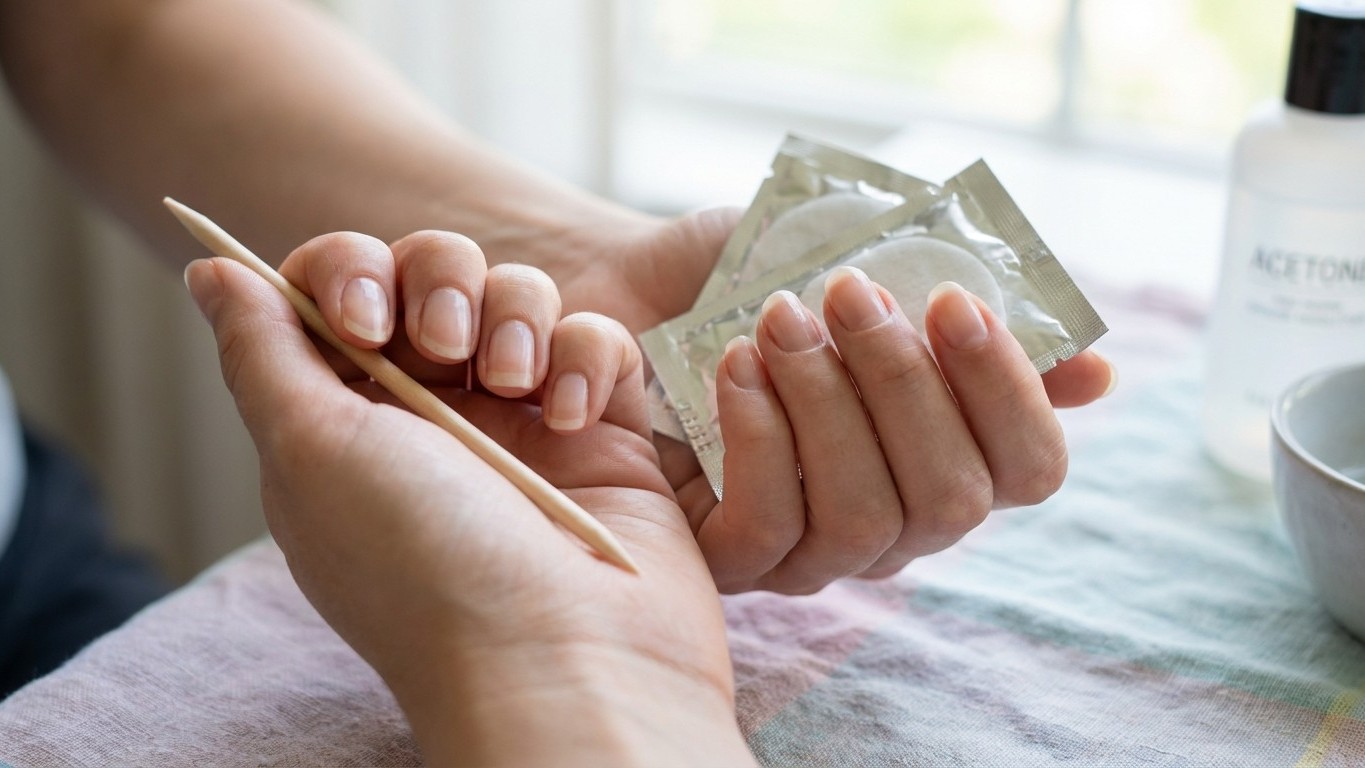
- Soak a cotton ball with acetone and place it directly on each nail
- Wrap in foil and relax for 10-15 Minutes
- Slide off the softened gel with an orangewood stick, don’t scrape
No nail was ever meant to be “chipped off.” And yes, acetone is drying, but nothing compared to literally removing the top of your nail. Hydration and cuticle oil easily counter swings in dryness. Peeling, on the other hand, is irreversible. The difference, over time, is visible: intact nail beds, no splits, and a smoothness you literally feel when you run your hand across silk sheets.
How I Broke the Cycle (And the Myth of Nail “Weakness”)
Old habits die with a struggle. The first time I resisted peeling, my nails were ragged at the edges. I almost caved at week two. But I forced myself to follow the professional method, foil, acetone, a little patience. Three months later, my nails no longer split when I reached for my keys. No more paper-thin edges snagging on sweaters. The change was subtle, but relentless.
Some blame genetics, age, or weather for weak nails. It’s a convenient shield, but often untrue. Consistent picking, prying, and shortcut removals are to blame for far more nail sadness than we care to admit. Not just for gels, either, Classic polish, dip, anything with a chemical bond. Every hurried shortcut sets the clock back on healing, reinforces the cycle, and leaves nails soft and splintered—one false move from a full break.
A friend swore by biotin supplements and nightly hand masks but still suffered breakage. Once she Ditched her own peeling habit, her nails improved faster than any supplement. A small, unglamorous truth: technique trumps product. My own nightly ritual became almost meditative, moisturizer, cuticle oil, admiration. A gentle rebellion against all those “miracle” serums lined up on the vanity, promising easy fixes.
Re-learning Nail Care: Beyond the Polish
After breaking the habit, something shifted. Nail care became a conversation about restraint, not acquisition. The trending look shifted, too, bar soap nails, bare nails, delicate minimalist art all began outpacing the once-dominant Instagram coffin shapes. Even high-fashion runways in New York and Copenhagen embraced the beauty of natural (or near-natural) nails in recent seasons. A cultural reset, perhaps—the end of constant covering, the beginning of unapologetic vulnerability.
Some now file “backwards”, from side to center—for less splitting. Others swear by nourishing hand balms or weekly saltwater soaks. No one seems to agree on the single best approach. Yet universal among strong-nailed friends is a newfound patience: trusting growth, embracing the less-is-more mentality, treating nails as living extensions of the self rather than surfaces to be stripped and re-layered every ten days.
Peeling your polish is a little like deleting a carefully written paragraph to avoid editing, faster in the moment, disastrous for the draft. Maybe the real trick isn’t about product at all; maybe it’s about honoring the slowness, the waiting, the quiet strength under each glossy layer.
Try resisting the urge just once. See if the world moves slower, or if it simply feels kinder to your own hands. What if strength was less about reinforcement and more about letting what’s fragile recover, uninterrupted?