
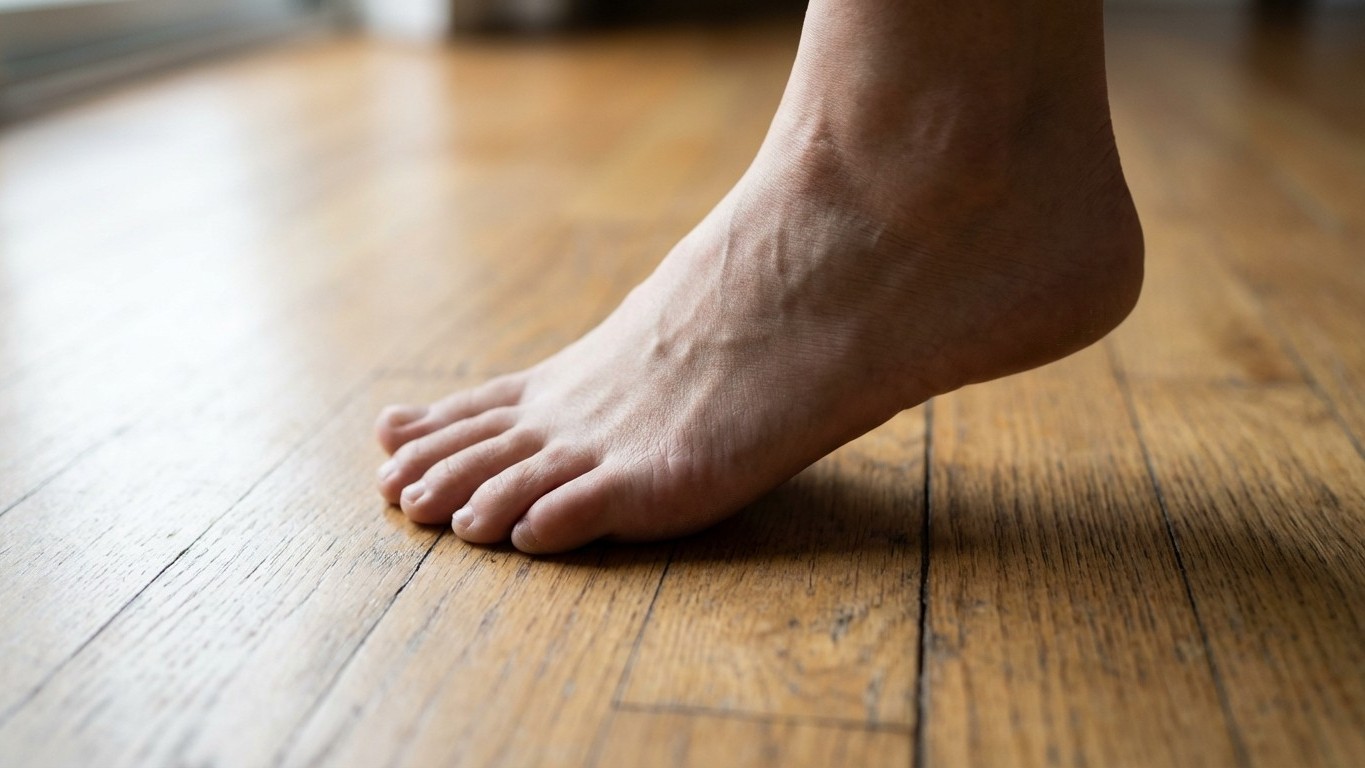
The first thing my physiotherapist said when she examined my feet last spring wasn’t about my posture or my chronic lower back tension. She said, “Your foot arch looks different. What changed?” Nothing dramatic had shifted in my life, no new workout, no diet overhaul. I had simply Stopped-wearing-slippers-at-home-what-i-noticed-about-my-legs-after-two-weeks”>Stopped wearing shoes inside the house.
Six weeks earlier, on a whim, I had kicked off my sneakers at the front door and started padding around in bare feet. No slippers, no socks. Just skin on hardwood, tile, and the occasional cold bathroom floor in the morning. I expected nothing. What I got was a physiotherapy appointment that turned into a thirty-minute conversation about foot mechanics I never knew I was missing.
Key takeaways
- A physiotherapist noticed structural changes in the author’s foot arch after weeks of going barefoot indoors
- Balance and stability improved faster from removing shoes than from months of targeted physical therapy exercises
- The sole of the human foot contains 200,000 nerve endings that shoes suppress—going barefoot reawakens dormant muscles
The foot as a forgotten sense organ
Most of us treat our feet like luggage carriers, they transport us from A to B and we don’t think much about them until something hurts. But the sole of the human foot contains roughly 200,000 nerve endings. That’s a sensory map the size of your palm, constantly processing texture, temperature, and pressure shifts. Shoes, cushioned and structured as modern footwear tends to be, muffle almost all of that signal.
Podiatrists and movement specialists have been pointing this out for years. When proprioceptive feedback from the foot is reduced, which Happens the moment you add a layer of foam between your sole and the ground — the small stabilizing muscles that keep your ankle, knee, and hip aligned start receiving less accurate information. Over time, those muscles do less. They atrophy, quietly, without any dramatic injury to announce it.
Walking barefoot on varied home surfaces, even something as modest as the transition between carpet and hardwood, forces constant micro-adjustments. Your foot grips slightly differently. Your toes spread. Your arch engages rather than being passively held in a shoe’s built-in support. The result, for many people who adopt this habit, is a gradual reactivation of musculature that has been dormant since childhood. My physiotherapist wasn’t seeing a miracle. She was seeing a foot doing its actual job again.
What actually changed in my body
This is the part that surprised me most, because the Changes weren’t where I expected. I wasn’t particularly focused on my feet. I was hoping, vaguely, for some benefit to my lower back, which has been stiff and cranky for most of my thirties. And that did improve, modestly, over time. But the first thing I noticed was balance.
Standing on one leg to put on pants, a daily circus act I had quietly normalized, became noticeably steadier within two to three weeks. The shift was subtle enough that I almost dismissed it, until I did a yoga class and realized I could hold tree pose on my left side for the first time without grabbing the wall like it owed me money.
My physiotherapist explained this through the lens of the kinetic chain. The foot is the foundation, and when it functions more accurately, everything above it recalibrates. Hip muscles that compensate for poor foot mechanics get a chance to work more symmetrically. Tension patterns that travel up the calf and into the lower back can, with time, begin to release. No single exercise she had given me over six months produced the change that simply removing my shoes at home did in six weeks. That’s the counterintuitive reality that the Wellness industry tends to underemphasize: more input from the body’s natural sensors can outperform targeted interventions.
The science worth knowing (without the hype)
Research on barefoot walking is genuinely interesting, even if you filter out the more evangelical corners of the barefoot movement. A study published in the journal Frontiers in Bioengineering and Biotechnology found that habitual barefoot walkers showed greater activation of intrinsic foot muscles compared to those who regularly wore supportive footwear. Another line of research has explored how arch stiffness and toe mobility contribute to overall gait efficiency, with barefoot conditions consistently producing more dynamic foot mechanics than shod ones.
There’s a distinction worth drawing here between outdoor barefoot walking, which carries obvious concerns about terrain and hygiene, and going barefoot indoors, which is accessible, low-risk, and frankly free. You don’t need a minimalist shoe program or a structured protocol. The floor of your home is already doing the work, if you let it.
That said, this habit isn’t universally appropriate. People with certain diabetic conditions, neuropathy, or specific structural foot issues should check with a professional before abandoning indoor footwear entirely. And anyone dealing with plantar fasciitis may need a more gradual transition rather than going cold turkey from arch-supported shoes to nothing. The foot muscles, like any muscles returning from a long rest, need time to build capacity before they’re ready for full-time use.
How to actually start (and what to expect)
The adaptation period is real. The first week or two, your feet may feel tired in a way they haven’t before, particularly through the arch and the ball of the foot. This is normal. Muscles waking up tend to announce themselves.
A few things that helped the transition feel manageable:
- Starting with short barefoot sessions rather than eliminating footwear all at once
- Doing simple toe-spreading exercises in the morning, which accelerate the reactivation process
- Noticing how your weight shifts throughout the day, most people discover they’ve been walking with nearly all pressure on a single zone of the foot
After a few weeks, the fatigue typically fades and what replaces it is a kind of groundedness, a physical literalness to that word that I didn’t expect. Your walk changes. Subtly, but it changes.
My physiotherapist still has plenty of work to do on me, years of desk posture don’t dissolve in a season of shoeless evenings. But she did say something I keep thinking about: “The body remembers how to move well. It just needs the right conditions.” Which makes you wonder what other small, low-tech changes might unlock something your body has been waiting to do all along.