
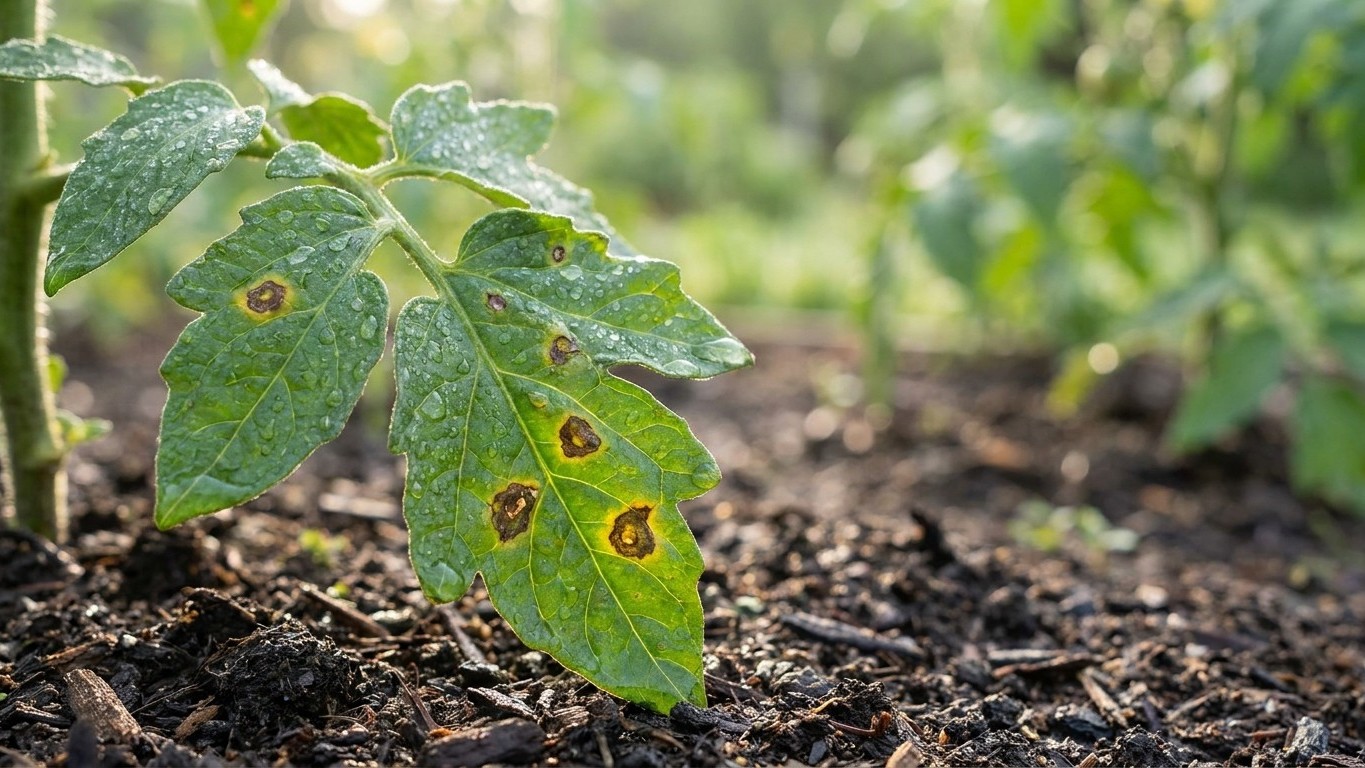
Early blight. That was the diagnosis staring back from underneath those tomato leaves, on a morning after yet another sweltering night of hand-watering with a hose. Dark, concentric spots ringed with yellow halos had crept across the lower foliage, exactly where the leaves had stayed damp longest, tucked close to the soil, shaded from any breeze that might have dried them out.
Watering after sunset during a heatwave feels like common sense. The air cools, evaporation slows, and every drop seems destined for the roots instead of the atmosphere. Except the tomato plants had other plans. Wet leaves overnight cause fungal disease, not night watering itself — and once the mercury climbs, that distinction stops being academic.
Key takeaways
- Wet tomato leaves at night create ideal conditions for fungal spores to germinate—sometimes in as little as 5 hours
- The cooler temperatures and humidity of heatwave nights amplify disease risk, not reduce it
- A single scheduling adjustment and targeted watering technique can eliminate the problem without sacrificing hydration
The logic behind night watering, and where it breaks down
The instinct isn’t wrong, exactly. Plants that are not in pots will benefit most from being watered morning or evening, when droplets have time to soak down into the soil. During a punishing heatwave, when soil dries out within hours and afternoon watering just evaporates before it reaches a single root, evening feels like the responsible choice.
The trouble starts with what happens to the foliage, not the soil. Evening watering gives plenty of time for the water to penetrate the soil and for the plant to take it up, but there is a concern that leaves staying damp overnight will provide access to disease. Tomatoes, it turns out, are particularly bad candidates for this gamble. Tomatoes are particularly prone to early blight and septoria leaf spot, both of which thrive with extended wet foliage. Lower leaves, shaded by the canopy above and pressed close to warm, humid soil, dry last, if they dry at all before sunrise.
What was actually breeding under those leaves
Fungal spores don’t need much time once conditions turn favorable. Research published in PLOS ONE found that bacterial leaf spot on stone fruits required as little as 5 hours of continuous leaf wetness at temperatures between 77°F and 95°F (25–35°C) to reach high disease severity. At cooler temperatures around 68°F (20°C), that threshold jumped to something closer to a full day, which sounds reassuring until you remember that a heatwave night rarely dips much below 68°F to begin with. the exact weather that makes night watering tempting is the exact weather that turns a few wet hours into an infection.
The mechanism itself isn’t mysterious. High humidity and poor air circulation significantly amplify these risky night watering conditions, creating an ideal environment for pathogens to thrive. Fungal spores that have been sitting dormant on old plant debris, on the underside of a leaf, or even drifting in from a neighbor’s garden, land on wet tissue and start germinating almost immediately. No sun to bake them off, no breeze to dry the surface, just hours of still, warm moisture. That’s precisely the scenario an evening hose session with the leaves in the splash zone creates.
There’s a second, less obvious risk hiding in the soil itself. If you water in the evening, then you’re more likely to encounter soil-borne fungal and bacterial diseases. These guys thrive in cool, damn environments and freshly watered tomato plants after dark become prime real estate. Splashback from a hose or watering can, especially the kind that hits low leaves directly, transports whatever is lurking in the soil straight onto plant tissue that’s already wet and vulnerable.
Rethinking the schedule without ditching the heatwave logic
None of this means abandoning the instinct to protect plants from midday scorching. It means shifting the clock earlier, not later. By watering in the morning, you allow foliage to dry out Completely during the day, which significantly reduces the risk of fungal diseases. The same volume of water, the same deep soak that heatwave tomatoes desperately need, just delivered before the sun climbs rather than after it sets.
If mornings genuinely aren’t workable, given a job, a family, a life that doesn’t revolve around a vegetable patch, early evening is a defensible fallback, provided the water never touches a leaf. If you must water in the evening, use drip or soaker hose systems that deliver water to the soil rather than the plant canopy. A soaker hose snaked along the base of each plant does the job a sprinkler never could: root-zone hydration with zero foliage contact, heatwave or not.
Mulch deserves more credit than it usually gets in this conversation. If you do one thing before a heat wave hits, mulch your vegetable beds. A proper mulch layer is the single most effective tool for protecting soil moisture and temperature, more impactful than any watering adjustment. A few inches of straw or shredded leaves around each tomato plant slows evaporation enough that even a single deep morning watering can carry plants through an entire scorching afternoon, cutting the temptation to reach for the hose again at 9 p.m.
Depth matters just as much as timing. The key is not just frequency but depth: water until moisture penetrates 6–8 inches into the soil, encouraging roots to grow downward where temperatures are cooler and moisture lasts longer. A quick daily sprinkle that barely dampens the surface does less for a heat-stressed tomato than one thorough soak every few days, and it certainly does less for disease prevention, since shallow, frequent watering keeps the topsoil, and the foliage above it, perpetually damp.
Not every heatwave habit needs an overhaul. Sometimes the best time to water is during or immediately after a rainfall, especially if the rain shower amounts only to a half-inch or so, because you want to add sufficient water at the same time to ensure penetration down to 5 or 6 inches. Rain, unlike a garden hose, tends to arrive with enough air movement to dry leaves within a few hours, something a still, muggy evening at the tap never quite manages. The plants know the difference. It’s usually the gardener who needs convincing.
Sources : gardensillustrated.com | gardeningknowhow.com