
After years of accumulating a jewelry box filled with pieces that turned my skin green, tarnished within weeks, or fell apart after a few wears, I had an epiphany. The problem wasn’t my budget or even my taste—it was my complete ignorance of one tiny detail that professionals have been using for centuries to separate quality pieces from cheap imitations.
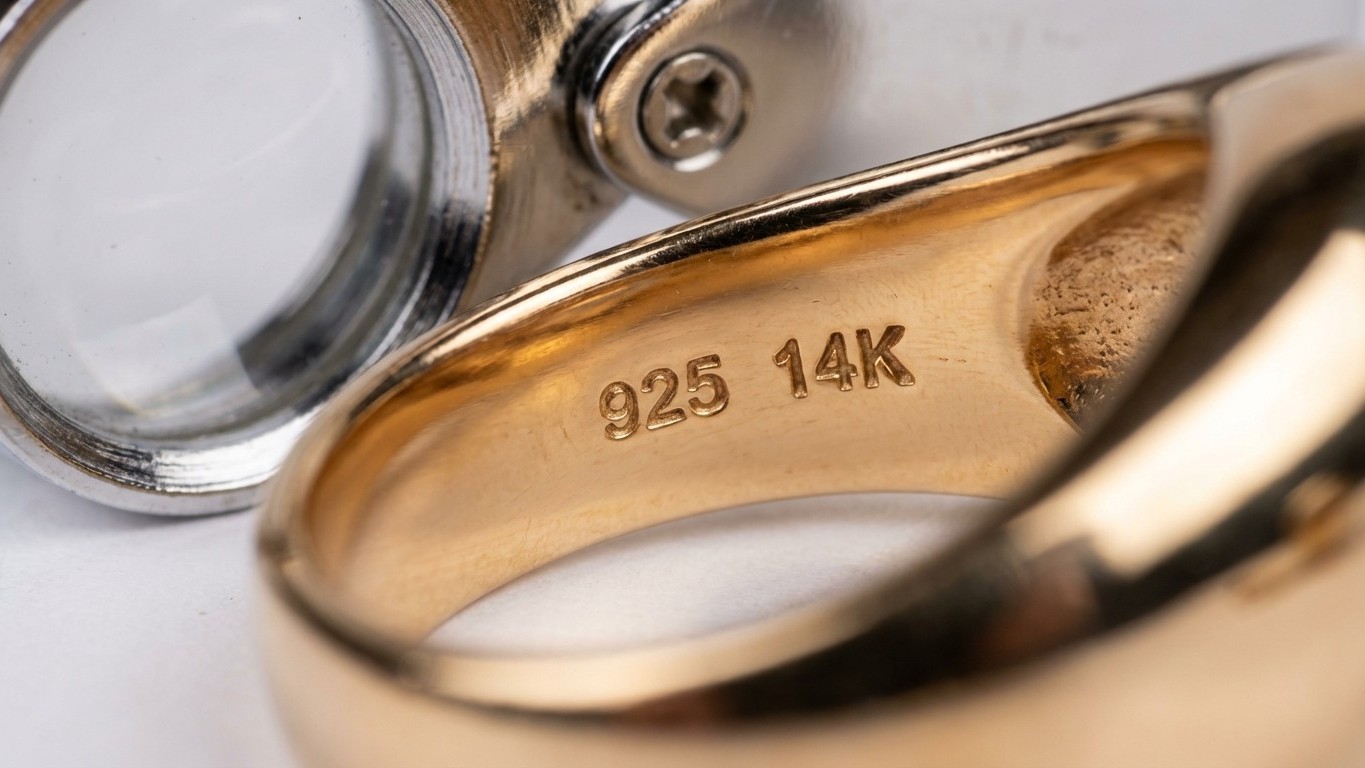
That detail? Hallmarks—the small stamps typically found on the inside of a ring band, the clasp of a necklace, or the back of a pendant. These microscopic engravings have become my jewelry shopping GPS, guiding me away from disappointing purchases and toward pieces that Actually-lengthens-lashes”>Actually last.
The Hallmark Revolution That Changed Everything
The moment I learned to recognize legitimate hallmarks was when my jewelry game completely transformed. These tiny engravings not only verify authenticity but also provide valuable insight into metal purity, origin, and craftsmanship, acting as a roadmap to ensure you’re investing in genuine, high-quality workmanship. What I once dismissed as meaningless scratches revealed themselves to be a sophisticated language of quality control.
Understanding this system isn’t just about avoiding fake pieces—it’s about making informed decisions that protect both your wallet and your skin. Some costume jewelry companies combine their metals with low-quality materials like nickel, which not only have less value but can also harm their wearer, as nickel can irritate the skin and many People have severe allergic reactions.
The hallmarking system has remarkable historical depth. As one of the earliest forms of consumer protection, hallmarking set the standard for quality control processes in jewelry-making all over the world, and in the U.S., it is required by the National gold and silver Marking Act of 1906 that gold jewelry be marked with a karat stamp denoting its purity.
Decoding the Language of Quality
Learning to read hallmarks felt like unlocking a secret code. The most common marks I encountered were surprisingly straightforward once I understood the system. The “925” stamp indicates sterling silver, meaning the piece contains 92.5% pure silver and 7.5% other metals, which is the international standard for sterling silver and ensures the piece has sufficient silver content to be durable while maintaining silver’s desirable properties.
For gold pieces, the system becomes even more revealing. If a piece of gold has the hallmark “375,” it is 37.5% pure gold or 9k gold, while a “417” stamp indicates 41.7% pure gold or 10k gold, and “585” stamped on a piece indicates 58.3% pure gold or 14k. This knowledge immediately separated quality pieces from gold-plated alternatives that would eventually reveal their true nature through wear.
The absence of proper hallmarks became my biggest red flag. If jewelry looks new but doesn’t have a hallmark, it is most likely costume jewelry. However, some counterfeit jewelry can have false hallmarks, which taught me that hallmark verification should be combined with other quality indicators.
Beyond Hallmarks: The Complete Quality Assessment
While hallmarks became my primary screening tool, I discovered that truly quality pieces reveal themselves through multiple indicators. The weight test proved invaluable—real metals like gold and platinum are heavier compared to base metals used in costume jewelry, so if a piece feels unusually light, it might be costume jewelry.
Craftsmanship details also became crucial markers. Fine jewelry has well-crafted and elaborate prongs, and a great way to separate high-end costume jewelry from fine jewelry is to check if the stones appear glued in place. The magnetic test offered another quick verification method—precious metals are not magnetic, so if a piece is attracted to a magnet, it is most likely not fine jewelry.
The finish quality became another telling indicator. Real jewelry typically has a polished, smooth finish, while costume jewelry may have a less refined finish, with visible seams or poor plating. I learned to examine pieces under good lighting, looking for smooth edges, seamless welds, and secure stone settings, with no visible glue or poorly attached embellishments, and symmetry in design and polish consistency.
The Investment Mindset Shift
Perhaps the most transformative aspect of this journey was shifting from a quantity mindset to a quality mindset. Rather than accumulating numerous inexpensive pieces that would disappoint me, I began investing in fewer, better pieces that would stand the test of time. This approach proved more economical in the long run and infinitely more satisfying.
Understanding hallmarks also opened up the world of vintage and antique jewelry. Many vintage jewelry brands have distinctive hallmarks, such as the Crown Trifari symbol, the Coro or Corocraft script, or Lisner art deco or block lettering marks, and other popular vintage jewelry manufacturers, such as Bakelite, did not typically include a hallmark but showed higher level of craftsmanship.
When uncertainty arose, I learned the value of professional verification. Taking pieces to a jeweler for testing is Recommended, as they have professional tests that determine whether jewelry is real as well as the purity of the metal itself, and a certified appraiser can provide the value of the piece as well.