
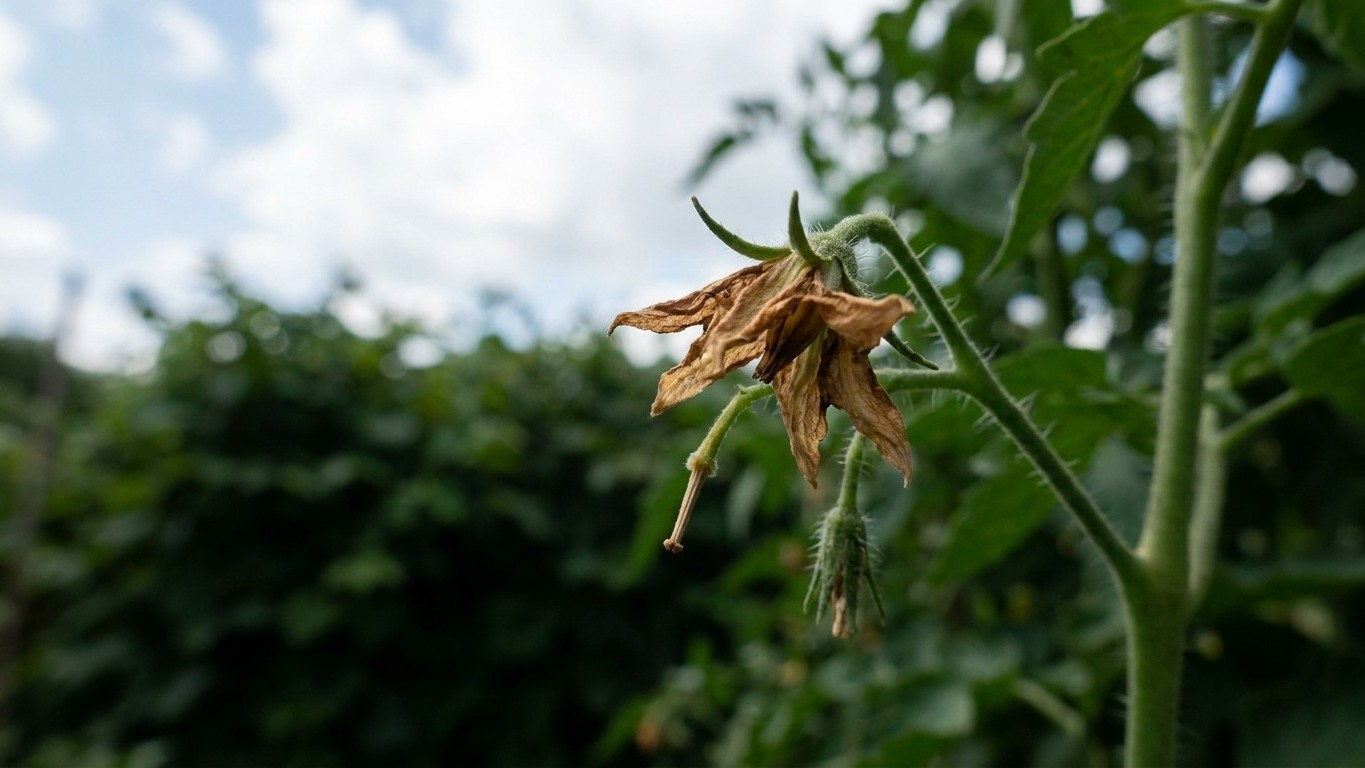
The blossoms turn brown at the tips first, then curl, then drop clean off the stem, no swelling ovary underneath, no pea-sized green tomato waiting to happen. Just an empty pedicel where a flower used to be. And no, it’s not a watering problem. When daytime air holds above 90°F (32°C), tomato pollen simply stops working. It becomes sticky, clumps together, and can no longer travel down the style to fertilize the ovary. The plant, sensing the reproductive effort is doomed, aborts the flower rather than waste energy on it.
This is blossom drop, and it is, according to extension agronomists, the single most common mid-summer tomato complaint in the country. The maddening part is that it happens to plants that otherwise look completely healthy, full, dark green foliage, six feet tall, loaded with buds. The vine isn’t struggling. The flowers are.
Key takeaways
- The flower you watched die today was actually doomed by a heat spike from 7–15 days ago—long before it even opened
- Night heat above 24°C damages pollen more than daytime heat, scrambling the sugar reserves pollen needs to reach the ovary
- Misting, pruning, and hormone sprays won’t fix heat-sterilized pollen—but shade cloth and heat-tolerant varieties actually work
Why heat, not drought, is the actual saboteur
Tomato reproduction runs on a tight thermal window. Research on pollen physiology shows that fruit set is optimal when average day and night temperatures range between 21–29 °C and 18–21 °C, and that prolonged stress with day temperatures exceeding 32 °C and night temperatures above 20 °C causes reduced fruit set, fruit weight, total yield and seed production. Push past that ceiling for more than a few consecutive days, and the plant’s chemistry shifts against you.
What actually happens inside the flower is almost mechanical. Temperatures exceeding 90F (32C) during the day, or sustained nighttime temperatures above 75F (24C), cause unviable pollen and inhibit the plant’s ability to support fruit development. Heat doesn’t just wilt the bloom, it scrambles the anther’s internal biology. A study on pollen carbohydrate metabolism found that continuous exposure of tomato plants to high temperatures prevented the transient increase in starch concentration and led to decreases in the concentrations of soluble sugars in the anther walls and the pollen grains, the exact sugar reserve pollen needs to germinate and grow down toward the ovary. No sugar, no fertilization. No fertilization, no fruit. The flower simply gives up.
Night heat compounds the problem more than most gardeners realize. Prolonged periods of high temperatures above 90°F and wind during the day are associated with blossom drop, but night temperatures may be most important for effective flower pollination, outside the 55°F to 70°F range, pollen becomes tacky and non-viable. That’s counterintuitive for anyone who assumes the sun is the enemy. A muggy 78°F night can do more damage to next week’s harvest than a scorching 95°F afternoon.
The flower dying today was doomed two weeks ago
Here’s the detail that trips up nearly everyone with a raised bed. Blossom drop isn’t really a same-day event. According to Penn State Extension, flowers and fruit are more sensitive to high temperatures than leaves and stems, and when high temperatures occur 7 to 15 days before flowering, you’ll likely see aborted and dropped flowers. Pollen development, is set in motion long before the bud even opens, effects of high temperature on fruit set are primarily on the stage of pollen development, which occurs about nine days before flowers open.
So the flower you watched shrivel this morning was likely condemned by a heat spike from two Tuesdays ago, one you may not even remember. The lush, blooming plant in front of you isn’t lying about its health, it was strong enough to push out flowers. The heat simply arrived at the wrong moment in that flower’s nine-to-fifteen-day production line, and by the time you noticed the brown edges, the outcome was already locked in.
Once a flower opens, the clock is even tighter. Pollen has to release from the anther and travel down the style to fertilize the ovary all within roughly 50 hours, or the flower aborts. A single 50-hour window, repeatedly wrecked by a heat dome, adds up fast across a whole growing season.
What actually moves the needle (and what’s a waste of spray)
Franchise gardening advice loves quick fixes, and this is exactly where most of them fall apart. Misting flowers doesn’t rehydrate pollen that’s already chemically cooked. Hard pruning to “focus the plant’s energy” does nothing for anther biology. And those blossom-set hormone sprays sold at every garden center? They’re formulated for a completely different problem. Extension guidance ties blossom-set sprays mainly to spring drop caused by cold nights below about 55–60°F, while in a heat wave the limiting factor is sterile pollen and an altered flower, which these sprays don’t address. Worse, forcing a set without genuine pollination tends to produce hollow, puffy, misshapen fruit, not exactly the reward you were hoping for.
What genuinely helps is less exciting but backed by field trials: 30 to 40 percent shade cloth stretched over the hottest afternoon hours, paired with deep, consistent watering and a thick mulch layer to keep root-zone temperatures stable. Consistency Matters More Than volume, erratic soil moisture stresses the plant on top of the heat stress it’s already fighting, which only accelerates flower abortion. If your garden sits in a region that regularly tips past 90°F for weeks at a stretch, it’s also worth scouting seed catalogs for heat-set or heat-tolerant cultivars, bred specifically to keep pollen functional when the mercury climbs — a breeding effort southeastern US growers relied on for years, until the advent of heat-set tomato varieties in the 1990s bred for tolerance to high day and night temperatures.
The reassuring part, if patience is on your side, is that this is rarely permanent damage to the plant itself. Most cultivars resume normal fruit set within a week or two once nighttime temperatures dip back under that 70–72°F threshold, pushing out a fresh flush of flowers that finally get to finish the job the July heat wave interrupted.
Sources : pmc.ncbi.nlm.nih.gov | biorxiv.org