
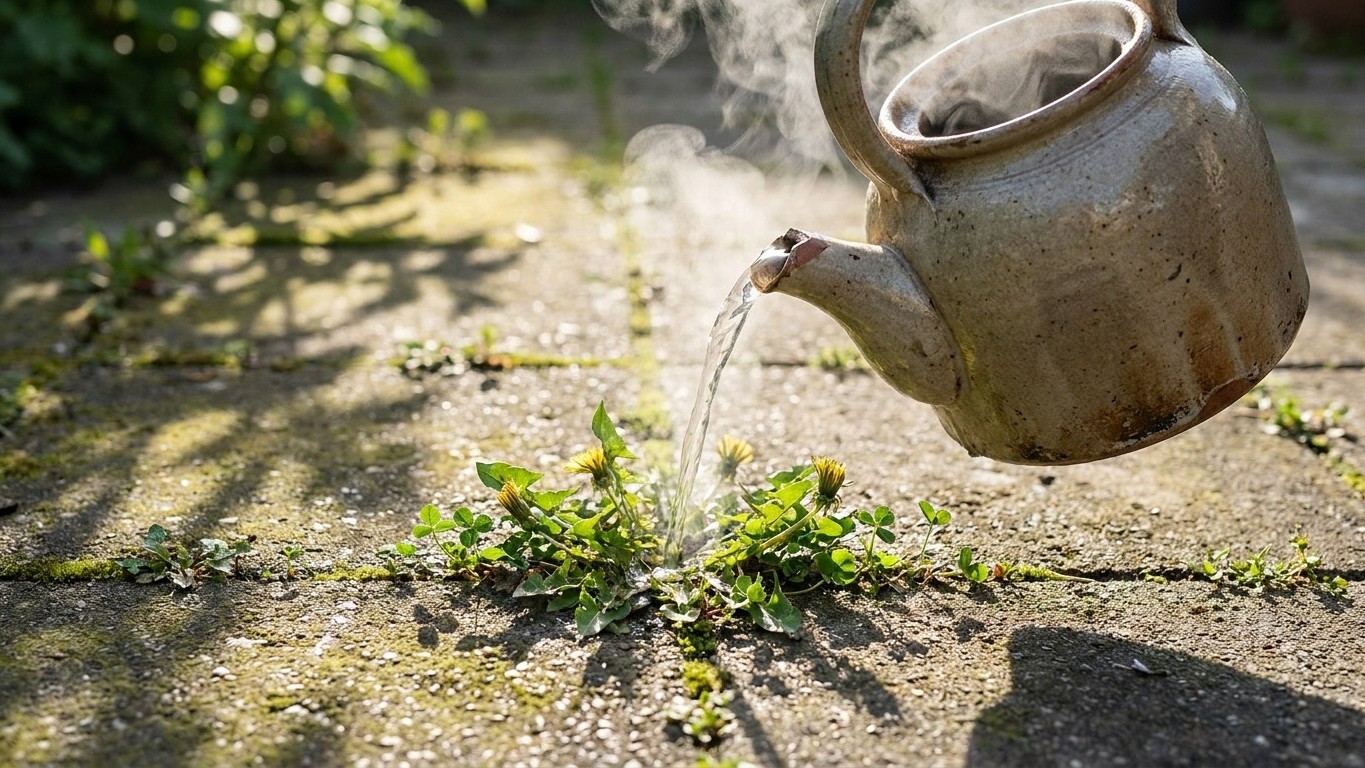
Steam curling off a battered stockpot, then that quiet hiss the moment scalding water hits a crack in the patio stone, it’s the sound of a century-old trick still doing its job. No spray bottle, no plastic jug with a skull warning on the label. Just water, heat, and gravity. Grandmothers were doing this decades before “eco-friendly weed control” became a marketing phrase, and the method hasn’t lost a step.
The science behind it is almost embarrassingly simple. Pouring boiling water on the weeds will kill them fast as the hot water destroys the plant cells. There’s no chemical warfare happening underground, no systemic poison traveling through the vascular system. It’s pure thermal shock, cell walls rupture, the plant’s internal plumbing collapses, and the visible part of the weed essentially cooks where it stands.
Key takeaways
- A single pot of boiling water triggers cellular collapse in weeds, but the visible death takes 1-2 days to appear
- Plain water actually beats vinegar and salt for patios because it leaves zero chemical residue or soil damage
- Stubborn weeds need 2-5 applications over weeks, but there’s a permanent solution most guides conveniently skip
What Actually Happens in Those First Few Hours
Don’t expect an instant vanishing act. Affected plants will wilt almost immediately after treatment, but plant parts in contact with the boiling water will not brown until one to two days later. That lag between “wilted” and “dead” trips up a lot of first-timers who panic and reach for a second pot too soon.
The transformation, once it starts, is oddly satisfying to watch. One documented test described how weeds turned By the second day, the weed sprouts showed noticeable changes in color. The vibrant green hues had faded to a dull brown, and the leaves were brittle to the touch. The growth had visibly halted, and the weeds appeared to be in a state of decline, with the process essentially finished by day four or five of repeated dousing. Franchement, for something that costs nothing but a gas bill, that’s a decent return on effort.
Here’s the catch nobody puts on the label, though: this is a contact killer, not a root killer. Boiling water will act as a contact “herbicide”, killing only the portion of the plant it comes in contact with. It will not kill roots or other plant parts in the soil. It is most effective on young, newly emerged annual weeds. A three-week-old chickweed seedling barely stands a chance. A dandelion with a taproot diving eight inches into the base layer beneath your pavers? That’s a different negotiation entirely.
Why It Beats Salt and Vinegar for Patios Specifically
This is where the counterintuitive part comes in. Everyone assumes salt or vinegar must be the “stronger” natural option because they sting more, smell sharper, feel more like a real weapon. In practice, for jointed stone and pavers, plain boiling water often wins, precisely because it does less collateral damage. Unlike vinegar or salt, boiling water does not leave any chemical residue, does not risk etching your pavers, and will not damage surrounding soil or plantings once it cools. Salt, meanwhile, has a nasty habit of sticking around. Soil Scientists-reveal-the-one-bedroom-object-that-matters-more-than-your-phone/”>Scientists note that even modest concentrations cause real trouble: studies show that 49g of granular salt per square meter causes severe phytotoxicity and death in weeds such as sourgrass — effective, yes, but that same salt doesn’t politely disappear afterward.
Adding salt to the boiling water for extra punch sounds logical. It mostly isn’t. You can, but it doesn’t help much. Adding salt to boiling water makes it marginally more damaging to plants but also introduces salt into your soil, which causes long-term contamination. Vinegar fares worse dissolved in hot water, since vinegar added to hot water loses its acetic acid through evaporation. The old-timers who swore by plain water over the fancier mixtures may have simply been onto something the chemistry confirms: keep it simple, keep it separate.
The Technique That Actually Works
Skip the giant stockpot theatrics, honestly. A kettle gives far more control, and a narrow spout means you’re not sloshing near-boiling water down your shin trying to aim it precisely at a weed crown wedged between two flagstones. Pour slowly, directly onto the base where the stem meets the joint, and let it soak in rather than splashing across the whole slab.
One application rarely finishes the job for anything beyond a fresh seedling. Plants with established root systems will resprout after several days, at which time the boiling water can be applied again. Budget for two to five rounds spaced roughly a week apart for the stubborn ones, dandelions, dock, plantain, the usual taproot troublemakers. Think of it less as an execution and more as attrition. You’re wearing the plant down, not delivering a single fatal blow.
A word of caution that’s easy to overlook: this method doesn’t discriminate. It’ll scald whatever it touches, wanted or not, so keep it away from anything rooted in soil nearby, flower beds, lawn edges, that new boxwood you just planted. And skip it entirely on frost-damaged or already-cracked stone, since sudden extreme temperature swings can occasionally worsen existing fractures.
The Part Most Guides Skip: Fixing the Real Problem
Killing today’s weeds is only half the story. They keep coming back for a structural reason that has nothing to do with your weed-killing method of choice. Weeds return because the joint material between your pavers has degraded, creating space for dirt and seeds to accumulate. Most weed removal methods (pulling, spraying, burning) address the visible weed but do not fix the joint. Until the polymeric sand is replenished and the joints are fully sealed, new weeds will continue to appear.
The permanent fix, if you’re tired of the seasonal ritual, involves re-sanding those joints properly. The only long-term solution is properly applied polymeric sand in the joints combined with a paver sealer on the surface. Polymeric sand hardens when activated with water, filling the joints completely so dirt and seeds cannot accumulate. A sealer locks the sand in place and creates an additional barrier. Together, they can keep joints weed-free for 3 to 5 years before needing to be reapplied. A pot of boiling water buys you a peaceful afternoon. Re-sanding buys you a few peaceful summers. Most people, understandably, start with the kettle anyway, and there’s no shame in that.
Sources : cooktopcove.com | quora.com