
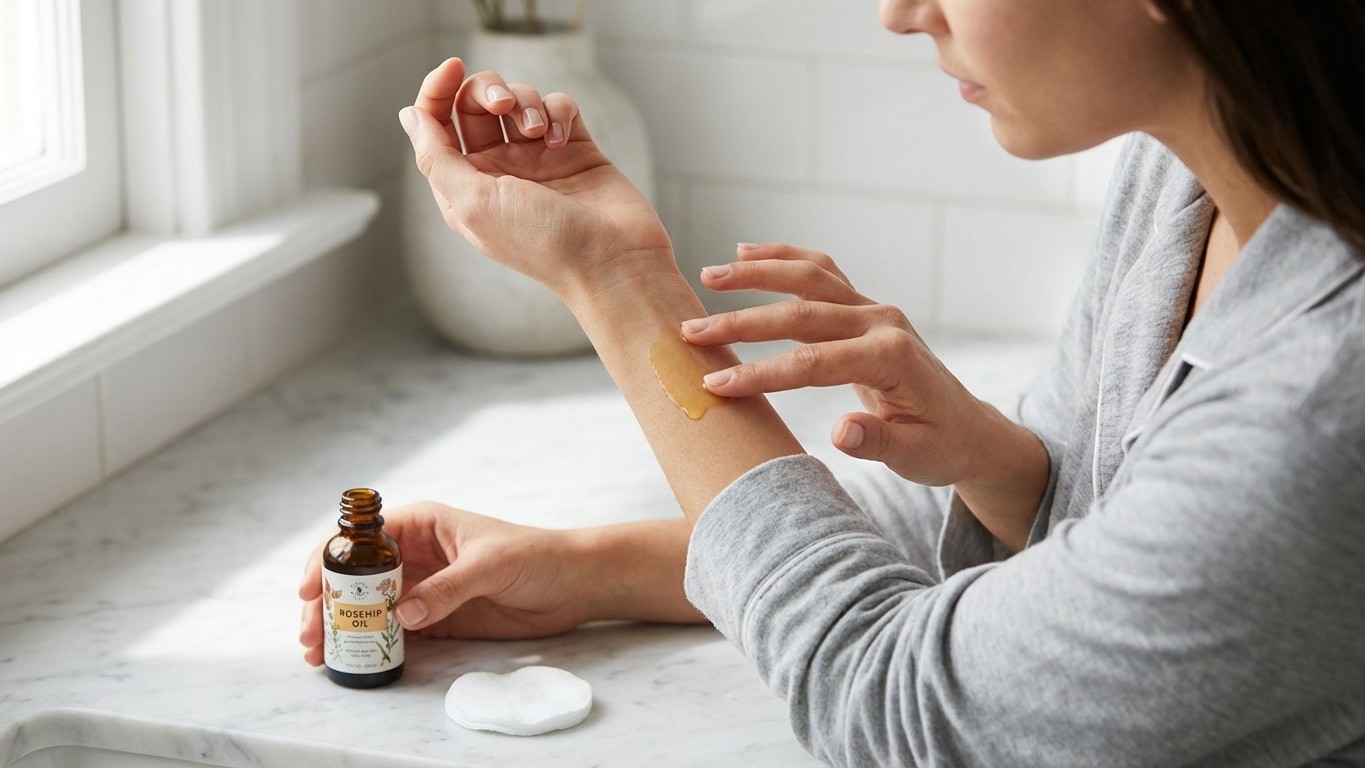
A rash that creeps across your cheek the morning after trying a new rosehip oil serum. A burning sensation under the arm, minutes after applying a “clean” deodorant made with baking soda and lavender. These are not rare horror stories, they are the predictable consequences of skipping one small, unsexy step: the patch test. And yes, this applies to natural products, too. Especially to natural products, actually.
The instinct to trust anything labeled “organic,” “botanical,” or “plant-based” is deeply human. It feels logical. But
products made of natural ingredients, often considered harmless, can absolutely cause allergic reactions.
The good news? A simple, methodical patch test done at home takes less than 10 minutes to set up and can save you weeks of inflamed, compromised skin.
Here is everything you need to know about how to patch test natural skincare products, from the biology of what actually happens under your skin, to the step-by-step protocol, to the specific plant-derived ingredients that deserve extra caution.
Why Patch Testing Still Matters With Natural Products
Allergies and irritations: even “clean” beauty has risks
The American Academy of Dermatology (AAD) states that more than 15,000 substances can cause an allergic skin reaction.
Many of those substances grow in gardens.
Researchers have compiled a list of roughly 80 plant-based oils that can trigger allergic reactions.
Among the most common are tea tree oil, ylang-ylang, jasmine, peppermint, and lavender oil.
The counterintuitive truth is that switching to natural products does not automatically reduce your allergy risk — and in some cases, it can increase it.
No two skin barriers are exactly alike. Factors like genetics, environment, health, hormones, and even stress levels affect how your skin reacts to ingredients — even natural ones.
A product that works beautifully for your friend can cause contact dermatitis on your skin, not because the formula is “bad,” but because your immune system reads one of its molecules differently.
The difference between an allergic reaction and irritation
These two responses are often confused, but they are biologically distinct, and the distinction changes how you respond.
Allergic contact dermatitis (ACD) occurs when a person has an allergic reaction following skin contact with an allergen. The reaction occurs when the immune system mistakes a harmless substance as harmful and attacks it.
This is a true hypersensitivity response: your body has been sensitized, meaning it learned to recognize that molecule as a threat, and it will react every time it encounters it again, often more severely with each exposure.
Irritant contact dermatitis, by contrast, is more mechanical.
It occurs when an external substance directly damages the skin’s epidermal cells, triggering an inflammatory response.
No immune memory is involved. The irritation can be acute (a too-concentrated essential oil applied directly) or cumulative (repeated use of a mildly disruptive ingredient over weeks).
Evidence suggests that 80% of people with contact dermatitis actually have the irritant form.
Both are worth catching early, and a patch test catches both.
One more nuance:
allergic contact dermatitis is a delayed (type 4) hypersensitivity reaction that generally occurs 24–72 hours following exposure to an allergen.
This is why a quick dab on your wrist and an immediate “looks fine” is meaningless. You need time.
How to Patch Test Natural Skincare Products: Step by Step
Before the test: choose your zone and prep your skin
Location matters more than most people realize.
Pick a small, discreet area of skin similar to your facial skin. Common options include behind the ear (ideal for testing products with strong fragrances or actives), the inner elbow (sensitive enough to mimic facial reactions), and the jawline or neck (for products intended for the face, this area provides the most accurate results).
Wash the test area with a gentle, fragrance-free cleanser to remove dirt, oil, and other residues. Pat the skin dry with a clean towel to ensure a clean base for testing.
Do not apply any other product to this zone. The test area needs to be neutral, no active serums, no exfoliants, nothing that could interfere with or mask a reaction.
Application: quantity, frequency, duration
Apply the product to a quarter-sized patch of skin, as thickly as you would when using it regularly.
This detail is more important than it sounds: applying a thin smear of a product you’d normally layer on generously won’t tell you how your skin responds to real-world use.
Leave the product on the patch of skin for as long as it would normally be on the skin. If you’re testing a product you would usually wash off, such as a cleanser, keep the patch on for 5 minutes or as long as the product instructions advise.
For a leave-on product, a serum, facial oil, or moisturizer, leave it on and don’t wash the area for the observation period.
Apply the product twice a day daily for at least 3 days and monitor for skin reactions.
This multi-day approach is what separates a serious test from a superficial gesture.
Some reactions only appear with repeated use, larger quantities, or when a product interacts with other skincare in your routine.
Observation: what to watch for and how long
Check the patch area regularly. Look out for redness, itching, bumps, stinging, or dryness.
Check at 24 hours, 48 hours, and again at 72 hours.
It is important to do a patch test for at least 7 days before fully incorporating new products. If a person has an allergy to a new substance, they might have a delayed response, meaning they might not develop any symptoms right away.
Keep the area dry and unobstructed.
Avoid washing the area for at least 24 hours — up to 48 hours if you have very sensitive skin.
And resist the urge to start using the product on your face simultaneously “just to save time.” That defeats the entire purpose.
Interpreting the Results: What Reactions Actually Mean
Reading the signs
A clean patch test — zero redness, no itching, no texture change after 48 to 72 hours, is a green light.
You’re likely good to go, but still introduce the product gradually.
That last part is not optional. Even a clear patch test cannot guarantee zero reaction when the product is used daily on your full face over weeks.
A mild reaction (slight pinkness, minimal stinging that fades quickly) suggests sensitivity rather than true allergy.
A sensitivity is your skin’s way of saying, “This isn’t quite right for me” — it might not mean the product is inherently unsuitable, just that your skin barrier may be a little overwhelmed or reactive.
In this case, try using less product, spacing out applications, or applying it over a light, fragrance-free moisturizer as a buffer.
A strong reaction, intense redness, swelling, hives, burning, or persistent itching — is a clear stop signal.
Wash off the product immediately and discontinue use. You may have an allergy to one or more ingredients.
What to do if something goes wrong
In cases of mild irritation, the skin will likely heal on its own within a day, especially if you remove the offending product quickly. To help it heal faster, you can use a soothing moisturizer or occlusive balm over the area.
A cold compress can also help calm the inflammatory response immediately.
If the reaction is significant, spreading, or doesn’t resolve within 48 hours, see a dermatologist.
A dermatologist can assess whether you have a particular skin trigger to help you put together a list of specific ingredients to avoid, or even diagnose potential underlying issues such as eczema or rosacea.
If fragrance in skin care products is causing your skin to react, opt for products labeled “fragrance free”, and remain cautious with products that have plant-based botanical ingredients, as these may still contain fragrance-related compounds.
Natural Ingredients That Deserve Extra Caution
Essential oils: always dilute, always test
Essential oils are the most common source of contact dermatitis in natural skincare. They are highly concentrated, biologically active compounds — and concentration is everything.
To minimize the risk of side effects from tea tree essential oil, it is important to dilute it to between 1 and 5%.
A dilution of 1% to 5% may be safe for most people; for children and people with sensitive skin, a dilution of 0.5% to 2.5% is generally considered safe.
Tea tree oil deserves special mention.
Of all essential oils, tea tree oil has caused the most published allergic reactions since the first cases were reported in 1991.
And there’s a storage factor people rarely consider:
oxidation upon exposure to air and light significantly increases its allergenic potency. Several oxidation-derived compounds have been identified as major allergens — which explains certain allergic reactions to tea tree oil, especially when the product is aged or improperly stored.
An old bottle of tea tree oil sitting in a sunny bathroom cabinet is a different product than what you opened six months ago.
High-risk natural ingredients to watch
Beyond essential oils, several beloved natural ingredients carry meaningful allergy potential that often surprises people:
- Honey and propolis:
Propolis, derived from bees, is a potential allergen sometimes found in lip balm and other products.
Those with pollen allergies may be at elevated risk. - Tea tree oil: As noted above, the highest documented allergy rate of any essential oil. Always diluted, always patch tested first.
- Rosehip oil: Generally well tolerated, but contains natural compounds that can trigger reactions in people sensitive to rose family plants. Worth testing, especially for reactive skin.
- Aloe vera: Widely considered soothing, but
a patch test should come first since some people might develop contact dermatitis from aloe.
The aloe vera in natural skincare routine context matters, raw gel from the plant and stabilized commercial products behave differently on skin. - Camomile and other Compositae plants:
Some people react to substances from the Compositae family of plants, a large group that includes camomile and chrysanthemum.
Common Mistakes to Avoid During a Natural Patch Test
Testing on the inside of your wrist and calling it done after two hours is probably the most widespread mistake. The wrist skin is thicker and less reactive than facial skin.
The forearm is less accurate because the forearm skin differs significantly from facial skin.
Always test on a zone that actually resembles where you plan to use the product.
Another mistake: testing multiple new products at the same time.
Introducing too many new products at once makes it nearly impossible to pinpoint what’s causing a reaction, should one occur.
One product, one patch, one window of observation. Then move to the next.
Skipping the test on products you’ve used before (with different formulas or from different brands) is also a common oversight.
You may be used to a certain product, but find your skin reacting after switching to another seemingly similar formula. This sudden irritation may be caused by different preservatives, fragrance, pH adjustors, or supporting ingredients.
Finally, assuming “no immediate reaction” means “safe forever.”
Contact dermatitis is a delayed hypersensitivity reaction, which can take a few days to appear.
Patience isn’t just a virtue here, it’s the methodology.
Frequently Asked Questions
How do you patch test a natural skincare product at home?
The AAD recommends applying the product to a small patch of skin where it is unlikely to be accidentally washed or rubbed away — good areas include the inside of the arm or bend of the elbow.
Apply the product as you would use it normally, leave it undisturbed, and observe over several days.
How long should you wait after applying a patch test?
The process involves applying a small amount of the skincare product to a discrete area of your skin and monitoring the skin’s reaction over a period of 24 to 48 hours.
For a more complete picture, especially with allergic reactions that are immune-mediated, extend observation to 72 hours or up to 7 days.
What ingredients in natural skincare are most likely to cause allergies?
Natural ingredients like essential oils or plant extracts can be potent allergens.
The most commonly documented culprits include tea tree oil, lavender, jasmine, ylang-ylang, propolis, and plants from the Compositae family. Understanding the best natural ingredients for skincare routine — including which ones carry higher sensitization potential, is the first step toward building a routine that your skin will actually love.
Building Your Routine Safely After the Patch Test
A clear patch test result is permission to proceed — carefully.
Introduce one new product at a time, ideally with several days between each, so you can monitor your skin’s response. Begin with the most essential item, such as a cleanser or moisturizer, and gradually build from there.
The best natural ingredients for skincare routine resources can help you prioritize which ingredients offer the best reward-to-risk ratio for your skin type.
Once you’ve cleared your core products, layering becomes much more strategic and much less stressful. For guidance on structuring those layers correctly, the natural skincare routine skin care tips framework walks you through sequencing, frequency, and the classic mistakes that undermine even the best-intentioned routines.
The patch test is not a formality. It’s the quiet, unsexy foundation that makes everything else in your natural skincare practice actually work. Which raises a genuinely useful question: how well do you actually know the ingredient lists of the products already on your shelf?