
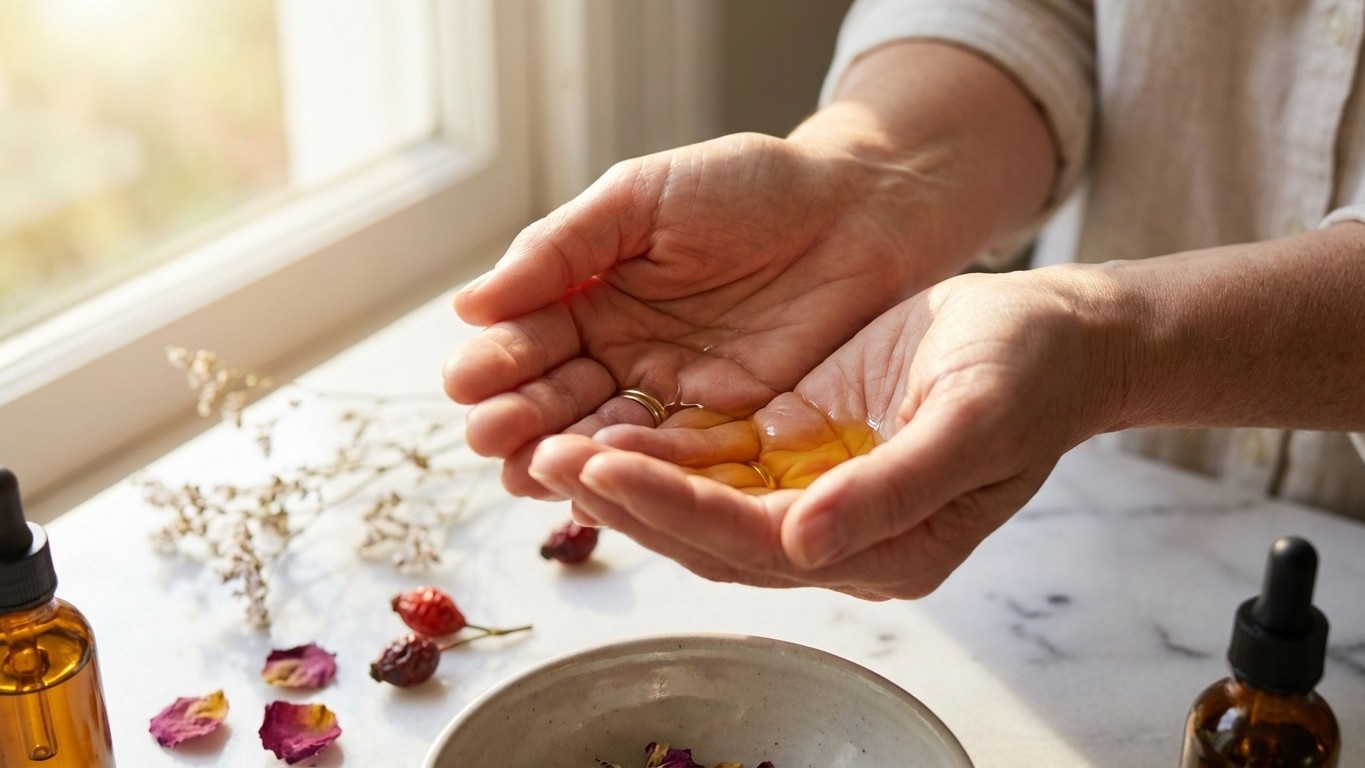
Close your eyes for a second. Picture the feeling of warm rosehip oil pressed between your palms, the faint scent of botanicals rising in the morning light, the quiet ritual of tending to skin that has laughed, cried, traveled, and aged with you. That’s the spirit behind a natural skincare routine for mature skin — not a battle against time, but a daily act of intelligence and care. Because here’s the thing most beauty marketing gets completely wrong: mature skin doesn’t need more products. It needs the right ones, applied with intention.
Understanding What Mature Skin Actually Needs
What happens beneath the surface
As we age, our skin goes through various changes that affect its texture, appearance, and health — including a loss of elasticity, dryness, fine lines and wrinkles, age spots, and a dull complexion.
These shifts aren’t random.
The science behind skin aging shows that fat is lost below the skin in the face, specifically the cheeks, chin, nose, eye area, and temples, which causes the skin to appear wrinkled and loose.
As estrogen levels drop during perimenopause and menopause, we often see that the skin becomes drier, thinner, and less resilient.
Collagen, that invisible scaffolding we all took for granted, quietly starts thinning.
Vitamin C helps the body produce collagen, the protein that provides structure, support, and strength to skin, muscles, bones, and connective tissues — and the body naturally produces less collagen as we age, which contributes to crepey, saggy, and wrinkled skin.
There’s also a hydration paradox worth naming.
Hyaluronic acid is a naturally occurring substance in the skin, but as we age, the skin’s ability to retain moisture diminishes, leading to dryness and a loss of plumpness.
Glycerin is naturally found in the skin, but as we age, the levels of glycerin decrease, leading to dryness and a compromised skin barrier.
Translation: mature skin is dehydrated from the inside out, not just from external factors.
The most common concerns after 50
Dryness, tightness, a grayish cast where there used to be glow, lines that seemed to deepen overnight. These are the complaints. The counter-intuitive reality?
As we age, our skin’s natural collagen production and cell turnover begin to slow down — which is why incorporating the right actives can make a big difference, including retinoids or gentle alternatives like bakuchiol to boost collagen and smooth fine lines.
The goal isn’t to freeze your face at 35. It’s to feed it what it can no longer produce on its own.
Why a Natural Routine Makes Sense for Mature Skin
The botanical advantage
Organic skincare avoids potentially irritating ingredients like parabens, synthetic fragrances, sulfates, and formaldehyde releasers — common culprits behind inflammation and dryness in older skin.
That matters more than ever when skin has thinned and its barrier function has weakened.
Organic products often harness the power of nature’s most potent ingredients, many of which have been clinically studied for anti-aging benefits, and the best organic skincare for older skin blends hydration, antioxidants, gentle exfoliation, and barrier repair.
Many women report that switching to natural ingredients helped reduce irritation and improved their skin’s daily feel.
This isn’t just anecdote.
Visible improvements typically appear within 4–8 weeks of consistent use, as natural actives work with the skin’s renewal cycle, patience and consistency are key.
What to watch out for
Natural doesn’t automatically mean safe. Essential oils, lavender, citrus, peppermint, can be irritating to sensitized, mature skin, particularly around the eye contour or on skin that has become reactive with age. Undiluted plant acids, even natural AHAs, can strip the barrier if overused. And well-meaning DIY mixtures with lemon juice or cinnamon? Worth skipping entirely.
As we age, skin becomes more delicate and prone to irritation — a gentle, non-foaming cleanser helps remove impurities without stripping the skin of its natural oils.
That principle extends to every step of the routine.
For a broader perspective on adapting your approach by skin profile, the natural skincare routine for oily skin hub offers a useful framework for understanding how skin type shapes every product choice.
The Step-by-Step Natural Routine: Morning & Evening
1. Cleansing without compromise
The right cleanser for mature skin is genuinely boring, and that’s a compliment.
A sulfate-free formula with aloe, coconut, or chamomile cleanses without stripping skin.
Foam cleansers, micellar waters loaded with alcohol, or anything that leaves skin feeling “squeaky clean” are too harsh. The goal is removal of the day’s grime while leaving the protective film intact. Apply with fingertips, not a rough cloth. Rinse with lukewarm water. Done.
2. Concentrated hydration: serums, oils, rich creams
Layering is where mature skin routines really live or die.
Serums are concentrated formulas that can penetrate the skin deeply and deliver potent ingredients, look for serums that contain antioxidants, hydrating ingredients, and collagen-boosting ingredients.
Hyaluronic acid can hold up to 1,000 times its weight in water, plumping the skin and reducing the appearance of lines instantly.
Apply it to slightly damp skin — that detail is everything.
Applying to damp skin ensures best absorption.
Follow with a facial oil or a rich cream to seal everything in.
Plant-based oils like argan oil, jojoba oil, and rosehip oil are rich in essential fatty acids and antioxidants, which help to nourish, hydrate, and repair mature skin, and are particularly beneficial for nighttime use when the skin undergoes its natural repair process.
3. The morning protocol: protect and brighten
In the morning: use a gentle cleanser, apply a vitamin C or niacinamide serum, layer with hyaluronic acid, and finish with a protective day cream.
Then, non-negotiable: SPF.
UV exposure is the leading cause of wrinkles, sagging, pigmentation, and collagen breakdown.
SPF has been called the ‘Ultimate Anti-Aging Product,’ preventing up to 90% of visible skin aging.
A mineral SPF with zinc oxide suits most mature skin tones without leaving a white cast.
Vitamin C deserves its own mention here.
Vitamin C is a powerhouse antioxidant that brightens skin, evens tone, reduces pigmentation, and protects against UV-induced free-radical damage.
A vitamin C-concentrated serum delivers maximum effect, look for products listing ascorbic acid or L-ascorbic acid in opaque packaging that reduces exposure to light.
4. The evening protocol: repair and regenerate
At night, use rosehip, bakuchiol, or vitamin E oils for repair.
This is when your skin shifts into active regeneration mode, and you want to support that process rather than interfere with it. A heavier occlusant, shea butter, squalane, a thick botanical cream, applied last seals everything in and prevents transepidermal water loss while you sleep.
For those approaching 50, richer creams, more potent antioxidants, and collagen-boosting ingredients become more important, and transitioning to thicker eye creams and barrier-restoring treatments ensures long-term skin health.
The Best Natural Ingredients for Mature Skin
Botanical oils worth knowing
Rosehip first.
Rich in vitamins A, C, and essential fatty acids, rosehip oil helps reduce the depth of wrinkles and improve skin texture.
It’s a classic among natural anti-aging ingredients thanks to its regenerating power, containing natural vitamins A and C and a high proportion of essential omega-3, 6, and 9 fatty acids, this combination supports tissue renewal, improves elasticity, and helps soften wrinkles and small scars.
Then argan.
Often referred to as “liquid gold,” argan oil contains vitamin E and fatty acids that nourish, hydrate, and improve skin elasticity.
Its structure allows for good absorption, so it hydrates and softens without clogging pores, used regularly, it improves elasticity, brings comfort and helps soften fine lines, and also strengthens the skin barrier, which reduces water loss and sensitivity.
Evening primrose oil often flies under the radar, and it shouldn’t.
Rich in gamma-linolenic acid (GLA), a fatty acid that supports skin hydration, elasticity, and hormonal balance, evening primrose oil is also a powerful antioxidant — best for dry, mature, or menopausal skin.
GLA levels decline with age, and this oil helps restore them naturally.
Actives that move the needle
Bakuchiol is the botanical story of the decade.
Sourced from the seeds and leaves of the Psoralea corylifolia plant, bakuchiol offers similar benefits to retinol, such as reducing the appearance of fine lines and improving skin texture — without the harsh side effects like irritation and sensitivity.
One clinical study found bakuchiol to be as effective as retinol in improving signs of aging, with fewer side effects.
For mature skin that reacts to traditional retinoids, this is genuinely useful.
Coenzyme Q10 is another underrated gem.
Found in sesame seeds and spinach, CoQ10 energizes skin cells and reduces the depth of wrinkles, enhances the skin’s natural repair process while boosting collagen and elastin production, and protects against free radical damage, keeping skin firm and youthful.
Peptides are short chains of amino acids that serve as the building blocks of proteins like collagen and elastin, proteins essential for maintaining the skin’s firmness and elasticity, both of which decline with age. Peptide-rich creams or serums can help stimulate collagen production and improve skin texture over time.
For a complete deep dive into ingredient layering across skin profiles, the natural skincare routine skin care tips guide covers the sequencing logic in detail.
Frequency and Rhythm: Organizing the Routine Over Time
Exfoliation: the case for restraint
Mature skin exfoliates more slowly on its own, which means that cell buildup contributes to dullness, and gentle exfoliation is necessary. The word there is gentle.
For people with dry or sensitive skin, exfoliating twice a week is the maximum frequency dermatologists recommend, and once a week or every other week may be preferable if you’re also using products that cause dryness, such as retinoids.
Mild chemical exfoliants are a better choice if you have dry, sensitive, or mature skin because they’re gentler than exfoliating scrubs — scrubs are easy to overuse and may damage your skin.
Lactic acid is the gold standard here.
Dry, aging skin can benefit from an AHA such as lactic acid, which contains hydrating properties.
One to two evenings per week, after cleansing. Then a nourishing oil to compensate.
Nourishing masks, think hydrating, not clay-stripping, can be used more freely, two to three times a week if the formula is gentle.
Those with more mature, dry, or sensitive skin may only want to exfoliate weekly.
Listen to that. Redness and tight, stinging skin after exfoliation is feedback, not a detox phase.
Adapting across seasons and decades
Winter demands richer occlusants, more oils, possibly a double-layer of cream at night. Summer allows for lighter serums and water-gel textures. After 60, many women find they benefit from dropping any active that causes irritation and focusing almost entirely on barrier support, ceramides, fatty acids, and gentle peptide serums. The routine becomes less about prevention and more about comfort and radiance maintenance. Both are equally valid goals.
Skin that tends toward dryness year-round will find specific seasonal guidance in this natural skincare routine for dry skin resource, which covers barrier repair in depth.
Glow-Boosting Rituals Beyond the Bottle
The art of facial massage
There’s a reason spas have always included facial massage — it works.
Adding gua sha massage to your routine can contribute towards lifted and healthy-looking skin, helping to relieve tension from your muscles, aid lymphatic drainage, calm the look of your complexion, and reduce the appearance of puffiness.
Facial gua sha increases circulation and the production of anti-aging molecules, collagen, and elastin.
A morning gua sha routine can help treat puffiness and energize the skin, whereas a night routine will help relax the muscles and release tight connective tissue in the face.
Two to three times a week tends to yield substantial results.
Always apply a facial oil first, the tool needs to glide, never drag, and on mature skin that distinction is especially important.
Chronic stress increases cortisol, which breaks down collagen — meditation, exercise, and rest can all help regulate stress and protect the skin from its damaging effects.
That’s not wellness fluff. It’s biology. Skin in a body that sleeps well, hydrates consistently, and manages stress looks measurably different. Green tea antioxidants consumed daily support the same free-radical protection you’re applying topically. The routine extends beyond the bathroom mirror.
Ingredients to avoid, and myths worth ditching
Over-exfoliation is the most common mistake in mature skin routines, full stop. The idea that “more is more” doesn’t apply here.
Exfoliating the face too often can dry out your skin and worsen your complexion, causing redness, irritation, and breakouts.
A compromised barrier on mature skin takes significantly longer to recover than on younger skin.
The second myth: expensive equals effective.
“An anti-aging routine isn’t about doing everything — it’s about using the right products, consistently.”
A $12 rosehip oil used faithfully every night outperforms a luxury cream used erratically. Consistency, not cost, is the active ingredient most routines are missing.
And DIY with essential oils at high concentrations? The risk of sensitization is real and cumulative. A one-percent dilution of lavender in a carrier oil for occasional use is reasonable. A homemade blend of five undiluted essential oils applied daily is not. Mature skin’s thinner barrier absorbs everything faster and protests more loudly when the chemistry is off.
FAQ: Adjusting the Routine Over the Years
When should you consult a specialist?
Sudden changes in skin texture, new persistent redness, or spots that change shape or color warrant a dermatologist visit, not a new serum.
If over-the-counter products don’t meet your needs, or if you’re dealing with hormonal changes or advanced signs of aging, consulting a board-certified expert is worthwhile, personalized recommendations can target your skin’s condition, especially when dealing with complex issues like melasma or deep-set wrinkles.
What about mixed skin types after 50?
Combination skin at 50 often means an oily T-zone that has diminished and dry cheeks that have intensified. The same principle applies: favor hydration everywhere, and use any actives only where the skin actually needs them. For sebum management without stripping, the natural skincare routine for oily skin offers targeted strategies that also suit mature combination profiles.
The underlying question in all of this, and the one worth sitting with, is what you actually want from your skin. Not what it looked like at 30, but how it feels today: comfortable, nourished, luminous in its own particular way. That aspiration is entirely achievable with the right natural routine. The science supports it. The ingredients exist. What remains is the ritual itself, practiced with the kind of patience that lets real change accumulate quietly, one morning at a time.