
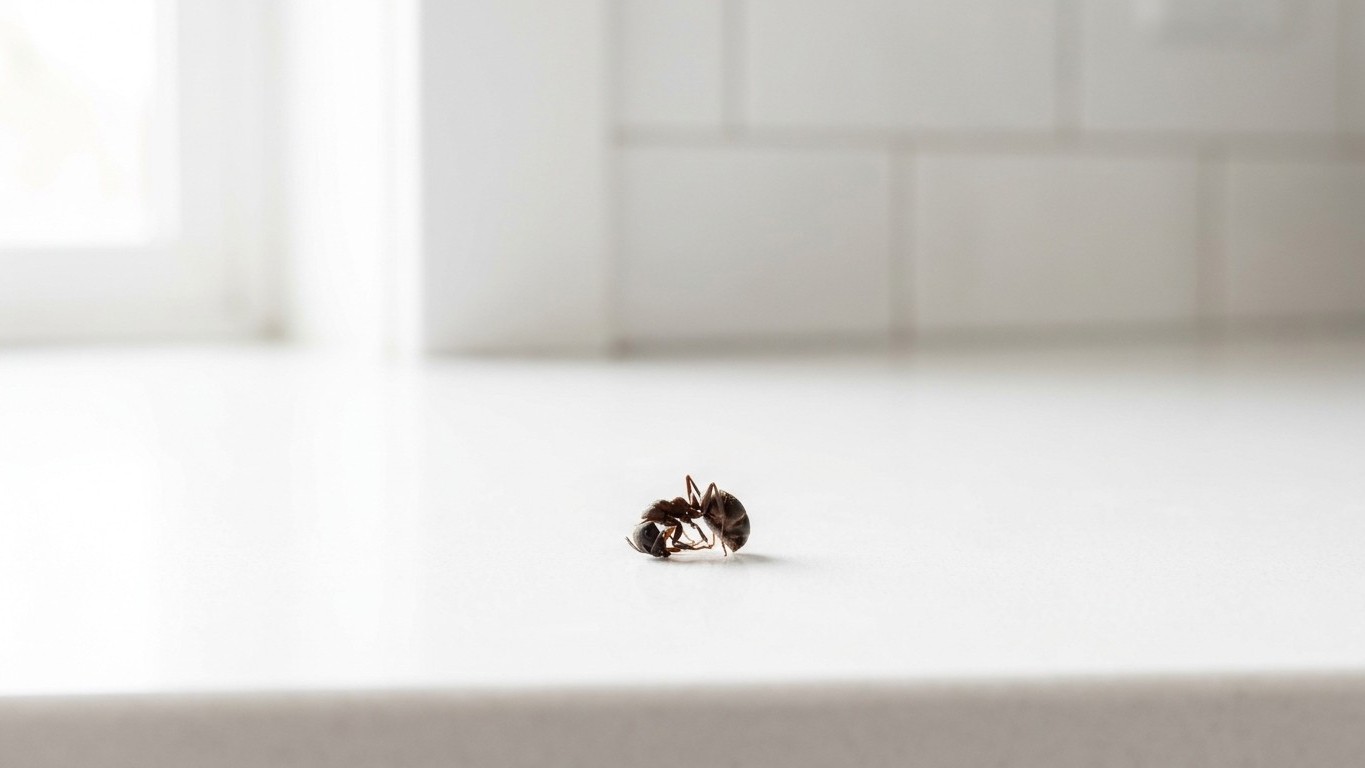
That kitchen counter kill feels satisfying for exactly one second. Then, a few hours later, an entire scouting party shows up to investigate the crime scene, and you’re left wondering why swatting a single ant somehow multiplied the problem. The answer isn’t bad luck. It’s chemistry.
Squishing ants releases alarm pheromones from their bodies that chemically signal danger to other colony members, potentially attracting dozens or hundreds of worker ants to investigate the threat and defend against perceived attackers. That thumb-press you thought ended the story actually opens a new chapter, one written in a chemical language you can’t smell but the rest of the colony reads instantly.
Key takeaways
- Squishing ants releases invisible chemical signals that recruit, not repel, the rest of the colony
- Some ant species literally split into multiple colonies when stressed—meaning you could be creating new infestations with one thumb-press
- The pheromone trails ants leave behind linger for hours, guiding reinforcements even after you’ve cleaned up
The Science Behind the Swarm
Ants don’t have voices. They have glands. Ants are social insects that rely heavily on chemical communication to organize their complex societies, and these chemicals, known as pheromones, are crucial for everything from foraging to defending the colony. When a body gets crushed, those internal chemical reserves spill out all at once, essentially broadcasting a distress signal at full volume.
Research on species like weaver ants has actually identified some of these compounds. Major chemical components of the mandibular gland secretion, 1-hexanol and hexanal, trigger alert and attraction, and less volatile minor components are thought to be markers for attack. In plain English: some molecules say “come look,” others say “come fight.” Neither one is what you want drifting across your kitchen tile at 7 a.m.
The mechanism gets even stranger once decomposition sets in. As the ant starts to decompose, its body releases oleic acid, which is more potent and can last longer than the distress pheromones. So even after you’ve wiped up the mess, an invisible chemical residue can keep signaling “danger here” or, worse, “investigate here” for hours. And the species matters enormously. Carpenter ants produce strong alarm pheromones recruiting nestmates from extensive colonies potentially containing thousands of workers, while Argentine ants from massive supercolonies can summon overwhelming numbers. Crush the wrong species in the wrong spot, and you’re not dealing with a nuisance anymore.
Here’s the genuinely counterintuitive part, the one that upends the instinct we’ve all grown up with: some species respond to crushing not by retreating, but by splitting up entirely. Pharaoh ants respond to disturbance by fragmenting colonies, a survival strategy called “budding,” where stressed colonies split into multiple new colonies, actually multiplying infestations when control efforts including crushing workers create pressure. Squash one Pharaoh ant thinking you’re solving a problem, and you might literally be founding new colonies elsewhere in your walls. Frankly, that’s the kind of detail pest control companies wish more homeowners knew before reaching for a paper towel.
Why That Trail Keeps Reappearing
The alarm pheromone is only half the story. The other half is the highway system ants build before you ever spot them. An ant will leave behind a pheromone trail once it identifies a food or drink source, like that grease stain next to your stovetop or those drops of water that collect behind your faucet, and that trail will then direct other ants to the source. This explains the almost supernatural speed at which a single scout becomes a full column marching across your counter overnight.
Once a scout ant discovers a crumb or a spilled drop of juice, it leaves an invisible pheromone trail for the rest of the colony to follow. Wipe the ant, ignore the trail, and you’ve solved nothing. The chemical breadcrumbs are still there, patiently waiting for the next forager to pick up the scent.
What Actually Works Instead
The fix isn’t complicated, but it does require resisting the urge to squish on sight. Pest control professionals and entomologists converge on roughly the same protocol, and none of it involves a rolled-up newspaper.
- Wipe, don’t crush. The fastest way to destroy an active trail is to spray it with a mixture of dish soap and water, since the soap kills the insects on contact and washes away the chemical pheromone trail they leave behind, preventing others from following.
- Deploy bait instead of brute force. Trapping ants can be a more effective long-term solution than killing them individually, since bait traps allow ants to carry poison back to the colony, eliminating the source of the infestation.
- Erase the evidence. Giving your kitchen a good cleaning helps erase the pheromone trails that ants leave behind.
- Try citrus or vinegar as a disruptor. Ants dislike the odor of white vinegar, and it disrupts their scent trails, so an equal-parts vinegar and water spray around problem areas is worth a shot.
One caveat worth flagging: not every home remedy is scientifically airtight. Some theories posit that the potent smell of vinegar is a deterrent to ants and that it can cover up the smell of the ant’s pheromone trails, but this hasn’t been proven. Vinegar’s real value seems to be as a cleaning agent that physically removes trail residue, not some mystical repellent force field. Worth keeping expectations realistic.
None of this means you have to develop patience for ants wandering your countertops. This temporary increase in ant activity should subside in a few days once the alarm signal fades and the trail gets wiped clean, which is honestly the more sustainable win. Bait stations targeting the colony’s queen, not the visible scouts, remain the closest thing to a permanent solution, since a colony can rebuild faster than any amount of individual squashing could ever keep pace with.
Sources : johnnybpestcontrol.com | accuratepest.net