
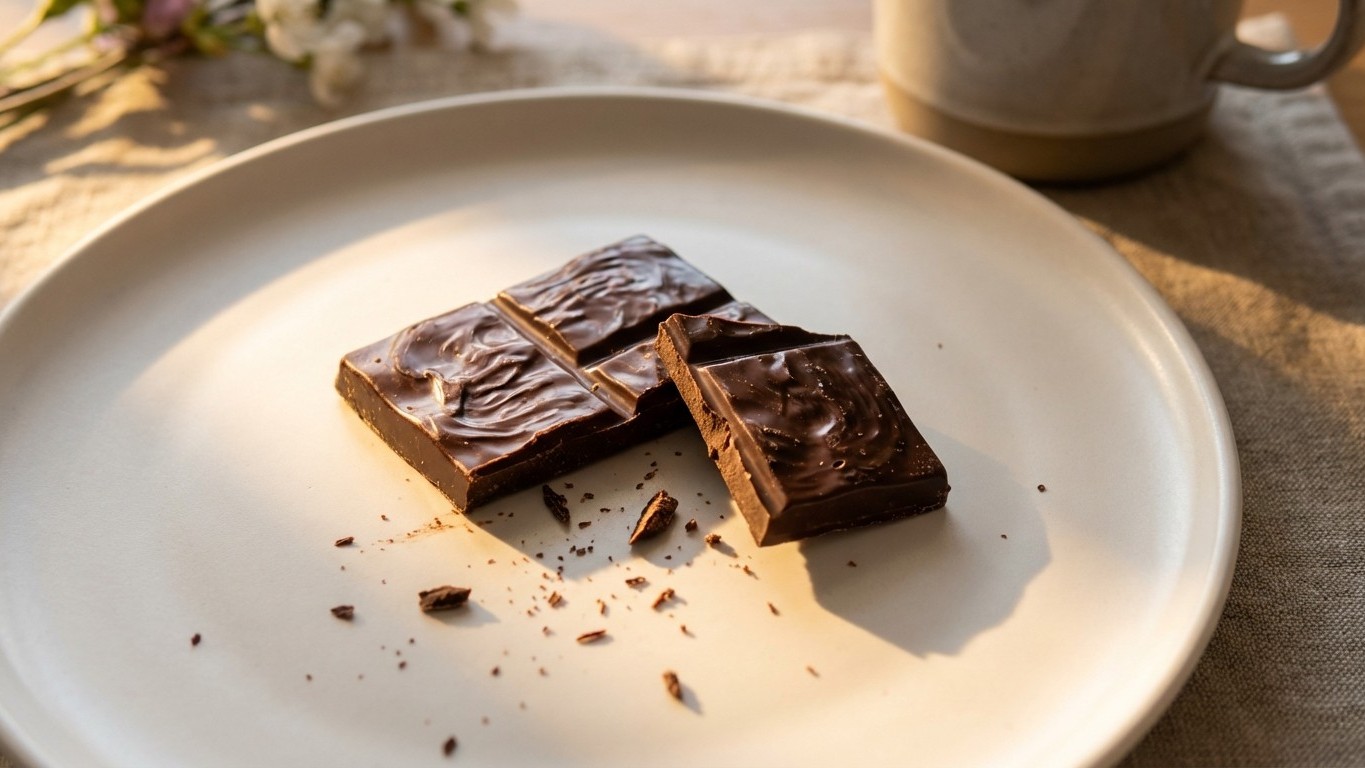
Easter morning. The foil is half-torn, there’s chocolate under your nails, and it’s barely 8 a.m. Before the coffee is even done brewing, a significant portion of that dark chocolate egg has vanished. The question most people never think to ask: what exactly is your liver doing with all of that right now?
The answer is more interesting, and more reassuring, than you’d expect. Depending on what kind of chocolate you reached for first, your liver may actually be getting a quiet gift this holiday morning.
Key takeaways
- Your liver processes dark chocolate’s compounds in a precise 30-minute biochemical relay that most people never realize is happening
- The polyphenols in cocoa may reduce liver fat content by over 12% and reshape your gut bacteria to reduce inflammatory signals
- That hollow Easter egg from the candy aisle tells a completely different story—one involving fructose, hepatic fat synthesis, and metabolic stress
The First 30 Minutes: A Biochemical Relay Race
The moment dark chocolate hits your digestive system, a remarkably fast process kicks off. Epicatechin from chocolate is rapidly absorbed by humans, with plasma levels detected after just 30 minutes of oral digestion, peaking after 2 to 3 hours and returning to baseline after 6 to 8 hours. That’s not a slow, lazy Sunday metabolism, that’s your body moving quickly on the compounds it actually values.
But here’s the thing most people miss: not Everything in that chocolate travels the same route. Flavanol monomers and dimers are absorbed in the small intestine, while procyanidins, the larger polyphenol chains, are metabolized in the colon by the intestinal microbiota into a variety of phenolic acids, which are then also absorbed. Two different roads, same destination. Once absorbed, these metabolites are transferred to the liver, where phase I and phase II reactions occur. In phase I, cytochrome enzymes lead to hydroxylations, oxidations and reductions; meanwhile, phase II produces conjugates through glucuronosyl transferases, sulfotransferases, and catechol-O-methyl transferases. The liver, is the processing plant, and with dark chocolate, the raw material arriving there is genuinely good.
What the Liver Does With the Good Stuff
Dark chocolate is rich in cocoa flavanols such as epicatechin and catechin, and exhibits antioxidant and anti-inflammatory effects. When these compounds reach the liver, the organ doesn’t just neutralize them, it activates them. The polyphenolic compounds present in dark chocolate, including epicatechin, a known natural antioxidant, are implicated in many of its beneficial effects, partly via inhibition of nicotinamide adenine dinucleotide phosphate-oxidase (NOX). That enzyme, when overactive, drives oxidative stress — the kind of cellular damage that quietly accelerates liver disease.
The science here has been building for years. A flavonoid-rich diet, including apples, tea, and dark chocolate, significantly lowers the risk of non-alcoholic fatty liver disease (NAFLD) and improves liver health biomarkers. More recently, a landmark clinical trial published in Scientific Reports in 2024 followed 120 patients with fatty liver disease, revealing that those who consumed dark chocolate with high cocoa content showed significant improvements, specifically, a 12.3% reduction in liver fat content, measured through advanced MRI technology. A single dietary habit. Measurable results on a scan. The result? Bluffant.
There’s also a gut-liver axis at play that most chocolate lovers would never guess. The polyphenols in cocoa can modulate the composition of the gut microbiota, exerting prebiotic mechanisms. They enhance the growth of beneficial bacteria such as Lactobacillus and Bifidobacterium, while reducing pathogenic ones like Clostridium perfringens. A healthier gut microbiome means fewer inflammatory signals traveling up to the liver through the portal vein, which is, essentially, the highway between your gut and your liver. Cocoa may also have prebiotic effects that improve gut barrier function, further reducing the bacterial “noise” the liver has to deal with after a meal.
The Sugar Problem: What Type of Chocolate Matters Enormously
Here’s the counter-intuitive part. Easter chocolate isn’t always dark chocolate, and that hollow egg from the candy aisle has a very different story to tell the liver.
What makes fructose particularly harmful is the way the body metabolizes it. Unlike glucose, which is used by cells as an energy source, fructose is metabolized by the liver, where it promotes the synthesis of fat. Milk chocolate and cheap Easter eggs, loaded with sucrose and sugar fillers, deliver a meaningful fructose hit straight to hepatic tissue. Regular consumption of both fructose- and sucrose-sweetened beverages in moderate doses, even with stable caloric intake, increases hepatic fatty acid synthesis even in a basal state; this effect is not observed after glucose consumption.
Dark chocolate, by contrast, operates under different rules. Dark chocolate, particularly those with high cocoa content (70% or more), contains less sugar, more fiber, and a greater proportion of fats than milk or white chocolate. These factors slow down the absorption of sugar into the bloodstream, which means it doesn’t cause a rapid spike in blood sugar levels. Less spike, less insulin surge, less demand on the liver to mop Everything up at once. Daily consumption of flavonoid-rich dark chocolate has been shown to improve fasting plasma glucose levels and insulin resistance to an extent three times greater than milk chocolate. Three times. On an empty stomach on Easter morning, that difference is not trivial.
The Morning Timing: Does It Actually Matter?
Eating chocolate before breakfast, on an empty stomach, feels like breaking a rule. The research suggests it may actually be a mild advantage, at least for liver metabolism. Despite the additional calories from chocolate, women who ate chocolate in the morning significantly reduced their daily energy intake and their waist circumference compared to the control group. The satiety effect of dark chocolate is real: consumption leads to a satiation response that inversely correlates with ghrelin levels, suggesting that chocolate may reduce appetite and help prevent weight gain.
The caveat, and there always is one, is that the presence of other foods significantly alters the metabolic timeline. Consuming chocolate after a protein-rich meal delays the glucose response compared to eating candy on an empty stomach. So the solo-chocolate-for-breakfast approach amplifies both the good (faster polyphenol absorption) and the potentially less good (faster sugar hit if it’s low-quality chocolate).
One detail worth knowing for next Easter: according to clinical studies published in Scientific Reports in 2024, the optimal dark chocolate for liver health should contain at least 70% cocoa content. The same study found optimal results with 30 to 40 grams of dark chocolate daily, roughly the weight of a few good squares, not half an egg. Portion is the variable that turns a hepatoprotective habit into a sugar overload. An obvious fact, almost too simple — yet consistently the one people sidestep on holidays.
What’s genuinely worth sitting with: clinical findings demonstrate improvements including reduced intestinal permeability and endotoxemia, improved lipid profile with increased HDL and reduced triglycerides, and attenuated hepatocyte apoptosis, though the evidence remains preliminary and is limited by heterogeneous study designs and small sample sizes. The liver science on dark chocolate is promising and growing, but it hasn’t been written in stone yet. The deeper question is whether the Easter egg you reach for first is actually a 70%+ bar — or the kind shaped like a bunny and filled with something caramel-adjacent. Your liver already knows the answer.
Sources : researchgate.net | sciencedirect.com