
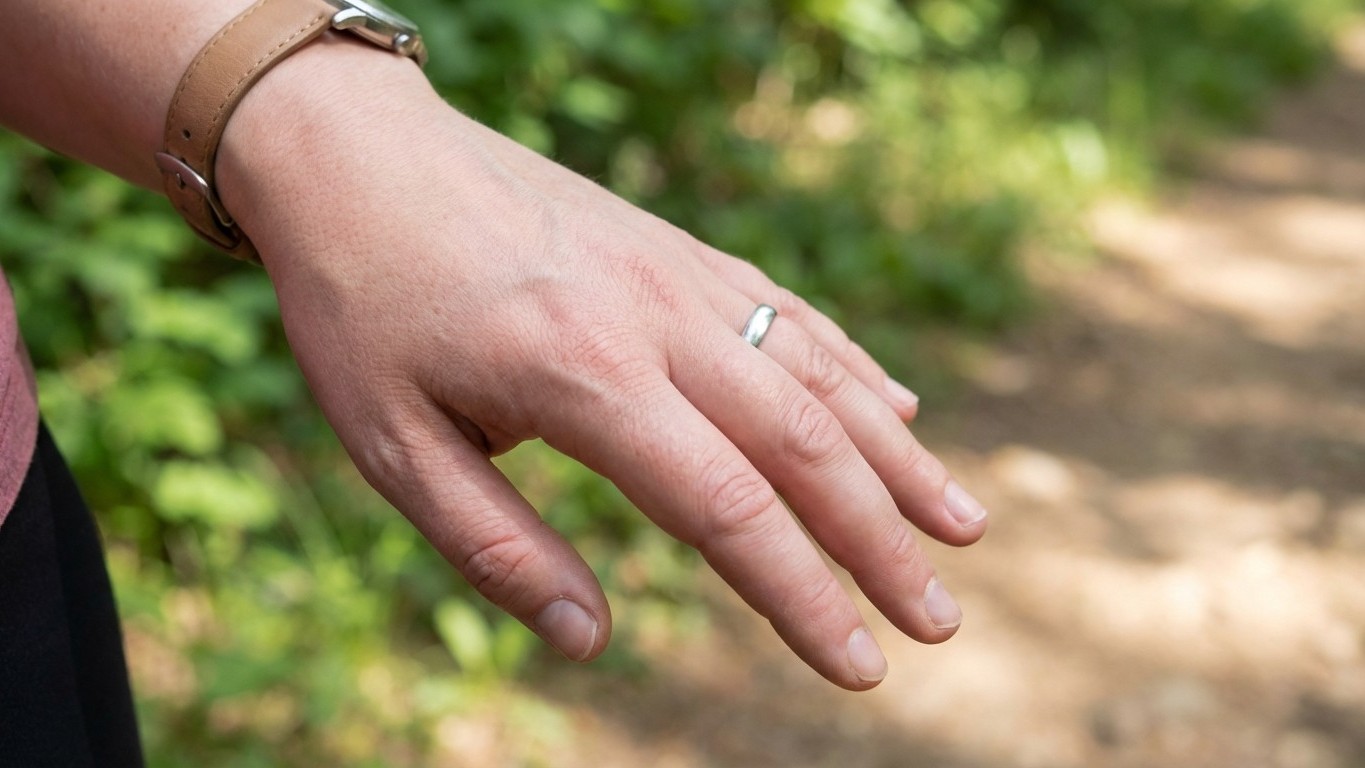
You’re halfway through your morning walk, feeling great, stride steady, playlist on point, and then you glance down at your hands and notice your fingers have turned into something resembling breakfast sausages. The rings feel tight. You try to make a fist and can’t quite close it. You shake your hands out, assume it’s nothing, and keep going. Most of us do exactly that: ignore it and move on.
That reflex to dismiss it is understandable. But your body is actually doing something worth paying attention to, and the story behind those puffy fingers is more layered than you might think.
Key takeaways
- A condition called POTASH affects 1 in 4 walkers, yet most people dismiss it without understanding why it happens
- Your blood vessels dilate to compensate for reduced hand circulation, and gravity compounds the effect over time
- Two scenarios demand attention: drinking too much plain water without electrolytes, or swelling that persists hours after exercise
What’s Actually Happening in There
The cause isn’t completely clear, but hand swelling appears to be a result of the way your body and blood vessels respond to the increased energy demands of your muscles during exercise. Here’s the counterintuitive part: to fuel your body during exercise such as a fitness walk, blood flow increases to your muscles, lungs, and heart, and that increase leads to less blood flow to your hands, so to counteract that, the blood vessels in your hands dilate to maximize blood and oxygen flow. The expansion of those vessels is what makes your fingers swell.
Gravity compounds everything. After walking for an extended period of time, during which the arms are at the sides, gravity simply pulls blood into the hands, causing swelling. Your hands hang lower than your heart for the entirety of the walk, fluid pools downward, and the result is that rubber-glove effect that walkers and hikers know all too well.
Temperature plays a role, too, in both directions, which surprises most people. A similar phenomenon can occur when exercising in the heat: your body generates excess heat, and in an effort to maintain its core temperature, it employs thermoregulatory mechanisms to cool you down. During exercise in hot temperatures, the body redirects blood to the surface of the skin to help release excess heat, causing blood vessels to expand, including those in the hands. Cold weather does something eerily similar: the temperature in your extremities drops when you exercise, causing all the capillaries and larger blood vessels in your fingers and hands to dilate or widen, which means more fluid fills those vessels, causing visible puffiness. Both extremes. Same result.
POTASH : Yes, That’s a Real Medical Term
There’s actually a name for what happens to regular walkers and hikers: Post Ambulatory Swollen Hands (POTASH) is an acquired condition that presents as asymptomatic swelling of the hands and their digits during ambulatory activities such as walking, hiking, and running, affected individuals cannot clench their fingers into their palm to make a fist, which is referred to as a “positive fist sign.” That test, try making a tight fist mid-walk, is the clearest self-diagnosis tool you have.
Research shows that hand swelling during walking affects about one in four people. Women are more likely to experience it than men. The benign condition typically resolves spontaneously within two hours, with complete resolution of the swelling. So if your hands are back to normal by the time you’ve showered and made coffee, that’s your body doing exactly what it’s designed to do. Annoying, but physiologically sound.
POTASH is an idiopathic recurrent condition whose pathogenesis remains to be determined, a report of occurrence in a brother and sister even raises the possibility that in some individuals, genetic factors may have a contributory role. Science is still catching up with something millions of walkers experience every week. That should feel oddly validating.
When to Stop Ignoring It
Here’s where the nuance matters. The vast majority of walking-related hand swelling is benign. But two scenarios deserve more attention.
The first is hyponatremia, low sodium in the blood. Exercise-induced hyponatremia can occur when walkers or runners drink too much water without taking in electrolytes — coupled with the simultaneous loss of electrolytes through sweat, this causes the relative amount of sodium in your blood to drop, and one of the first signs is swelling or puffiness in your hands. Swollen fingers and hands may be a sign of hyponatremia, but other signs such as confusion and vomiting are more prominent than the swelling, drinking too much water, particularly during a long event, may cause your body’s sodium to become so diluted that you become hyponatremic, and this requires immediate medical attention. The takeaway: if you’re walking long distances and drinking only plain water in large quantities, switch to something with electrolytes.
The second scenario involves persistent or symptomatic swelling. While swelling from exercise is usually benign, there are instances when it could indicate an underlying condition, if the swelling persists long after exercise, is accompanied by pain, redness, or involves other parts of the body, it is prudent to consult a healthcare provider, as conditions such as carpal tunnel syndrome, arthritis, or circulation disorders may potentially be responsible. Those who experience symptoms of shortness of breath, chest pain, or have a history of cardiovascular issues should seek immediate medical attention. If the swelling does not go down after an hour or two post-walk, it may be worth consulting a health professional to ensure the swelling is not a symptom of a more significant issue, such as congestive heart failure.
Also worth flagging: swelling can arise in various situations outside of walking, it can be a side effect of medications, hormonal changes, or a symptom of certain health conditions like kidney or liver diseases. If the pattern seems to extend beyond your walks, that’s a different conversation to have with your doctor.
Simple Things That Actually Help
Since the medical community acknowledges that there’s no proven way to prevent or reduce most exercise-related hand swelling, the focus shifts to management. A few habits make a real difference:
- Stretch your fingers wide, make fists, and raise your hands higher than your heart several times during exercise.
- When walking, use a hiking pole to keep your hand muscles actively squeezing.
- Drink fluids that have some salt in them while exercising, such as a sports drink with electrolytes.
- Remove rings before a long walk, if your fingers swell while you’re wearing one, it can become extremely uncomfortable and difficult to remove.
- If carrying a backpack, ease the strap tension, overly tight backpack straps can restrict blood flow from the arms back to the body, exaggerating the swelling.
One move that’s underrated: periodic arm circles. Performing occasional forward and backward arm circles during exercise disrupts the gravitational pull on your hands, keeps circulation moving, and costs exactly zero effort. The people who do this mid-walk look slightly ridiculous on the trail. Their fingers, however, stay perfectly normal-sized.
The bigger question, really, isn’t how to stop the swelling, it’s whether your body’s response to sustained effort is trying to tell you something about hydration, sodium, or circulation that you’ve been brushing off. Puffy hands on a walk are almost always harmless. But they’re also a real-time report from a body in motion, and those reports tend to get louder when something else is off. So the next time your rings feel tight at mile two, maybe don’t just shake it out. Ask yourself: what have you been drinking, how long have you been pushing, and when did this pattern start?
Sources : yourhealthmagazine.net | pmc.ncbi.nlm.nih.gov