
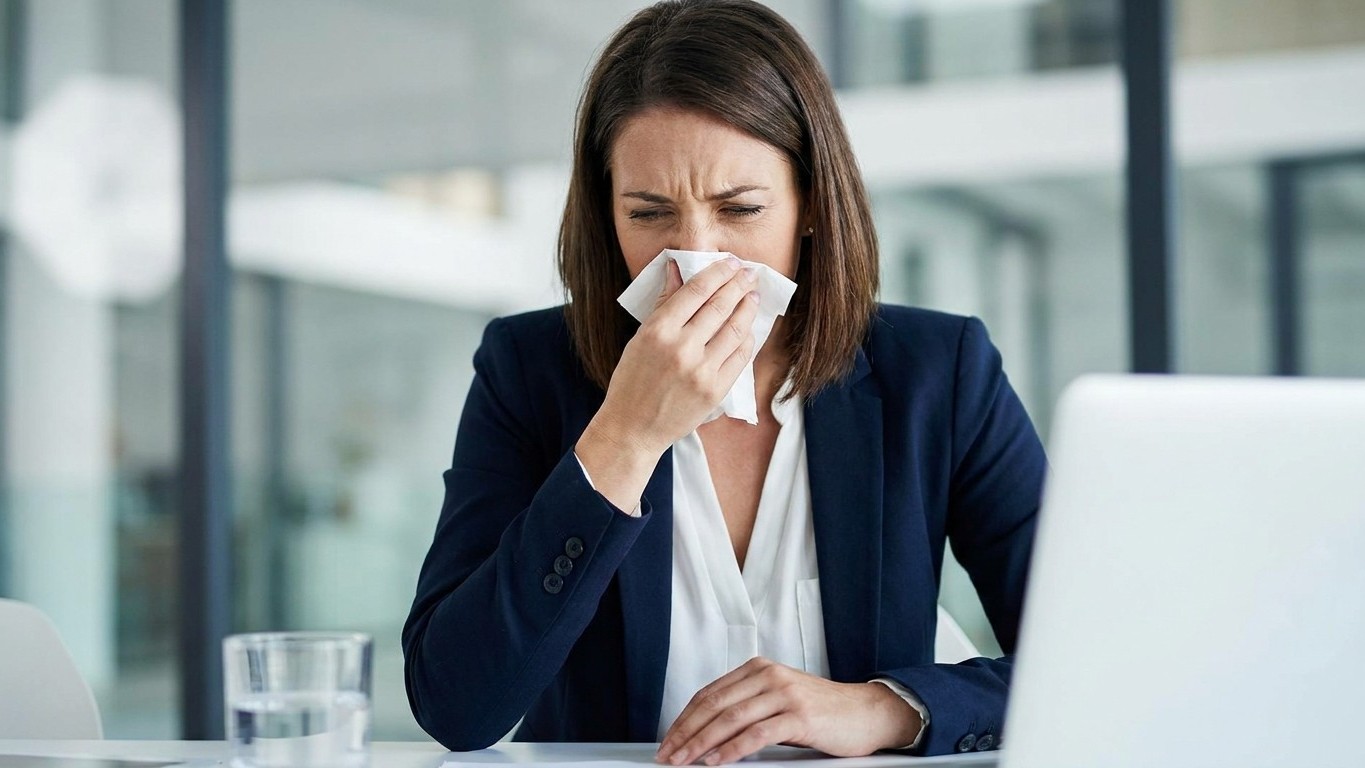
The habit forms quietly, almost imperceptibly. A meeting room. A crowded subway car. A funeral. The tickle hits, and within milliseconds, you’ve sealed your lips, pinched your nostrils, and swallowed the whole thing, proud, in a strange way, of the restraint. Turns out, what felt like good manners was something closer to a small act of self-destruction. The medical literature is remarkably clear on this, and once you’ve seen what a suppressed sneeze can actually do inside your skull, your throat, your ears, you don’t do it again.
Key takeaways
- A suppressed sneeze creates up to 20 times the normal airway pressure with nowhere to go
- Medical case reports document ruptured eardrums, throat perforations, and vision loss from held sneezes
- The solution is embarrassingly simple and doesn’t require holding it in at all
A sneeze is not a sound. It’s a pressure event.
To understand why holding one in matters, start with the physics. A sneeze can expel tens of thousands of droplets from your nose at up to 100 miles per hour. That’s not sneezing being dramatic, that’s the body engineering a forceful expulsion reflex to clear bacteria, pollen, dust, or any irritant that has no business being in your airway. The process begins when the mucous membranes in your nose detect an irritant, which is then transmitted to the brainstem, initiating a coordinated reflex involving multiple muscle groups. The whole system is designed to go out. When you force it back in, the consequences can be surprisingly severe.
Active intervention to limit a sneeze can be deleterious. Closing off the airway during a sneeze can result in over 20 times the airway pressures of a normal sneeze. Twenty times. That number, from a peer-reviewed review published in the American Journal of Rhinology & Allergy, is what should recalibrate your instincts. When you stop a sneeze mid-action by pinching your nose or keeping your mouth shut, all that built-up pressure has nowhere to go. Instead of being released outward, it gets redirected internally.
What doctors have actually seen
The case that circulated most widely in medical circles involved a 34-year-old man in the UK. He reported having an extreme amount of pain, and he was barely able to speak or swallow. He said he felt a popping sensation in his neck, which began to swell, after he tried to hold in a sneeze by closing his mouth and pinching his nose at the same time. That documented case saw him develop a hole in his throat from suppressing a particularly strong sneeze, leaving him temporarily unable to swallow or speak properly. He made a full recovery, but he was also lucky.
The ears are perhaps the most vulnerable casualty. Prior to a sneeze, a significant amount of air pressure builds in the lungs. If the sneeze is held in by pinching the nose or holding the mouth closed, this pressurized air is forced back through the Eustachian tube and into the middle ear cavity. This type of trauma to the membranous structures of the middle and inner ear has caused sudden severe sensorineural hearing loss, conductive hearing loss, and even vertigo. Most ruptured eardrums do heal on their own in a few weeks, but some require surgery.
Then there’s the eye socket. Suppressed sneezes can cause rupture of the delicate blood vessels in the nasal passages and sinuses, which may result in nosebleeds or subcutaneous emphysema, air trapped under the skin, especially around the eyes and nose. In rarer documented cases, orbital emphysema is a condition where air leaks into the eye socket, causing swelling, vision disturbances, and pain. Pneumocephalus, though rare, is a life-threatening condition where air enters the cranial cavity. These are not urban legends, they appear in peer-reviewed case reports catalogued over decades of medical literature.
The brain angle is the one that tends to make people stop mid-habit. In rare cases, holding in a sneeze can trigger a sudden increase in blood pressure, which may pose a risk for individuals with pre-existing aneurysms. Some injuries from holding in a sneeze can be very serious, such as ruptured brain aneurysms, ruptured throat, and collapsed lungs. Ruptured brain aneurysms are deadly in about 40 percent of cases. The operative word is “rare”, but “rare” and “impossible” are not the same thing, and the distinction matters when the downside is permanent hearing loss or worse.
The etiquette trap, and how to get out of it
Here’s the counter-intuitive truth: the socially anxious reflex to suppress a sneeze actually creates a hygiene problem, not just a health one. Sneezing helps clear out your sinuses, but when you hold it in, the trapped air can force mucus and bacteria deeper into your sinus cavities, which, over time, may lead to sinus infections or prolonged nasal congestion. You’re not keeping your germs to yourself by holding them in. You’re routing them somewhere they can fester.
As the BMJ case report authors wrote directly: “Halting sneeze via blocking nostrils and mouth is a dangerous manoeuvre and should be avoided, as it may lead to numerous complications such as pneumomediastinum, perforation of tympanic membrane and even rupture of cerebral aneurysm.” That’s not alarmism. That’s a clinical summary of observed injuries.
The fix is almost embarrassingly simple. Cover your mouth and nose loosely. “Covering your mouth and nose loosely will reduce this risk without blocking the release of pressure from the nasal airway,” says Dr. Bruce Stewart, an ENT specialist with Banner Health. A tissue, a bent elbow, even a sleeve, anything that muffles the sound without sealing the airway. Sneezing into your elbow, rather than holding it in, prevents the spread of germs while still allowing your body to release the pressure. No drama. No injury. No explanation required.
Dr. Zi Yang Jiang, a head and neck surgeon at the University of Texas Health Science Center at Houston, sees one or two cases arising from repressed sneezes each year, and says it was bizarre that a single sneeze could generate enough force to cause the kind of physical damage that usually results from trauma, such as a gunshot wound to the neck. One sneeze. The kind you’ve been silently absorbing in boardrooms and movie theaters for years.
Worth noting: people with high blood pressure or eye conditions like glaucoma may be at greater risk from the pressure spikes a suppressed sneeze creates, making the habit particularly unwise for anyone managing those conditions. If you’ve been politely clamping down on sneezes your whole adult life, you’ve probably been fine, the risk on any single occasion is genuinely low. But the body keeps score, and “fine so far” is a different thing from “no risk at all.”
Sources : healthspectra.com | themirror.com