
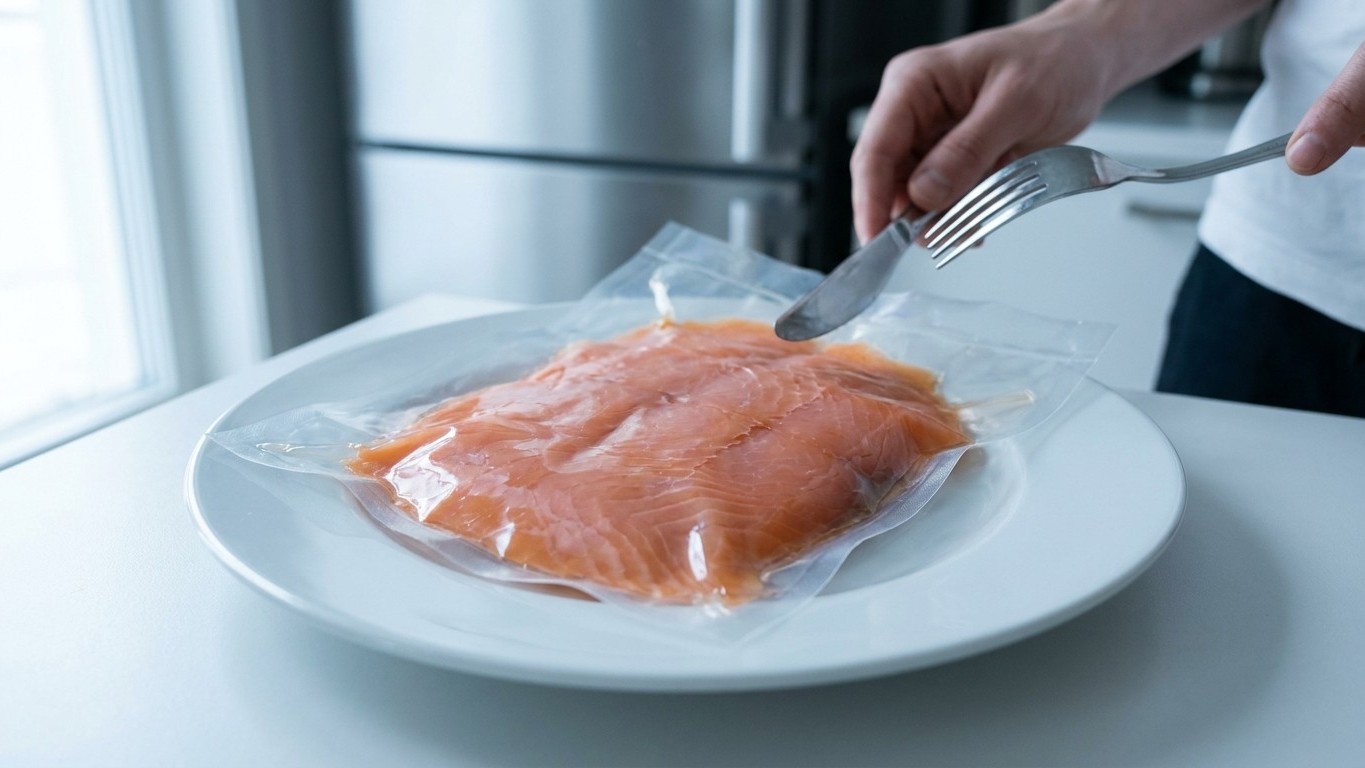
Four degrees Celsius. That’s the number stamped on every fridge thermostat, the number food safety agencies repeat like a mantra, the number I trusted blindly for years while stacking vacuum-sealed smoked salmon on the middle shelf. Turns out that number protects almost nothing when it comes to one particular bacterium: Listeria monocytogenes doesn’t just survive at 4°C. It multiplies there, slowly, quietly, in the dark of your refrigerator door.
A food inspector I spoke with pulled up research that stopped me mid-bite. Viable listeria has been found in vacuum-packed smoked salmon at 4°C. Not a rare lab anomaly. A documented, repeated finding across decades of food science. The cold I’d been relying on as a safety net was, in this specific case, barely a speed bump.
Key takeaways
- The bacterium that’s been quietly multiplying in your fridge all along plays by completely different rules than other dangerous pathogens
- A food inspector revealed decades of scientific data showing a problem hiding in plain sight on grocery store shelves and home refrigerators
- The smoking process most people assume makes smoked salmon safe actually leaves it vulnerable to this specific threat
Why the Cold Doesn’t Do What You Think It Does
Most bacteria slow to a crawl in the fridge. Salmonella, E. coli, the usual suspects, they need warmth to thrive. Listeria plays by different rules. It’s what scientists call psychrotrophic, meaning cold-loving, or at least cold-tolerant enough to keep dividing when everything else has shut down. L. monocytogenes and nonproteolytic strains of C. botulinum are psychrotrophs and can grow at refrigeration temperatures as low as 1.1°C (34°F). That’s colder than most home fridges even manage.
The CDC doesn’t mince words on this either. Refrigeration does not kill Listeria. Freezing doesn’t either, it just pauses the clock. “But if Listeria gets on the fish after it has been smoked, it can keep growing on it in the refrigerator. Freezing doesn’t kill it; it just keeps it from growing,” a food-safety expert explained to Food Safety News back when a wave of recalls first drew attention to the problem.
Here’s the part that genuinely surprised me: the smoking process itself, the one that gives smoked salmon its silky texture and that distinctive amber sheen, isn’t designed to kill bacteria at all. In hot-smoking, salmon is smoked at around 70-80°C to cook the flesh, but in cold-smoking, salmon is smoked at no higher than 33°C to avoid cooking the flesh or coagulating the protein. Cold-smoked salmon, the nova-style, lox, silky stuff most of us pile onto bagels, is essentially still raw fish that has been cured and perfumed with smoke. Cold-smoked salmon never gets that hot, which means bacteria like Listeria can survive the process.
The Numbers Behind the Warning
This isn’t theoretical hand-wringing. Contamination shows up with unsettling regularity. A relatively high incidence of the organism (6–36%) in ready-to-eat cold smoked salmon and cooked fish products has raised concern about the survival and growth potential of this organism in seafoods. In the European Union, the pattern is stark: 86 alert notifications were recorded by the European Rapid Alert System for Food and Feed from 2019 to 2023 linked to the presence of L. monocytogenes in fish products, mainly smoked salmon, representing 75% of the alert notifications related to pathogenic microorganisms in fish products over five years.
Britain lived through a sobering case study of exactly this scenario. A smoked fish outbreak in England that began in 2020 continued through 2024, eventually reaching 19 confirmed cases, with all patients having underlying health conditions or other risk factors, and the outbreak traced to a smoked salmon supplier led UK health authorities to formally add smoked fish to their “high risk” food list for vulnerable populations. Australia had its own scare more recently, when two people over 70 with underlying health conditions died after eating smoked salmon contaminated with listeria.
The mortality figure is what makes this bacterium different from a routine stomach bug. L. monocytogenes causes the disease listeriosis and has a mortality rate of 20%. Franchement, that’s not a statistic you shrug off because a product smells fine and looks fine. Listeria gives you no warning signs on the package. Listeria is odorless and tasteless. No sour smell, no slimy texture, nothing. Your senses simply cannot detect it.
What Actually Reduces the Risk
The inspector’s advice wasn’t to panic-toss every package of smoked salmon in the house. It was to understand time, not just temperature. The longer ready-to-eat refrigerated foods contaminated with L. monocytogenes are stored in the refrigerator, the more opportunities there are for this pathogen to grow, so to slow down or prevent the growth, keep the refrigerator at 40°F (4°C) or below. The fridge setting still matters, it just isn’t a magic shield.
A few concrete habits make a real difference:
- Once opened, treat cold-smoked salmon as a countdown, not a pantry staple sitting for weeks.
- Choose hot-smoked salmon when possible. Hot-smoked salmon reaches an internal temperature of at least 145°F during processing, which kills harmful bacteria and parasites.
- Cook it if you’re pregnant, over 65, or immunocompromised. The CDC specifically lists refrigerated smoked seafood as a riskier food choice for pregnant women, recommending either shelf-stable smoked fish or smoked fish cooked into a dish like a casserole.
Reheating helps only if the fish hasn’t already sat too long. Reheating hot-smoked salmon to 74°C (165°F) kills pathogens but does not make cold-smoked salmon safe to eat if improperly stored, since listeria may have multiplied before heating. That distinction Matters More Than most labels admit.
What stuck with me most from that conversation wasn’t the bacteria itself, it was the shelf life gap nobody advertises. Commercial cold-smoked salmon can sit in a vacuum pack for about three to eight weeks in the refrigerator before it even reaches your grocery cart. Add the days it spends in your own fridge after opening, and that “fresh” pink slice on your Sunday bagel might already be well into its second act. Worth checking the packing date next time, not just the sell-by one.
Sources : sciencedirect.com | ncbi.nlm.nih.gov