
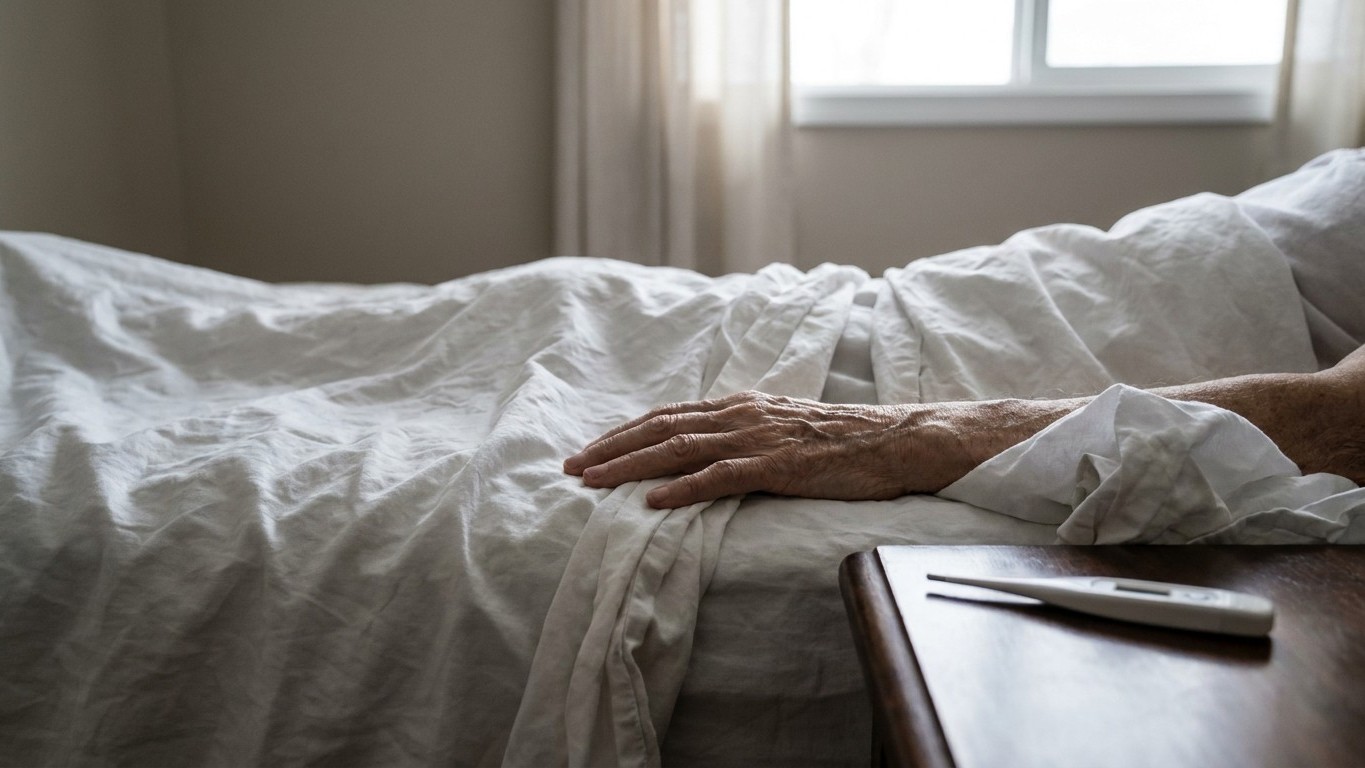
A bedroom that won’t cool below 77°F (25°C) isn’t just uncomfortable. For anyone past 65, it’s a measurable physiological event, tracked in heart rate, sleep architecture, and even stroke risk. That restless, sweaty night you’ve been blaming on stress or a bad mattress may actually be your cardiovascular system working overtime.
The confusion is understandable. Sleep advice for decades has pushed one universal number: keep it cool, somewhere around 65°F. But that guidance was built on studies of younger bodies. A 2025 observational study monitored 47 older adults through an Australian summer and found that bedrooms above 24°C increased the odds of clinically relevant heart rate variability reductions by 2.0 to 2.9 times. The higher the mercury climbed, the worse it got.
Key takeaways
- A 2025 study found that bedrooms above 24°C increase heart rate variability problems by 2-3 times in older adults
- The safe temperature zone for seniors shifts warmer than younger adults—but there’s a precise sweet spot most people miss
- Hot nights don’t just cause grogginess; they’re linked to cardiovascular disease, stroke risk, and medication effectiveness loss
What actually happens to an aging body past 25°C
The numbers from that study break down with unusual precision. Compared with under 24°C, nighttime bedroom temperatures of 24 to 26°C carried an odds ratio of 1.4 for clinically relevant reductions in heart rate variability, rising to 2.0 at 26 to 28°C and 2.9 at 28 to 32°C. Higher temperatures were also linked to reduced markers of parasympathetic activity, an increased ratio favoring sympathetic dominance, and elevated heart rate.
Translated out of lab language: a hot bedroom pushes the nervous system into a low-grade fight-or-flight state, all night, every night. The researchers describe this as autonomic disruption and heightened physiological stress, consistent with a shift toward sympathetic dominance, with effects growing stronger as temperature rises. This isn’t a subjective complaint. It’s your heart working a night shift it wasn’t built for.
Sleep quality takes a parallel hit. A separate longitudinal study tracking community-dwelling older adults across more than ten thousand nights found something strikingly consistent: sleep was most efficient and restful when nighttime ambient temperature ranged between 20 and 25°C, with a clinically relevant 5 to 10 percent drop in sleep efficiency when the temperature increased from 25°C to 30°C. The relationship isn’t a straight line either. Researchers found the relationship between temperature and sleep was mostly nonlinear, with sleep most efficient and restful in that 20 to 25°C window, dropping off at both higher and lower levels.
Here’s the twist that surprises most people: colder isn’t automatically safer for this age group. Younger adults sleep best around 60 to 68°F. But for adults 65 and older, the target shifts warmer, to roughly 68 to 75°F, because of age-related changes in the body’s ability to shed heat at night. The comfort zone narrows and moves up. Which is exactly why a room that feels merely “a bit stuffy” to a 40-year-old can already be doing damage to a 70-year-old sharing the same house.
Why sleeping badly turns into something bigger
Sleep specialists have been sounding this alarm for a few years now, and the stakes go well beyond grogginess. Dr. Carol Ash, a sleep expert who discussed the research on TODAY, noted the mechanism plainly: “We think it’s related to the fact that, as you age, your ability to regulate your internal temperature is not as robust.” The consequences of the resulting sleep loss aren’t trivial either. Tossing and turning night after night translates to higher risk of cardiovascular disease, diabetes and cognitive decline. Poor sleep efficiency is also tied to irritability, depression, anxiety and difficulty coping.
And the cardiovascular angle doesn’t stop at a racing pulse. Researchers studying more than 11,000 stroke cases in Germany over 15 years found that older individuals, along with women and patients with milder stroke symptoms, showed significantly increased vulnerability to nighttime heat. The study’s authors were direct about the implication: these results underscore the importance of considering nocturnal heat as a critical trigger of stroke events in a warming climate. A hot bedroom, sits somewhere on the same risk continuum as a heat wave outside, just quieter and easier to dismiss.
There’s a national picture that makes this less abstract. More than 80 percent of the estimated 12,000 people in the United States who die of heat-related causes annually are over age 60. Nighttime is a particular blind spot in that statistic, because climate change is raising nighttime lows, which prevents body temperatures from resetting after dark, and older adults are more likely to have chronic conditions and take medications that contribute to heat intolerance. Diuretics, sedatives, and certain blood pressure drugs are common culprits, quietly blunting the body’s ability to shed heat exactly when it needs to most.
Reading the warning signs before they become an emergency
The financial reality complicates all of this more than most people admit. Among U.S. householders aged 60 and older, 19 percent reported difficulty paying energy bills, and 11 percent kept their homes at unhealthy indoor temperatures as a result. Running an air conditioner all night isn’t a lifestyle choice for everyone. It’s a cost calculation, made worse in older housing stock with inefficient cooling systems.
One detail worth flagging to anyone managing a household with an older relative: heat doesn’t just wear down the body, it can quietly ruin medication. Medications can lose their effectiveness if stored in places much warmer than 77°F. A pill bottle left on a nightstand in a stuffy bedroom is a small, invisible risk multiplying alongside the bigger one.
None of this means chasing a frigid bedroom either, since going too far the other way carries its own hazards for older bodies with reduced circulation. The useful number to actually track is 25°C, roughly 77°F, measured at night with a simple thermometer rather than guessed at. A fan that circulates air, blackout curtains that block afternoon heat gain before it accumulates, a mattress and bedding swapped for breathable fabric: none of it is glamorous, but according to the physiology, it’s the difference between a body resting and a body quietly on alert until sunrise.
Sources : ncbi.nlm.nih.gov | sciencedirect.com