
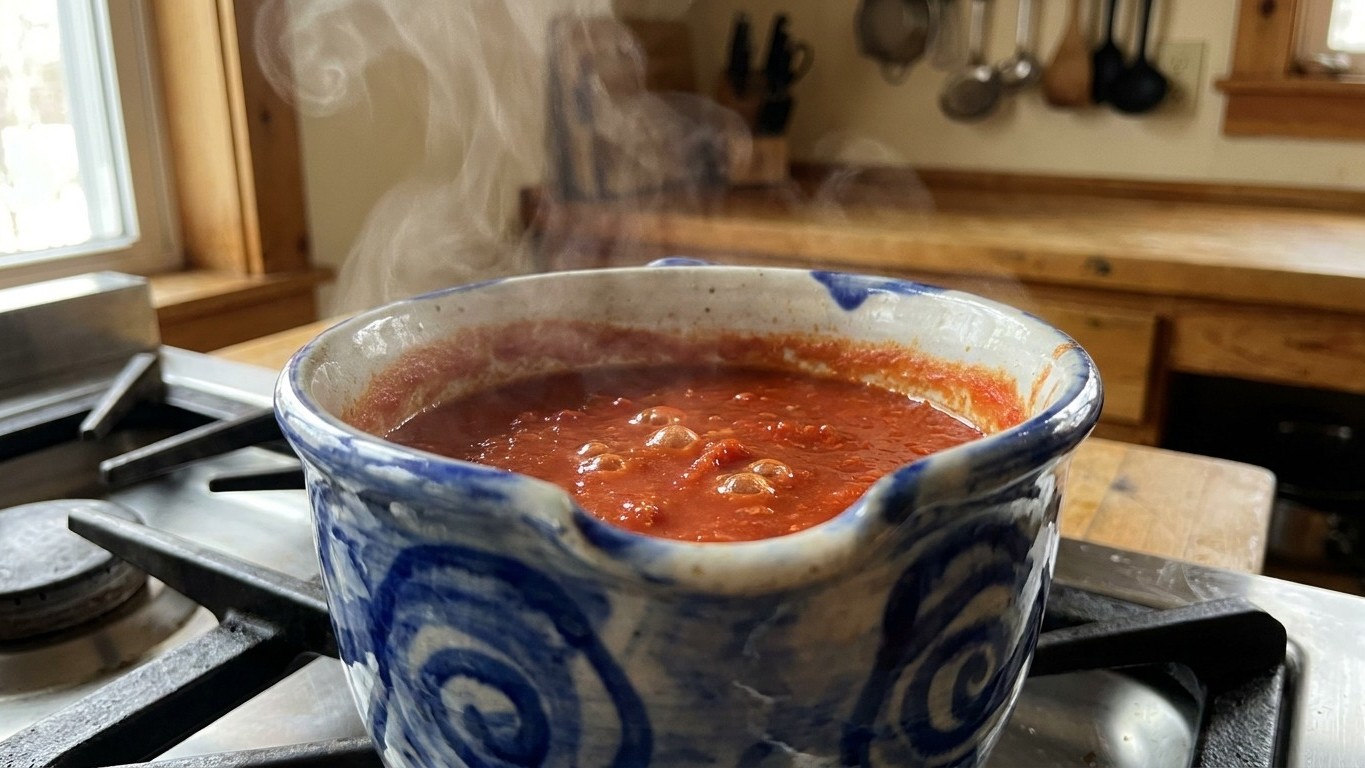
Three hours is a long time for anything to sit quietly on a stove, long enough for a sauce to reduce, for a kitchen to fill with the smell of garlic and basil, and, as it turns out, long enough for a glaze to start giving something back. The pot in question wasn’t cookware. It was one of those hand-painted ceramic pieces that live on open shelving because they’re too pretty to hide: cobalt swirls, a slightly uneven rim, the kind of object bought on vacation or inherited from a grandmother’s cupboard. Using it for a slow tomato sauce felt like a small act of rebellion against matching cookware sets. Turns out that rebellion has a chemistry lesson attached to it.
Tomato sauce is one of the most acidic things you can put in a pot, and acid is precisely what makes decorative glazes nervous. Older or improperly fired ceramic glazes often rely on lead compounds to help the glaze melt evenly and to allow a wider firing temperature range. Lead compounds, such as lead oxide, have historically been used in glaze formulations to regulate the melting properties of other glaze components and to enable the use of a broad firing temperature range in the production process. The problem shows up when the firing itself isn’t quite right. When fired at inadequate or uncontrolled temperatures, the lead is not fully incorporated into the glaze structure and is available to leach into food in quantities that may pose a health hazard to consumers. A decorative pot bought for its color, not its craftsmanship pedigree, is exactly the kind of item that may never have been tested against that standard.
Key takeaways
- Acidic foods like tomato sauce act as solvents that break down ceramic glazes and release heavy metals
- Brightly colored glazes—especially reds and yellows—historically contain lead and cadmium pigments that won’t announce themselves through taste or appearance
- The FDA has strict testing protocols, but ‘lead-free’ labels are often marketing claims without verification behind them
Acid, heat and time: the trifecta that unlocks a glaze
Food Scientists-reveal-the-one-bedroom-object-that-matters-more-than-your-phone/”>Scientists studying this exact scenario didn’t pick tomato sauce by accident. Acidic foods and beverages such as tomato sauce, fruit juices, wine, and coffee are far more likely to accelerate the leaching of heavy metals from glazes, because the acid acts as a solvent, breaking down the chemical bonds that hold these elements in place. Add duration to the equation and the risk compounds rather than plateaus. The duration of contact between the food and the material is a critical variable, and prolonged storage of food in a container increases the cumulative amount of leached chemicals. A three-hour simmer isn’t storage, technically, but it’s a sustained acid bath at heat, which is worse, not better.
There’s also a color bias worth knowing about. Brightly colored glazes, especially reds and yellows, have historically been a common source of lead and cadmium due to the pigments used. That hand-painted floral pattern, the one with the punchy red rim? It might be the most decorative part of the pot and the least reassuring, chemically speaking.
Here’s the genuinely unsettling part: none of this announces itself. Leached lead does not change the look or taste of foods but can cause lead poisoning. The sauce that simmered for three hours in that pretty pot would have tasted, by every sensory measure, completely normal. There’s no metallic tang, no cloudiness, no warning sign a home cook could reasonably catch by instinct. That’s precisely why regulators don’t rely on taste tests, and neither should anyone else.
What “food-safe” actually measures
The FDA doesn’t leave this to guesswork. Its standard test involves soaking a piece in a mild acid solution for a full day and measuring what comes out. The FDA’s test method involves a 24-hour leach with a 4% acetic acid solution, followed by a quantitative analysis of the extract, with compliance limits specified in milligrams of lead or cadmium per liter of the extract, varying by the type of product. That protocol exists because real-world data backs up the concern: a recent study on pottery sold near the US-Mexico border found acidic food cooked on glazed pottery showed a median lead concentration of 103.4 mg/kg, whereas nonacidic food cooked on glazed pottery showed a median lead concentration of 11.19 mg/kg, roughly a tenfold difference driven entirely by acidity.
The label distinction that matters most is a subtle one. Products are categorized as lead-safe rather than lead-free, because even when all materials and processes are lead- and cadmium-free, there’s always a chance for naturally occurring heavy metals to be present in trace amounts, meaning there is no such thing as 100% lead-free ceramics. “Lead-safe” is a passed test. “Lead-free” on a piece with no testing behind it is closer to a marketing flourish, and the FDA has specifically flagged this. FDA has received reports that traditional pottery from several manufacturers in Mexico labeled as “lead free” in fact contains levels of extractable lead comparable to levels found in lead glazed pottery, and in some cases in excess of FDA’s action levels.
Reading a pot before you cook in it
Regulators have a fairly consistent profile for the pieces most likely to fail. Consumers should pay particular attention to ceramicware that is handmade with a crude appearance or irregular shape, antique, damaged or excessively worn, or purchased from flea markets or street vendors where the manufacturer can’t be verified. That vacation find checks at least two of those boxes for a lot of people, which isn’t an accusation, just a statistical pattern worth respecting.
Visual cues help too, even if they’re not a substitute for testing. Glazes that are smooth and evenly applied and cover the entire food-contact surface are generally more stable than decorative patterns applied over the glaze. A raised, textured, or crackled surface, especially one where the pigment sits visibly on top of the glaze rather than fused into it, is a piece better reserved for holding fruit than for holding heat. And the fix isn’t complicated. Decorative pottery or souvenir dishes shouldn’t serve food unless they were made to serve food, and retiring dishes with a lot of cracking, chipping, or glaze wear is prudent.
The pot in this story got a second life as a fruit bowl, which is the job it was designed for all along. Home lead-test kits exist and are widely sold in hardware stores, though ceramics educators note they’re an imperfect proxy compared to the FDA’s own lab protocol, useful for a quick red flag rather than a clean bill of health. The safest habit costs nothing: reserve the beautiful, unverified pieces for serving, and let the enameled cast iron or unglazed stoneware marked explicitly for cooking handle anything that’s going to simmer for three hours with tomatoes in it.
Sources : pubmed.ncbi.nlm.nih.gov | sciencedirect.com