
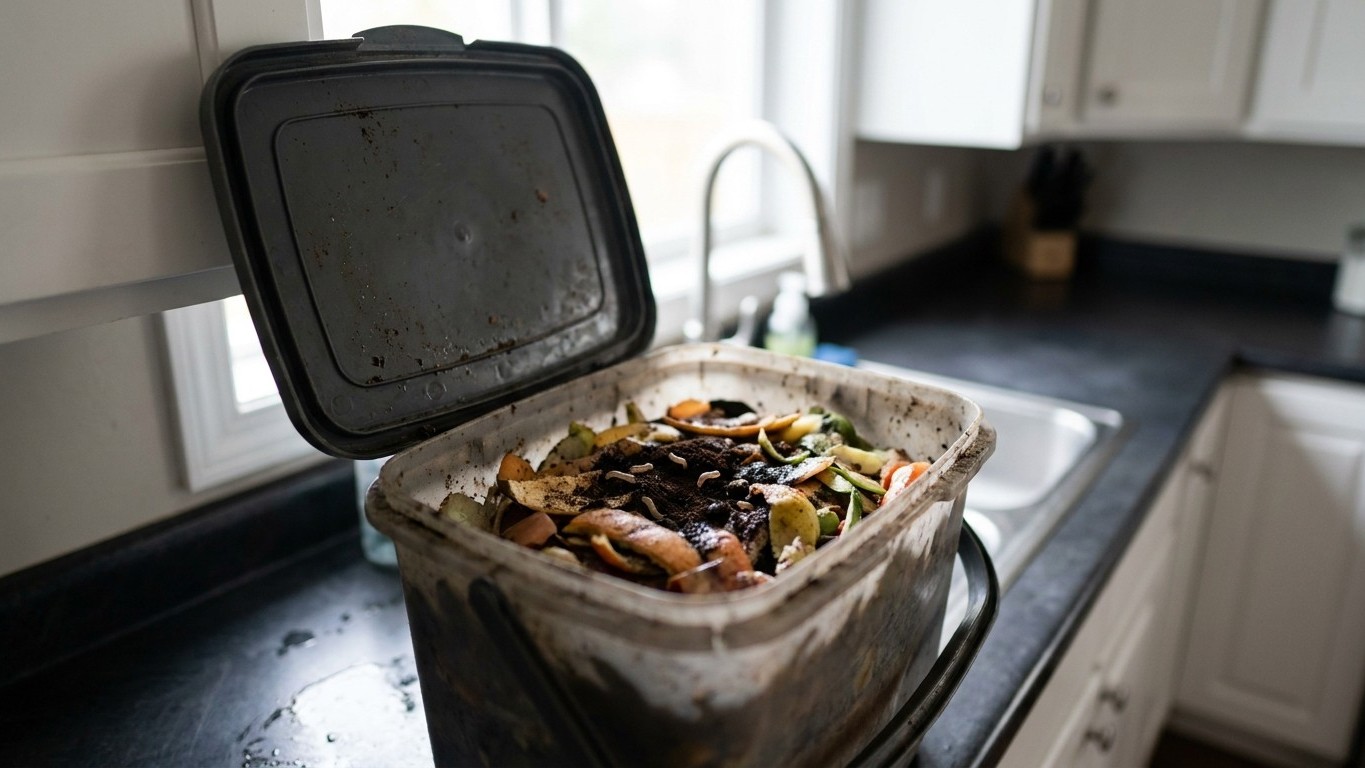
Three days. That’s how long the apple cider vinegar trap dangled over my kitchen sink before I finally admitted defeat. The jar was doing its job, technically, drowning a fly or two here and there, but the swarm kept regenerating overnight like some kind of tiny, buzzing hydra. The real culprit wasn’t hovering near the fruit bowl at all. It was sitting three feet away, lid slightly ajar, in the compost caddy I’d been dutifully filling with banana peels and coffee grounds for weeks.
Pulling that caddy out from under the counter and lifting the lid revealed the problem in full, disgusting clarity: a churning little colony, larvae included, thriving in the damp scraps I’d assumed were harmless until collection day.
Key takeaways
- A popular vinegar trap caught flies but the infestation kept growing—revealing a hidden nursery just feet away
- Female fruit flies lay 2,000 eggs that become adults in just two days on any moist surface
- The real solution had nothing to do with better bait and everything to do with daily habits and a closed lid
The vinegar trick works. It just wasn’t fixing the actual problem
Let’s give the trap its due, because the science behind it is genuinely clever. The basic trap is simple: pour about half an inch of apple cider vinegar into a small bowl or jar, then add a drop of dish soap. The soap is the critical ingredient that turns an attractant into a trap. Without it, flies land, sip, and lift right back off. Vinegar alone has enough surface tension that fruit flies can land on it, drink, and fly away. Dish soap breaks that surface tension, so when flies touch the liquid, they sink and drown instead of walking across the surface.
As for why the smell works in the first place, apple cider vinegar is the top choice for attracting fruit flies. Its fruity, slightly sweet fermentation profile is closer to what flies encounter in nature compared to plain white vinegar. Interesting side note: it’s not even the most powerful bait out there. A study at Texas A&M comparing common household baits found that actual rotting bananas attracted more flies than apple cider vinegar, followed by mushrooms. Vinegar came in third, ahead of wine, beer, simple syrup, and sugar water. The researchers noted that real decomposing fruit releases a broader mix of volatile chemicals than any single bait can replicate. Which, in retrospect, explains a lot. My trap was competing with an actual buffet a few feet away.
There’s also a placement issue nobody tells you about. A common mistake is covering the jar with holes large enough for flies to fly back out, and setting the trap somewhere other than the actual source. A trap on the far side of the kitchen competes with the smell of whatever’s rotting in the trash or fruit bowl. A single jar hanging over the sink was never going to out-compete an open-air nursery sitting a few inches below it.
What was really happening inside that caddy
Here’s the part that made my stomach turn slightly. A female fruit fly can lay up to 2,000 eggs on any moist surface, and within two days, those eggs turn to maggots and then grow into fruit flies. Two days. Not two weeks, not a leisurely seasonal cycle, two days from egg to larvae, in whatever damp, sugary residue happened to be sitting in that caddy.
The compost bin checks every box on a fruit fly’s wish list, and pest professionals confirm it’s a known blind spot in otherwise clean kitchens. If you’re the type that keeps a compost bin under the kitchen sink, consider cleaning it regularly, it’s another fruit fly hotspot. Even the entomologists at university extension programs flag it specifically: fruit flies also will breed in drains, garbage disposals, empty bottles and cans, trash containers, mops and cleaning rags. All that is needed for development is a moist film of fermenting material. A compost caddy, by design, is a moist film of fermenting material with a lid on top. It’s basically a nursery with a “do not disturb” sign.
What surprised me most wasn’t that flies had found the caddy. It’s that they’d probably arrived on the produce itself, long before I ever tossed the scraps in. Fruit flies can be a particular problem in summer and autumn because they’re attracted to ripe and rotting food, especially bananas, melon, tomatoes, squash and apples. The smell attracts adult flies, which lay their microscopic eggs in the fruit skins. The eggs might already be present in fruit that you buy or get from the garden. Which means the trap wasn’t catching new invaders so much as the great-grandchildren of flies that hitched a ride home in my grocery bag weeks earlier.
Breaking the cycle actually meant fixing the caddy, not the trap
Once I understood where the real nursery was, the fix stopped being about vinegar and started being about hygiene. Composting experts are blunt about this: if you then put the rotting fruit or peel into your food waste caddy and then into your garden composter you might be unwittingly transferring fruit fly eggs to the compost to hatch out later when the temperature is right. The lid Matters More Than I’d realized. Keep stored waste in a lidded kitchen caddy. Always keep the lid on your caddy, even between new additions of waste as you are preparing food.
I also started emptying it far more often than “when it’s full.” One composting resource put it plainly: using the bokashi composting system, we recommend that this kitchen counter container is emptied no more than once a day. This gives fruit flies plenty of time to find your pile of food scraps. Translated for anyone not running a bokashi system: daily rinsing beats weekly overflow, every time.
The vinegar jar still hangs by my sink, honestly, because it catches the stragglers that do wander in from outside or hitch a ride on a peach. But it’s no longer doing the heavy lifting. That job now belongs to a caddy that gets emptied every evening and rinsed with hot water, not the fermented bait I’d pinned all my hopes on. One thing I didn’t expect: entomologists note that a single rotting potato or onion forgotten at the back of a closet, or fruit juice spillage under a refrigerator can breed thousands of fruit flies, which means my compost caddy was probably just the most visible offender in a kitchen full of quieter suspects I still haven’t fully investigated.
Sources : bloomingexpert.com | aol.com