
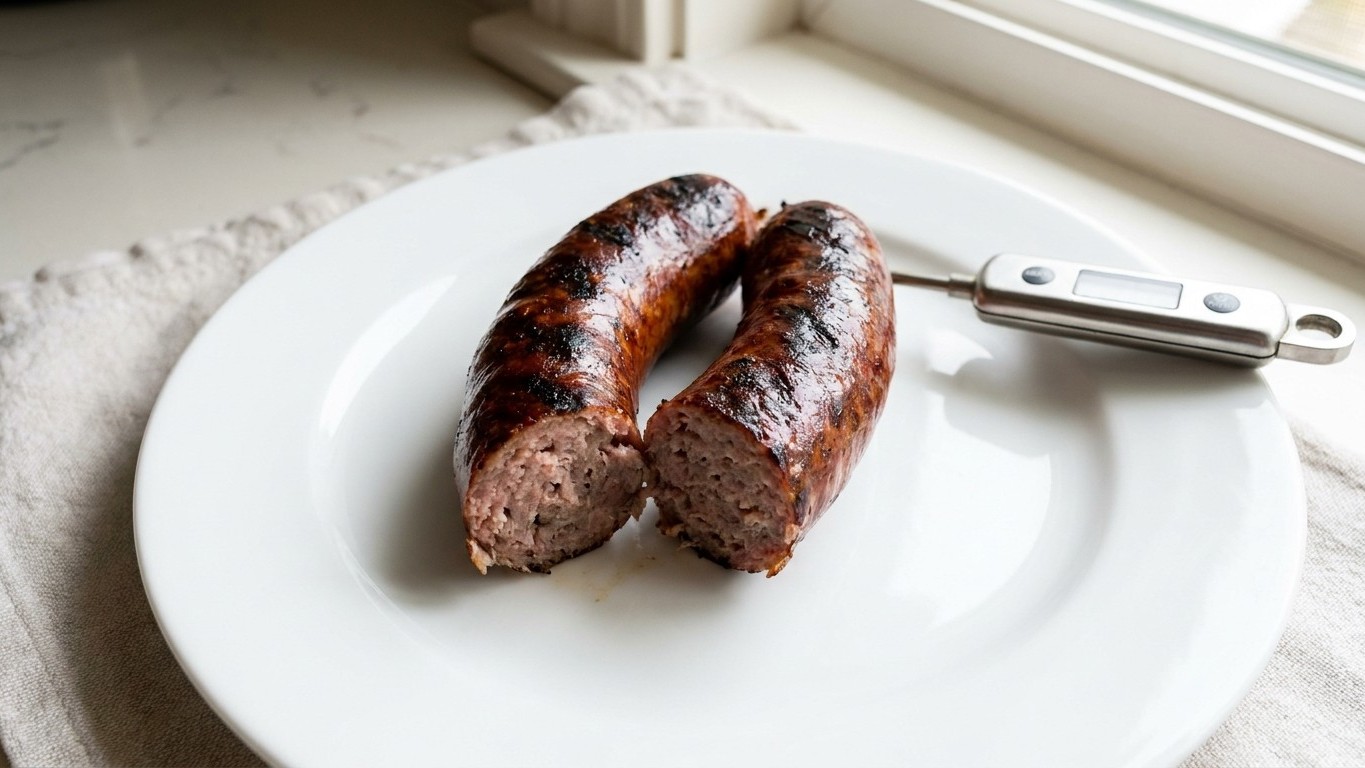
The outside looked flawless: mahogany brown, blistered casing, that faint hiss you only get when the fat starts rendering just right. Then the knife went in. Not pink, exactly, but that dull, wet, grayish-pink that no home cook wants to see pooling on a dinner plate. The center of that sausage was nowhere close to done, despite ten minutes of turning it over hot coals like a rotisserie chicken.
That moment (knife halfway through, appetite instantly gone) turns out to be one of the most common grilling disasters in America. And the reason has almost nothing to do with skill. It has to do with how heat physically moves through a stuffed, cylindrical piece of ground meat.
Key takeaways
- A perfectly charred exterior can hide dangerously undercooked meat in the center
- Color and visual cues are completely unreliable—one kitchen tool makes all the difference
- The difference between a juicy, safe sausage and a dry, overcooked one comes down to one simple adjustment
Why a Beautifully Browned Sausage Can Still Be Raw Inside
Sausages are deceptive by design. Sausages are deceiving, and many sausages appear to be completely cooked on the surface long before their insides are done. The casing chars and caramelizes fast because it’s thin and directly exposed to flame, while the dense, tightly packed interior needs far more time for heat to travel to the core.
Crank the grill too hot, and the mismatch gets worse. Direct, hot heat cooks the outside rapidly before the interior has a chance to finish, and you wind up with charred casings and inconsistent doneness. It’s the sausage equivalent of judging a cake by its frosting.
There’s a second, sneakier trap: pulling sausages straight from the fridge and tossing them on a screaming-hot grate. It’s always recommended to avoid cooking meat cold, straight from the refrigerator, letting it acclimatize instead, so it cooks more evenly inside and out without triggering thermal shock when exposed to heat. Skip that step, and you’re almost guaranteeing the outside finishes long before the middle does.
Color is the real villain here, though. Most of us were taught to trust our eyes: golden-brown crust, clear juices, done. But relying on visual cues like browning or firmness is dangerously unreliable, since pork sausages can appear fully cooked at 140°F, yet still harbor Trichinella parasites. Translation: a gorgeous exterior tells you exactly nothing about what’s happening thirty seconds of chewing away from your fork.
The Only Number That Actually Matters
Forget the “cut one open and check” method entirely, and forget the “poke it until juices run clear” trick too. Cutting open the sausage to check its status only serves to release additional juices and dries it out further, which is exactly what a food thermometer is meant to prevent. The knife-on-the-plate reveal, dramatic as it is, isn’t even a reliable safety test.
The U.S. Department of Agriculture recommends that all sausages be cooked to a minimum internal Temperature of 160°F (71°C). For poultry-based sausages, that threshold climbs even higher, since USDA mandates 160°F internal temperature for raw pork or beef sausages and 165°F for poultry sausages to destroy harmful pathogens. Those aren’t suggestions from a cautious food blogger. They’re the numbers that determine whether Trichinella and E. coli actually die, and neither pathogen cares how nice your grill marks look.
Technique matters almost as much as the number itself. Insert the thermometer into the thickest part of the sausage, avoiding contact with bone or the grill, to measure the temperature accurately. Going in sideways through the end, rather than stabbing straight down through the center of a link, tends to give a truer reading without turning the sausage into a sieve.
One more detail most grillers never think about: the temperature keeps climbing even after the sausage leaves the heat. Resting time after cooking adds five to ten degrees of carryover heat, which matters for reaching final safety margins without overcooking. Pull sausages at 155°F expecting them to coast up to a safe zone, and, well, that’s roughly how my raw-centered dinner started.
Fixing the Habit, Not Just the Sausage
The fastest fix, honestly, is the least exciting one: lower heat, more patience. Even when grilling, start out on low, indirect heat and get sausages cooked through before adding on a little extra flame-grilled color. Reverse the sequence people usually follow (sear first, hope for the best) and let the interior catch up before chasing char marks.
Medium heat, somewhere in the 350°F to 400°F range on the grate itself, tends to strike the right balance. The ideal grilling temperature for sausages is medium heat, typically around 350°F to 400°F, which allows them to cook evenly without burning the exterior, renders out the fat for a juicy result, and helps prevent flare-ups that cause charring. Anything hotter and you’re essentially racing the clock against the casing.
Skip the pricking, too, tempting as it is when a link starts to bulge ominously. Piercing the casing releases the fat and juices inside the sausage, which are important to flavor, and once those juices are gone, the sausage is no longer moist and flavorful. If the casing keeps splitting anyway, the heat is too aggressive, not the sausage’s fault.
Not every sausage plays by the same rules, either. Pre-cooked links like most hot dogs and knackwurst are already safe once they’re heated through, so a quick pass over the coals is really just about building color and snap in the casing rather than eliminating raw meat. Fresh sausage, the kind that’s still soft and pale before it hits the grill, is a different animal entirely, and it’s the one that demands the thermometer, the patience, and the resistance to slice it open just to peek. The peeking, it turns out, was never the answer.
Sources : spice.alibaba.com | thetakeout.com