
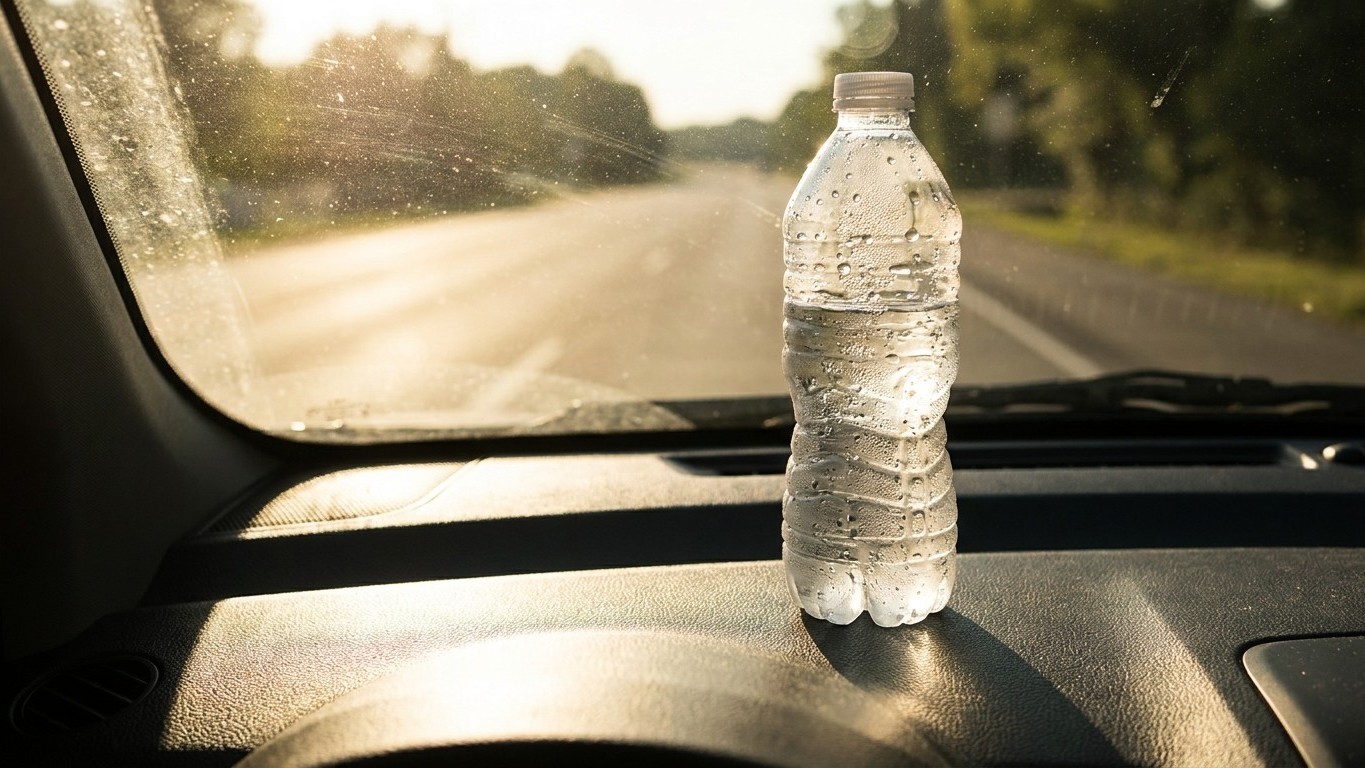
That whiff test everyone swears by, cracking the cap and sniffing before taking a sip, catches exactly nothing useful. The compounds that matter here don’t smell like anything at all. Some researchers who study plastics recommend against drinking water from plastic bottles that have been sitting in hot places for a long time, such as a car sizzling in the sun, concerned that the heat could help chemicals from the plastic leach into the water. Antimony and BPA, the two chemicals most consistently found in these studies, are odorless. Your nose is checking for bacterial funk. Meanwhile the actual risk is dissolving invisibly into the water you’re about to drink.
Key takeaways
- Heat causes plastic molecules to ‘jiggle’ faster, releasing hidden chemicals into water at alarming rates—but there’s no smell to warn you
- Lab tests show antimony levels can spike from single digits to over 2,600 ng/L when bottles go from cool to car-dashboard temperatures
- That viral warning about dioxin and cancer? Completely false—but the real antimony risk is far more subtle and harder to detect than the internet claims
What’s really happening inside that overheated bottle
Most of the water bottles you find on supermarket shelves are made of a plastic called polyethylene terephthalate, or PET, recognizable by the recycling number one and accepted by most curbside recycling programs. Antimony trioxide is baked into the manufacturing process itself, used as a catalyst to build the polymer chains that give PET its strength. The amount of antimony used in PET preparation ranges from 100 to 300 mg/Kg, so a 1-litre bottle can contain 3-9 mg of antimony. Under normal conditions, almost none of it moves. Heat changes the physics entirely.
Biochemistry professor Cheryl Watson put it in terms that stick: when you heat things up, the molecules jiggle around faster and that makes them escape from one phase into another, so the plastic leaches its component chemicals out into the water much faster and more with heat applied to it. She compares it to steeping tea. It’s kind of like when you put mint leaves in your tea, the heat extracts the mint-tasting molecules and it happens faster in hot tea than it does in cold tea. The unsettling part is that antimony and BPA migration follows the same logic, just without the flavor cue to warn you.
The numbers behind the panic (and where the panic overreaches)
Laboratory data on this is not thin. A Chinese study that stored sixteen brands of bottled water found that after 1-week storage, Sb release increased from 1.88–8.32 ng/L at 4 °C, to 2.10–18.4 ng/L at 25 °C and to 20.3–2604 ng/L at 70 °C. That’s not a modest bump. That’s a jump of two to three orders of magnitude between fridge temperature and a dashboard in July. A separate review of PET beverage research reached a similar conclusion, noting that storing PET bottled drinks at elevated temperatures, i.e., in a hot car or in summer, can cause antimony migration to exceed the limits allowed in the EU or USA.
And your car gets there faster than most people assume. On an 80 degree day, a parked car can reach 110 degrees in less than thirty minutes. National Geographic’s reporting on the topic notes that a hot car can reach temperatures over 150 degrees Fahrenheit in the summer. Under sustained lab conditions matching that heat, it took 38 days for water bottles heated to that temperature in a lab to show levels of antimony that exceeded safety recommendations. So a single sweltering commute won’t push you over any regulatory line. A forgotten case of water bottles baking in a garage all summer is a different story.
Here’s where I’ll push back on the internet’s favorite version of this scare, though. The viral claim that hot cars release dioxin, the industrial carcinogen linked to breast cancer in a widely shared Facebook post, is simply false. Dioxins are not found in plastic, nor do plastic water bottles left in hot cars release dioxin, experts say, and dioxins are a group of toxic chemical compounds that share certain chemical structures and biological characteristics, according to the Environmental Protection Agency. The real story is less cinematic than a cancer-causing bottle, but it’s grounded in actual chemistry rather than a misattributed talk-show anecdote.
BPA-free doesn’t mean risk-free
The instinct to reach for a bottle stamped “BPA-free” makes sense, except that stamp is doing less work than people assume. Toxin expert Dr. Paul Savage, chief medical officer at MDLifespan, has flagged that even BPA-free bottles may not be a safer alternative, since many of these products use chemical substitutes that are structurally similar to BPA and may have similar endocrine-disrupting effects. Those substitutes, he adds, haven’t been studied extensively, leaving scientists cautious. Regulators haven’t ignored antimony either. Studies on the subject have confirmed that PET is the origin of antimony presence in bottled waters, that antimony concentrations are usually below regulated values, and that temperature increasing favours antimony leaching. The mechanism is settled science. The magnitude of harm from occasional exposure remains the genuinely debated part, and honestly, that nuance rarely survives the trip to social media.
What to actually do about the bottle in your cupholder
None of this means panicking over the water bottle rolling around your back seat right now. It means changing two or three small habits. Keep bottled water out of direct sun and out of a car that’s been parked for hours, since glass is better than plastic wherever possible, and otherwise the message should be to keep the water bottle in a bag or covered when not in use and not to leave plastic bottles in a hot car as temperatures rise fast. If a bottle has clearly been baking for days, not hours, toss it rather than drink it. And skip the sniff test as your safety check. If you’ve ever left a plastic water bottle in a hot car for a while, you may notice the water tastes a little funny, and that’s everybody’s bottom-line sensing mechanism, you can even taste it. A funny taste is your body noticing something real. The absence of one just means the chemistry moving into your water hasn’t crossed your taste threshold yet, not that it isn’t there.
Sources : ncbi.nlm.nih.gov | plasticpollutioncoalition.org