
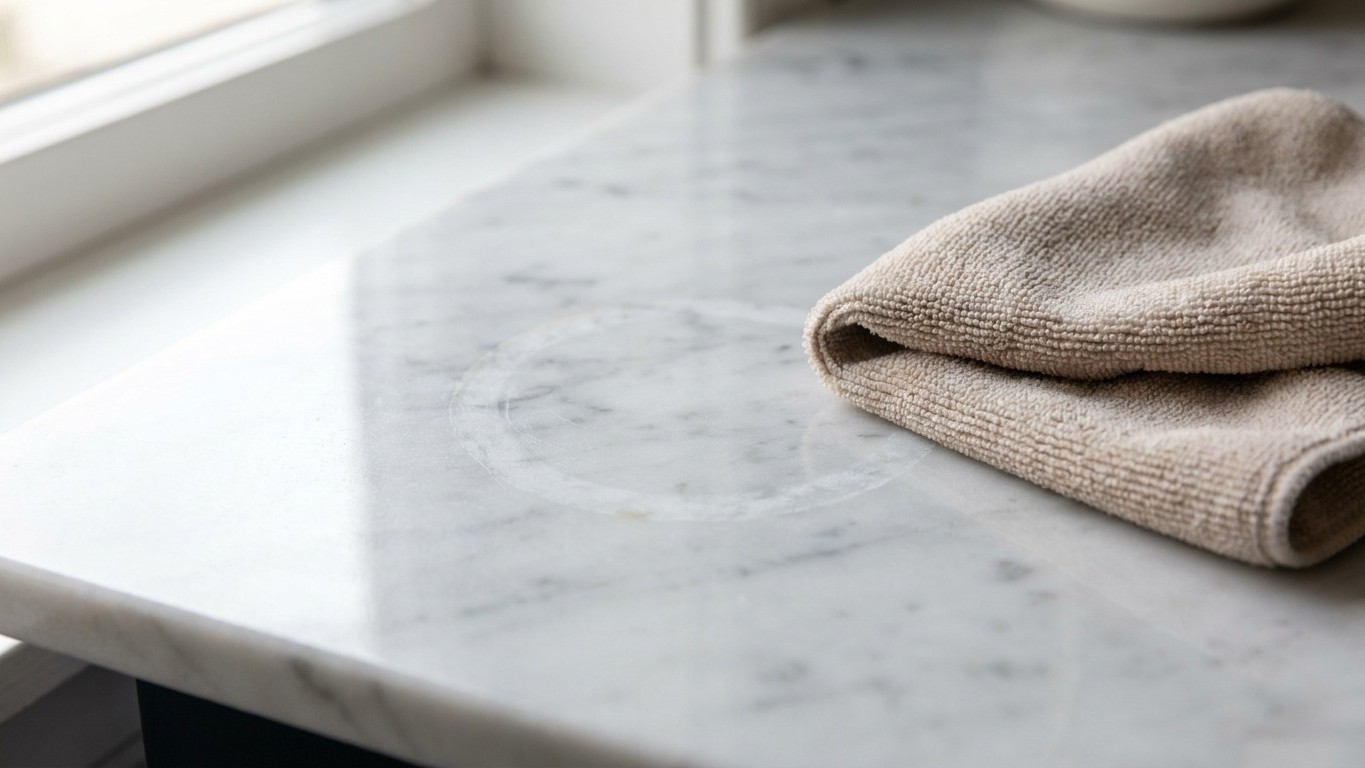
Three weeks. That’s how long it took for a spotless, streak-free marble counter to start looking worse than before the daily vinegar ritual began. Not dirty, exactly. Hazy. Faded in odd, circular patches, like the stone had been breathed on and never quite recovered its shine. The instinct was to clean harder. Wrong instinct entirely.
What looked like stubborn grime, or leftover soap film, was actually the opposite of dirt. It was damage. And the tool used to fight it every single morning, a splash of white vinegar on a cloth, was the exact thing causing it.
Key takeaways
- A common household cleaner is chemically dissolving your marble surface without leaving visible traces until it’s too late
- The cloudy, dull rings you’re seeing aren’t stains—they’re a type of damage that regular cleaning will never fix
- There’s a crucial difference between two problems that look identical but require completely opposite solutions
The chemistry nobody mentions on cleaning hacks
Marble is not glass, and it’s not plastic. It’s calcium carbonate, compressed over millions of years into something that looks indestructible but behaves, chemically, a lot like chalk or limestone. Marble is calcium carbonate, the same material as limestone and chalk, and acetic acid eats it through a chemical reaction that releases carbon dioxide and dissolves the stone surface. White vinegar isn’t a harsh industrial acid, but it doesn’t need to be. White vinegar contains 4 to 7 percent acetic acid, a weak acid by laboratory standards but strong enough to react with calcium carbonate.
That’s the part that trips people up. Vinegar feels gentle, natural, grandmother-approved. It cuts grease, deodorizes, disinfects a little. On tile, on glass, on stainless steel, it’s genuinely useful. On marble, it’s corrosive. When the acid hits the stone, it strips away the polished surface layer and leaves a microscopically rough texture that scatters light instead of reflecting it. That’s the technical explanation for why a once-glossy counter starts looking like it’s permanently fogged over, no matter how much elbow grease goes into buffing it.
The speed of it is honestly a little alarming. Marble etching occurs when acidic substances chemically react with calcium carbonate in the stone, dissolving the surface layer. This damage can begin within 30 seconds of acid contact and becomes visible within minutes. So a “morning shine wipe” isn’t a maintenance routine at all. It’s a slow, repeated acid bath, applied with the best of intentions, once a day for weeks.
Etching, not staining: the distinction that changes everything
Here’s where most home remedies go sideways. A stain and an etch look similar at first glance, but they’re not the same problem, and they definitely don’t respond to the same fixes. Etch marks are dull or lighter-colored spots that appear when acidic substances come into contact with marble. Unlike stains, which soak into the stone, etching is surface damage caused by a chemical reaction with the calcium carbonate found in natural marble.
A stain sits in the pores of the stone, and scrubbing (eventually) helps. An etch has physically altered the surface itself. The spot feels smooth. The surface has lost its shine. No amount of wiping, polishing spray, or elbow grease restores that reflective quality, because there’s nothing sitting on top to remove. The marble itself has been eaten away, microscopically, but permanently until it’s mechanically repaired.
This is exactly why those “dull rings” from the vinegar routine didn’t budge with more cleaning. The acid in vinegar reacts with calcium carbonate in marble, travertine, limestone, and concrete, causing etching and dullness. Etching can appear as rings, spots, or faded patches, especially after regular mopping with vinegar. Every wipe was technically a fresh, tiny dose of the same reaction that created the problem in the first place. Franchement, it’s the kind of cleaning “hack” that sounds harmless enough to go viral, and does real damage before anyone notices.
What actually undoes the damage (and what doesn’t)
The frustrating part is that etching isn’t always a lost cause, but fixing it looks nothing like cleaning. An etch mark is caused by acids in foods and drinks and by harsh cleaners, and when the acidic liquid or substance comes in contact with marble the acid rapidly reacts with the marble creating a dull or light-colored chalky spot. For light surface etching, a calcium-carbonate polishing powder, worked into the spot with a damp cloth, can mechanically re-flatten the disrupted crystal structure and bring back some shine. Marble polishing powder contains fine abrasives and sometimes a mild acid that works to chemically and physically re-polish the surface, designed to abrade away the etched layer and restore the reflective quality of the stone.
For deeper or widespread damage, that DIY fix hits its limit fast. Etching is repaired through diamond honing, physically removing the damaged surface layer to expose fresh marble below. That’s a Professional job, not a weekend project, and it’s worth knowing before reaching for another bottle of anything acidic “just to be safe.”
The better move going forward has nothing to do with vinegar at all. Clean only with pH-neutral stone cleaners, and avoid acidic or bleach-based household cleaners. Warm water, a few drops of dish soap, and a soft microfiber cloth handle daily grime just fine without touching the calcium carbonate at all. Spills, especially from citrus, wine, coffee, or tomato-based sauces, deserve immediate attention rather than a leisurely cleanup, since damage can begin within minutes, and even brief exposure to vinegar may dull polished marble surfaces.
Sealing helps against staining but does something people often misunderstand: it doesn’t stop etching. A sealer does not prevent etching. A penetrating sealer helps protect marble from absorbing liquids and staining, but it does not stop acidic substances from reacting with the stone. The only real protection against those cloudy morning-after rings is keeping acids off the surface entirely, coasters under glasses, cutting boards under lemons, and, yes, retiring the vinegar spray bottle to the tile floor where it actually belongs.
Sources : marblelife.com | roserestoration.com