
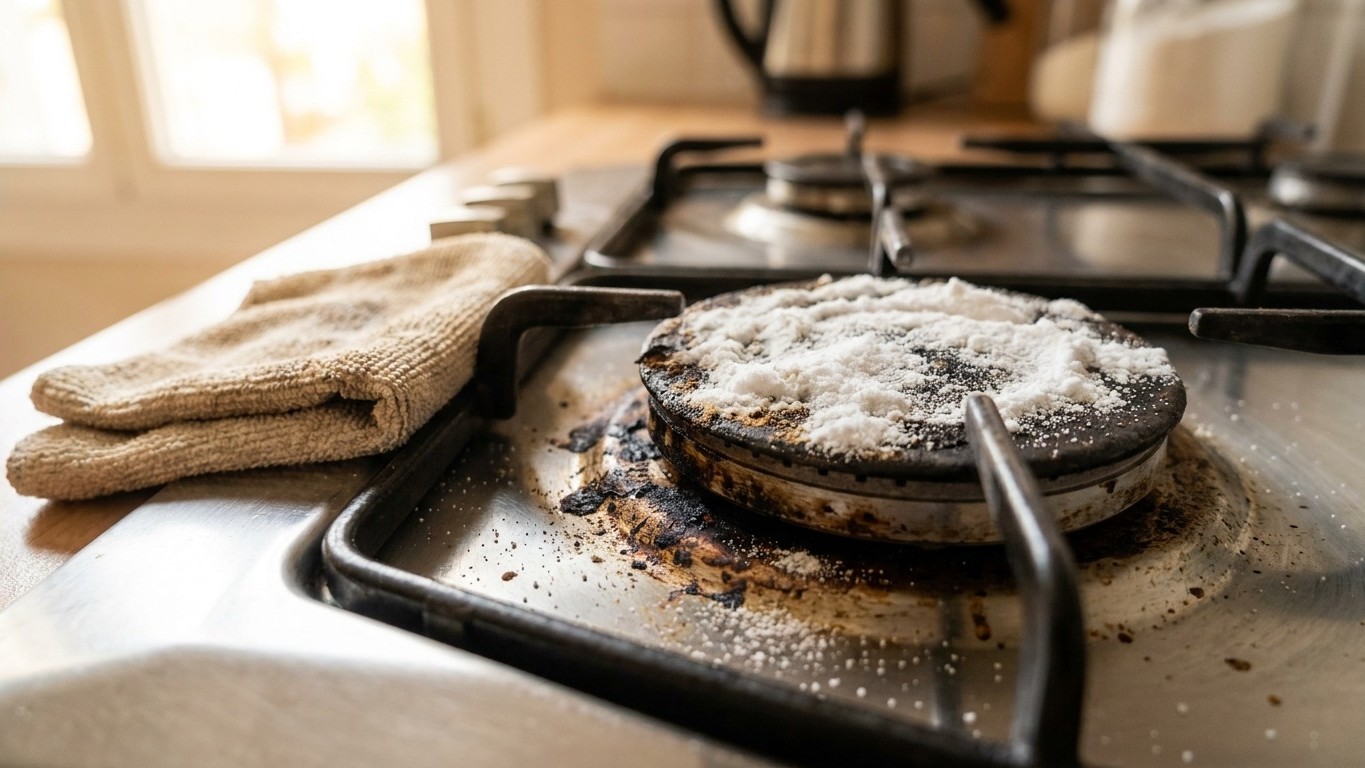
The ritual was almost meditative: sprinkle the bicarbonate over the scorched ring on the hob, drown it in white vinegar, watch the foam rise and hiss like a tiny kitchen volcano. Every week, same gesture, same satisfaction. Then one day, out of laziness or curiosity, no vinegar. Just the powder, a wet sponge, and elbow grease. The burnt residue lifted anyway, faster, even. That’s when the real question surfaced: what had the fizz actually been doing all along?
Key takeaways
- The fizzy reaction between vinegar and baking soda creates a satisfying visual that feels productive but actually accomplishes almost nothing
- Over 99% of the baking soda never reacts—it’s the leftover powder, not the bubbles, doing all the real work
- When vinegar neutralizes baking soda’s alkalinity, you’re left with salt water that can’t dissolve grease or burnt sugars
The Foam Is a Show, Not a Cleaning Agent
Here’s the uncomfortable truth chemists have been trying to explain for years. The bubbling reaction between baking soda and vinegar is, according to researchers writing for The Conversation, the chemistry behind the bubbly reaction doesn’t support the cleaning hype, since the fizzy action is essentially a visual “placebo,” formed by the combination of an acid and a base. Sodium bicarbonate is a mild base, vinegar a mild acid, and when they meet they don’t team up. They cancel each other out.
Mixing vinegar and baking soda causes an immediate chemical reaction that forms water, sodium acetate (a salt) and carbon dioxide, the fizzy part. That gas escaping is what makes the mixture look so satisfyingly alive on a greasy stovetop. But gas bubbles rising through a puddle of liquid don’t scrub anything. They just look like they might.
There’s a nuance worth savoring here, though, and it explains why the ritual felt productive for months. A typical recipe calling for one and a half cups of baking soda and one quarter cup of vinegar means that after the fizz subsides, over 99% of the added baking soda remains. the foam was theater, but the leftover powder underneath, the part that never reacted, was the actual worker. The vinegar was mostly a spectator sport poured on top of the real cleaner.
What the Vinegar Was Actually Erasing
This is the part that reframes the whole habit. Far from boosting the baking soda, the vinegar was quietly weakening it. Chemists describe the leftover liquid after the reaction as close to useless: while the rapid release of gas creates a scrubbing action that can physically dislodge loose debris, the resulting solution has a near-neutral pH, meaning it lacks the potency of the original acidic vinegar or the abrasive alkalinity of pure baking soda.
That alkalinity is precisely what dissolves grease and breaks down burnt sugars and proteins on a hob. Neutralize it with acid, and you’re left with salt water. Some researchers have gone looking for a silver lining, wondering if the byproduct itself might secretly clean. It doesn’t. The product of the fizzy reaction, sodium acetate, is an even weaker base than baking soda, so it doesn’t do the job any better. Franchement, it’s the kind of finding that should retire an entire genre of cleaning folklore — the reaction people trust most is the one doing the least.
There’s also a structural reason the abrasive powder works so well alone on baked-on grime. Baking soda’s crystals are mildly abrasive at a microscopic level, gentle enough not to scratch glass or enamel but rough enough to physically break the bond between burnt residue and the surface. Wet it into a paste, let it sit, and it softens the crust chemically while its texture does the scrubbing mechanically. Drown that same paste in vinegar and you’ve dissolved its structure into a puddle before it ever got the chance to work.
The Method That Actually Clears a Burnt Hob
The fix isn’t complicated, and it doesn’t require abandoning either ingredient — just using them at the right moment instead of at the same one. A thick paste of baking soda and a little warm water, spread generously over the scorched area and left to sit for fifteen to twenty minutes, gives the alkalinity time to soften burnt sugars before any scrubbing begins. Cleaning experts consistently recommend this exact sequence for stovetops: mix baking soda and warm water into a paste, apply it to the burnt residue, and let sit for 15-20 minutes before scrubbing gently with a non-abrasive cloth.
Vinegar still has its place, just not as a co-star in the same puddle. Used separately, on mineral deposits or hard water spots, its acidity does real work: soak a paper towel in white vinegar and drape it over faucets or tile grout, and leave it for 30 minutes to allow the acid to break down the minerals. On a burnt hob, though, the sequence that matters is patience first, then pressure — paste, wait, scrub. The wait is doing more than the vinegar ever did.
There’s a small safety note too, easy to overlook when the fizz feels harmless. Don’t mix them in a spray bottle, as the pressure build-up can cause the container to burst or leak, and the gas released in a confined, poorly ventilated space can be irritating if the reaction is large enough. Nothing dramatic, but one more reason to let the powder work solo rather than turning the counter into a science-fair display every Sunday.
The strangest part of giving up the fizz is how quiet the kitchen feels without it. No hiss, no bubbling crown of foam climbing over the burner rings, just a paste sitting there, doing something slower and less photogenic. Turns out the most effective cleaning moment on that hob was never the one that looked the most alive.
Sources : chefsresource.com | lifetips.alibaba.com