
Two hours. That’s the exact window between a smart Sunday meal-prep habit and a plate that could put you in the bathroom for a day, or worse. I found this out the hard way, not from a stomachache, but from a rabbit hole of food safety pages I stumbled into after a friend casually mentioned “fried rice syndrome” over brunch.
For months, my Sunday ritual looked simple: cook a big batch of rice, spread it across the counter to cool while I tackled the rest of my meal prep, then bag it up for the week once everything was tidy. Efficient, I thought. Turns out that pot sitting on the worktop wasn’t just cooling. It was quietly becoming a breeding ground.
Key takeaways
- Your Sunday rice-cooling habit sits perfectly in the ‘danger zone’ where bacteria thrives
- One bacterium survives cooking, thrives on rice, and produces toxins that reheating won’t destroy
- The fix takes three extra minutes and completely changes how to batch-cook safely
The Bacterium That Survives Its Own Execution
Here’s the part that stopped me mid-scroll: cooking rice doesn’t actually kill everything inside it. Uncooked rice often contains the bacteria Bacillus cereus, and these bacteria can form protective spores that survive the cooking process, so if the rice is cooled slowly, these bacteria spores can germinate, grow and produce a toxin that causes vomiting. A survival mechanism dressed up as an inconvenience for the rest of us.
What makes this bacterium particularly sneaky is that reheating won’t save you once the damage is done. Unlike common foodborne bacteria like Salmonella and E. coli, cooking or reheating your food won’t protect you from a Bacillus cereus infection because the toxins are heat-resistant and the spores can also survive cooking or digestion and can afterward begin growing on food or in your intestines. Microwave it, fry it, boil it again. The toxin doesn’t care.
And rice isn’t a marginal case here. A review of Bacillus cereus food safety risk found that rice was associated with 43 documented foodborne incidents, more than any other single food type for cereulide-producing strains. Pasta shows up too, but rice takes the crown. My weekly worktop ritual, it turns out, was a textbook setup.
Why My “Efficient” Sunday Was Actually a Countdown
The nickname is almost too playful for what’s actually happening. Fried rice syndrome is food poisoning caused by a bacterium known as Bacillus cereus, a microscopic germ that likes to live on starchy foods like rice and pasta. One expert put it plainly: the whole sequence of “cooking rice, leaving it out and then reheating it creates a perfect environment for this germ.” That’s a description of exactly what I was doing, minus the reheating part, which just delayed the reckoning to Tuesday’s lunch.
Rice also has a structural disadvantage that I never considered. As one food safety specialist explained, its physical form works against it: “Rice is a bunch of tiny pieces, so it has more surface area than something like a steak,” which means “more places for germs to hide.” A steak left out is risky. A pile of loose grains, spread across a counter to cool faster, is practically an invitation.
The official guidance is consistent across every health authority I checked, and it’s stricter than I assumed. The USDA’s food safety standard for cooling cooked foods is to get from 140°F to 70°F within 2 hours, then from 70°F to 40°F within the next 4 hours. Left entirely on a counter at room temperature, rice never gets that structured cooldown. It just sits in what food safety experts call the danger zone. This means you should keep cooked rice hot, above 140 degrees F, until served and cool any leftovers rapidly to 40 degrees F or below.
What really got my attention was how symptoms can announce themselves. Emetic syndrome is characterized by nausea and vomiting, occurring within 1–6 hours of consuming contaminated food. Fast, and fairly convincing evidence in hindsight that a case of “I think I just have a bug” was actually a Tuesday lunch mistake made the previous Sunday.
Fixing the Ritual Without Losing the Time-Saving Part
The frustrating irony is that batch cooking rice is still a genuinely smart habit. The problem was never the batch, it was the cooling method. Food safety specialists are unanimous on the fix, and it’s less fussy than I expected.
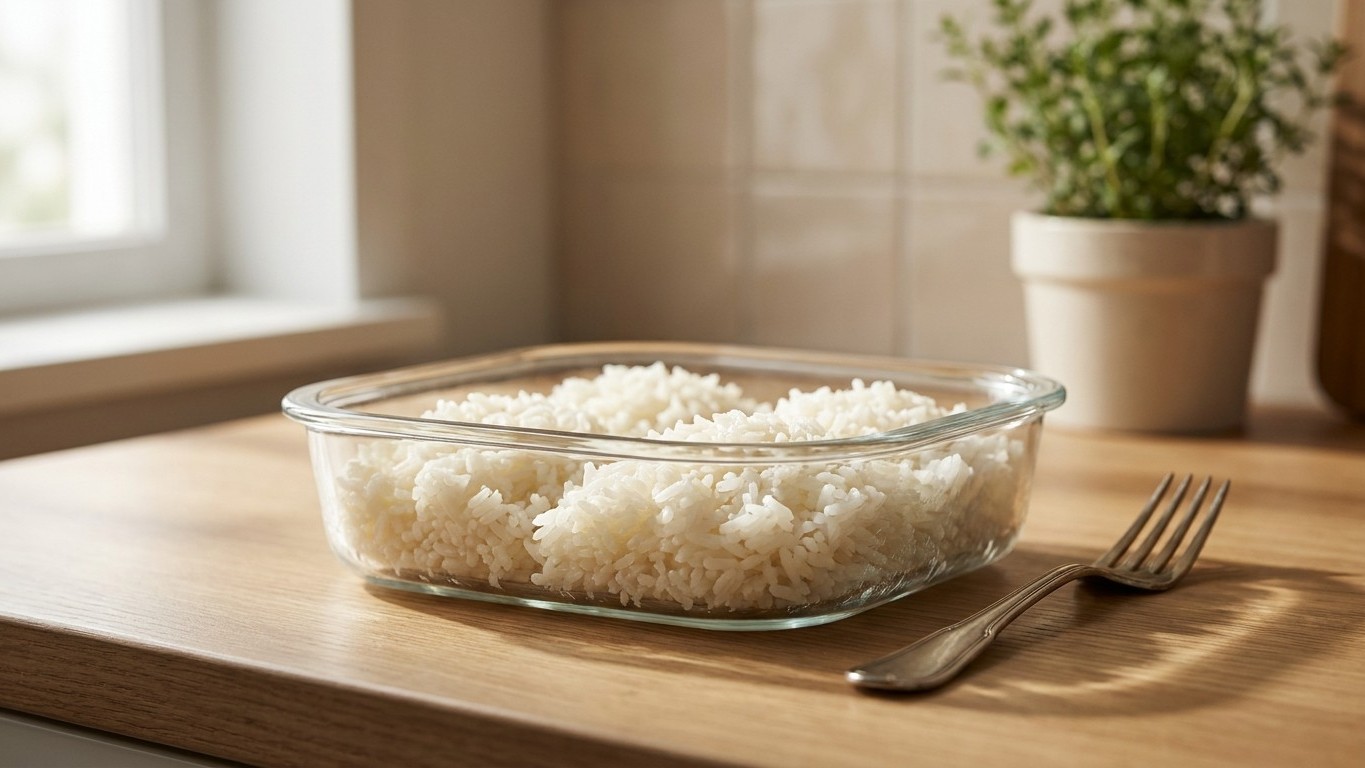
Cool cooked rice quickly by spreading it thin or putting it in shallow containers, refrigerate within one hour of cooking, and reheat once to 165°F and eat. Shallow containers, not one deep pot. That single change accelerates cooling dramatically, since heat escapes faster from a thin layer than from a dense mound sitting in its own steam.
One nutrition specialist offered a practical detail I now follow religiously: “People either leave rice out on the counter for too long, or they don’t break it into smaller pieces to cool it down quickly in the refrigerator.” Breaking up the rice with a fork before it goes into the fridge, rather than leaving it in one dense clump, Matters More Than I would have guessed.
There’s also a storage ceiling worth knowing. Health authorities generally recommend eating refrigerated rice within about five days, and reheating it only once, bringing it to a full internal temperature of 165 degrees F, using a food thermometer to be sure. A rice cooker left on “warm” for hours doesn’t count as safe storage either, no matter how convenient the button looks.
My new Sunday routine takes maybe three extra minutes: divide the rice into shallow glass containers the second it’s done, let it steam off for ten minutes uncovered, then straight into the fridge. No more counter, no more guessing how long it’s been sitting there while I chop vegetables. The batch-cooking habit survived. It just got a little less improvised, and a lot less risky.
Sources : 123foodscience.com | ingredicheck.app