
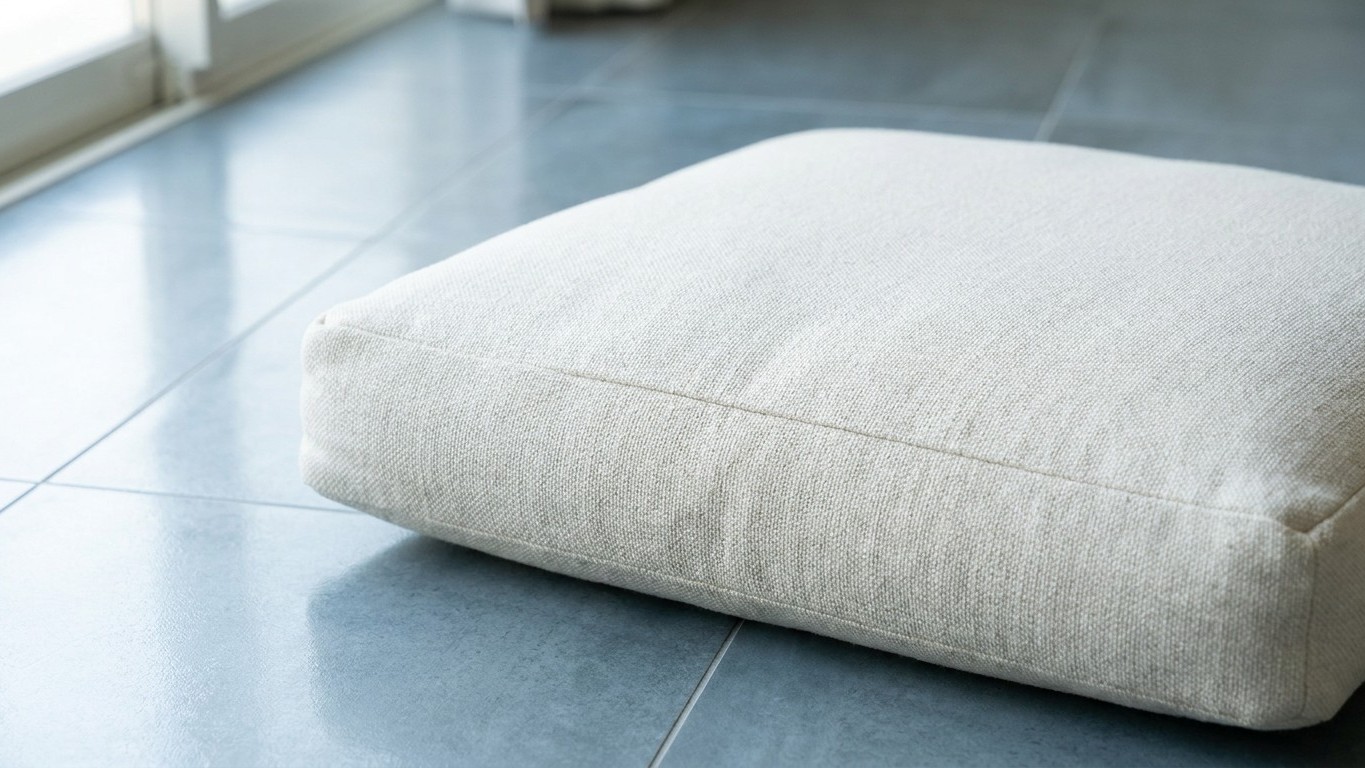
Floor cushions have quietly become one of the defining pieces of the low-seating movement sweeping American living rooms, part of that Japandi wave that treats a sofa as optional. But underneath the aesthetic appeal sits a problem nobody puts on a moodboard: what happens when foam meets tile, day after day, month after month, with zero airflow in between.
The mechanism is almost embarrassingly simple. Tile floors, especially over concrete slabs, run cooler than the air around them. Any foam cushion sitting flush against that surface traps the humidity your body releases, the condensation that forms overnight, and whatever ambient moisture is already in the room. A related phenomenon happens with mattresses placed directly on tile or concrete: when warm, humid air hits your cooler floor surface, especially concrete or tile, condensation forms underneath your mattress where it can’t evaporate. Swap “mattress” for “floor cushion” and the physics hold exactly the same.
What makes this particularly sneaky is the absence of any warning sign. You’d expect a damp cushion to smell, right? Not necessarily. Foam’s dense structure creates millions of tiny pockets where mold spores thrive undisturbed, and the problem intensifies in bedrooms with poor ventilation or high humidity levels. The mold sets up shop deep inside the cellular structure, not on a visible surface where your nose would catch it first.
Key takeaways
- Tile floors trap moisture underneath foam cushions where mold thrives invisibly—with zero warning odor
- Standard indoor foam was never designed for direct ground contact and locks moisture inside indefinitely
- A simple air gap, the right foam type, and humidity control turn the aesthetic back into something actually safe
Why standard foam is the wrong material for the job
Here’s the counterintuitive part: the denser and “higher quality” a foam feels under your hand, the worse it often performs on a cold floor. Standard, closed-cell type foams simply don’t let water pass through and out. Outdoor furniture specialists have documented the exact same failure mode with patio cushions left on stone or concrete patios. Mold and mildew are living fungi that thrive in damp, warm, and poorly ventilated environments, which perfectly describes what happens to traditional cushion foam when it is exposed to rain, morning dew, spilled drinks, or even high humidity levels, and once moisture seeps inside standard foam, it tends to stay trapped for days, creating a dark and wet environment that allows spores to multiply quickly.
Industry sourcing for outdoor cushions has actually moved on from this problem, and it’s worth understanding why, because the same logic applies indoors. Mold and mildew resistant foam, sometimes referred to as quick-dry foam or reticulated foam, features an open-cell design that allows both water and air to flow freely through it, so when cushions are exposed to rain or splashes, the water doesn’t stay trapped inside, but instead drains out quickly, while air circulation helps the foam dry in a fraction of the time. Standard indoor foam, by contrast, was never engineered with that airflow in mind. It was built for a sofa frame with legs, sitting well above a floor, not for direct ground contact on ceramic or porcelain tile.
The comparison with carpet padding on concrete is instructive too. Flooring specialists warn that carpet underlay behaves almost identically to cushion foam once it’s sandwiched against a hard, moisture-wicking surface. Never install carpet padding directly on concrete without a vapor barrier, as moisture from the concrete will inevitably seep into the padding. A floor cushion, minus the vapor barrier, minus the carpet on top acting as a partial buffer, is more exposed, not less.
The health stakes are real, even if the smell isn’t there to tip you off
This isn’t just a housekeeping annoyance. The Environmental Protection Agency is blunt about what chronic indoor mold exposure can trigger. Allergic reactions to mold are common and can be immediate or delayed; molds can also cause asthma attacks in people with asthma who are allergic to mold, and mold exposure can irritate the eyes, skin, nose, throat, and lungs of both mold-allergic and non-allergic people. For a household with young kids doing floor time on cushions daily, or anyone with a respiratory condition, that’s not a small detail.
The agency’s core prevention principle is disarmingly simple, and it’s the one rule that actually solves the floor-cushion problem: mold spores will not grow if moisture is not present, and indoor mold growth can and should be prevented or controlled by controlling moisture indoors. Speed matters too. Dry the area quickly, within 24-48 hours if possible. A cushion permanently pressed against tile never gets that 24-to-48-hour window at all. It’s in a state of perpetual, low-grade dampness that never fully resolves, which is precisely the scenario mold biology loves most.
What actually fixes it, without abandoning the low-seating look
The good news: you don’t need to give up the aesthetic, just the direct floor contact. A thin platform, a woven mat, or a low wooden base underneath the cushion creates the air gap that lets moisture escape instead of pooling. Outdoor furniture guides recommend the same principle for patio seating, and it translates indoors just as well: elevate cushions off solid surfaces to improve airflow and drying.
A few habits make a measurable difference. Flip and air cushions out regularly rather than leaving them undisturbed for weeks, particularly if the room runs humid. If you’re shopping for new floor cushions, look specifically for open-cell or reticulated foam cores, the same technology that rescued the outdoor cushion market, rather than assuming any foam marked “indoor-outdoor” will do the job. And keep an eye on your room’s humidity: the EPA recommends indoor relative humidity (RH) should be kept below 60 percent, ideally between 30 percent and 50 percent, if possible. A small hygrometer costs less than a nice throw pillow and tells you instantly whether your floor-seating corner is living in a mold-friendly microclimate.
None of this means tossing every floor cushion in the house. It means treating tile the way you’d treat a damp basement floor: never a direct resting surface for anything foam, always with a breathable layer in between. The zabuton, Japan’s traditional floor cushion, has survived centuries on tatami mats precisely because it’s paired with a surface designed to breathe, not one engineered to hold cold and moisture like ceramic tile does.
Sources : airoasis.com | quickdryfoam.com