
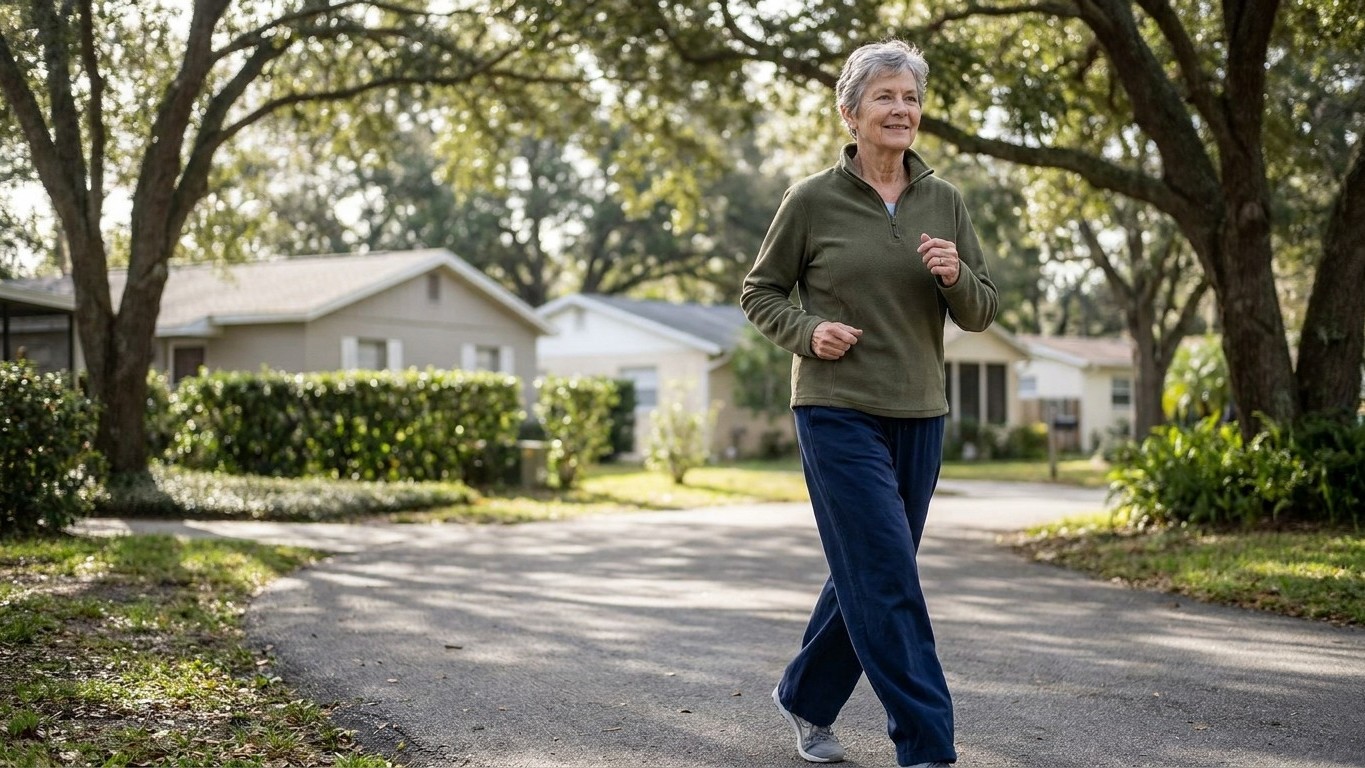
The number 10,000 has quietly disappeared from the vocabulary of geriatricians, cardiologists, and physical therapists working with patients over 60. It never came from a lab in the first place. A study cited by researchers traces the figure back to a 1960s pedometer marketing campaign in Japan that gave the device a catchy name roughly translating to “10,000-step meter.” From there, the number rode the wave of fitness trackers and app defaults straight into public consciousness, without ever being tested against actual mortality data.
That changed in 2022, when a landmark meta-analysis pooling data from 15 international cohort studies gave scientists something the marketing campaign never had: hard numbers. Published in The Lancet Public Health, the paper tracked nearly 50,000 adults and found that
Key takeaways
- The iconic 10,000-step goal traces back to a marketing campaign, not medical research
- A major study found older adults hit the longevity plateau at just 6,000-8,000 steps daily
- Women over 70 showed significant health benefits at just 4,000 steps per day
Why the plateau shows up sooner after 60
The study’s lead voice, exercise researcher Amanda Paluch, put it plainly. For adults 60 and older, the risk of premature death leveled off at about 6,000 to 8,000 steps per day, meaning that more steps than that provided no additional benefit for longevity. Below that range, every extra step still counted. Above it, the curve flattened out, statistically speaking, into a plateau rather than a cliff.
Younger bodies apparently need more volume to hit the same protective ceiling. Adults younger than 60 saw the risk of premature death stabilize at about 8,000 to 10,000 steps per day. The mechanism isn’t fully mapped, but researchers have a working theory: after 60, the body’s baseline vulnerability to cardiovascular events, falls, and inflammation shifts the cost-benefit math, so a smaller volume of movement buys a proportionally larger drop in risk.
One detail from the same research surprised even the scientists involved. The research found no definitive association with walking speed, beyond the total number of steps per day, getting in your steps, regardless of the pace at which you walked them, was the link to a lower risk of death. Translation: shuffling counts. Power-walking is not a prerequisite for the benefit.
A separate 2023 study, this one presented at an American Heart Association conference and tracking adults 70 and older, zoomed in on the lower end of the range with a finding that’s more useful for people just starting out. Walking an additional 500 steps per day, or an additional quarter mile of walking, was associated with a 14% lower risk of heart disease, stroke or heart failure. And the comparison at the extremes was striking: compared to adults who took less than 2,000 steps per day, adults who took about 4,500 steps per day had a 77% lower observed risk of experiencing a cardiovascular event.
The women-specific data that pushed the number even lower
A JAMA Internal Medicine study focused specifically on older women added another layer to the story, and it landed at an even more modest figure. Researchers followed roughly 17,000 women with an average age in the early 70s using wearable trackers, and the results reframed what “enough” looks like at this stage of life. They concluded that for these older women, it only took about 4,000 steps each day to boost longevity, with those who averaged 4,400 steps per day being 40% less likely to die in the following years than those who took just 2,700, and benefits appeared to peak around 7,500 steps, with little additional gain beyond that.
Franchement, that’s a number a lot of people over 60 are already hitting without realizing it, just from errands, gardening, and stairs. A short trip to the mailbox, two loops around the block, a grocery run. It adds up faster than the old 10,000-step goal ever let people believe.
Frequency matters too, not just the daily total. A 2025 study published in the British Journal of Sports Medicine looked at how often older women hit meaningful step counts across a week rather than every single day. Clocking up at least 4,000 daily steps on just 1 or 2 days per week was linked to a lower risk of death and cardiovascular disease among older women, compared with not reaching this level on any day. That’s a genuinely reassuring finding for anyone whose mobility fluctuates week to week, whether from arthritis flare-ups, weather, or simply a busier schedule.
What this actually means for a daily goal
None of this data suggests people should stop walking once they cross 6,000 or 8,000 steps. Movement still carries benefits for mood, balance, bone density, and blood sugar regulation well beyond what mortality statistics capture. But the framing has shifted from a punishing, one-size-fits-all number to a range that flexes with age and starting point. Someone currently averaging 2,500 steps doesn’t need to leap to five digits. If you’re currently walking 2,000 to 3,000 steps a day, adding even 500 to 1,000 more steps can support better circulation, strength, and overall well-being over time.
For those managing a chronic condition that limits comfortable walking, the bar drops further still. The NIH recommends seniors with mobility-limiting conditions aim to walk only about 5,500 steps each day, or an average of two miles. The 10,000-step badge that once popped up on a smartwatch screen like a finish line was never calibrated to any of this. What actually protects a 65-year-old’s heart and lifespan turns out to be a number most people could hit before lunch.
Sources : newsroom.heart.org | bmjgroup.com