
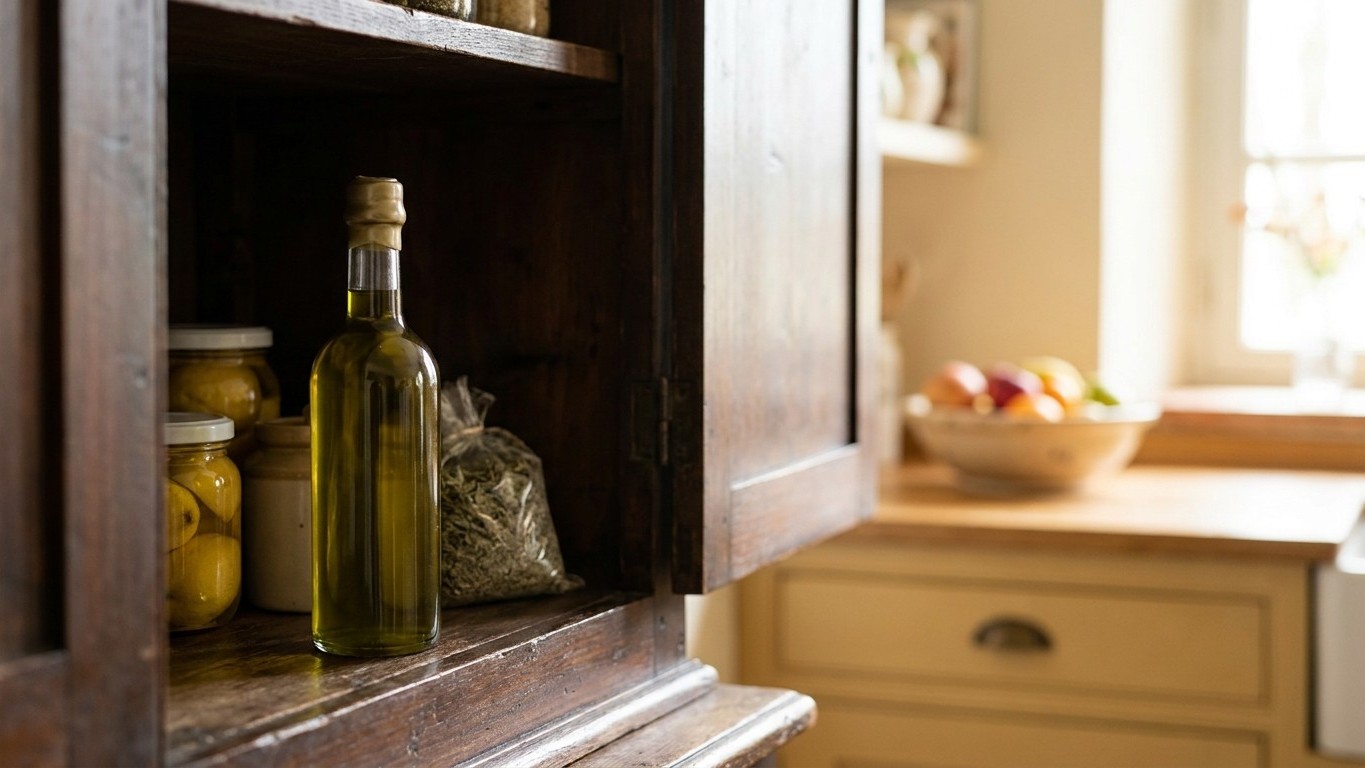
Ask any olive oil producer where the bottle lives in their own kitchen, and you won’t hear “next to the stove.” You’ll hear “in a cupboard,” “in a dark closet,” sometimes even “downstairs, away from the kitchen entirely.” Keep your oil away from any heat source, since it can get damaged if exposed to heat from a nearby stove or oven, or even warm sunlight. At home, growers keep their oil in a cool, dark closet downstairs. That’s not superstition, it’s chemistry, and it’s the opposite of how most home cooks actually store the bottle.
The instinct makes sense. You reach for olive oil constantly, so why not park it right where you cook? It’s tempting and awfully convenient to store oil right next to the stove, within arm’s reach, but is that really the best spot? Growers say no, emphatically, and the reasoning has nothing to do with kitchen aesthetics.
Key takeaways
- A three-year scientific study revealed which storage enemies matter most to olive oil quality
- Temperature swings near your stove are more damaging than you’d expect—even without extreme heat
- One simple habit growers use could extend your oil’s life by months and save you money
Heat, light and air: the trio that ruins good oil
The North American Olive Oil Association says there are “four enemies of olive oil”: heat, oxygen, light and age. A three-year research effort settled the question of which matters most. In 2012, researchers confirmed with a three-year study that light, heat and oxygen are the biggest enemies of extra virgin olive oil, and improper storage exposing it to these elements can change an oil so much it would no longer be classified as extra virgin. That’s a striking downgrade for something as simple as leaving a bottle in the wrong spot.
Heat is the sneaky one because it doesn’t announce itself the way spoiled milk does. Heat does damage on a slower timeline, with warm temperatures speeding up oxidation and breaking down the volatile compounds that give good oil its grassy, peppery, slightly bitter character. And the counter beside the range happens to be the single worst offender in most kitchens. The cabinet above your stove is the worst offender, as is the spot next to the oven, the windowsill, and any shelf exposed to varying temperatures and sunlight.
Numbers help make this concrete. Olive oil sold commercially is typically stored at temperatures roughly between 68 and 78 degrees Fahrenheit, but that’s already warmer than the recommended 60 to 70 degrees that ensures slower oxidation. Park your bottle on a countertop that spikes past 90 degrees every time you preheat the oven, and you’ve pushed the oil well outside the zone growers consider safe. The result isn’t dramatic or immediate. It’s cumulative. Slow decline. A flavor that fades before you even notice.
Light does damage you can’t taste right away
Heat gets the headlines, but light might be the more underestimated culprit. Light is the worst threat to olive oil freshness, since both UV and visible light degrade chlorophyll and create oxidation. Academic research backs this up directly. Research from the UC Davis Olive Center has shown that oil spoils much faster when exposed to UV light, and a clear bottle on a bright counter loses real flavor in a matter of weeks.
The mechanism is almost identical to what happens to fruit. Light causes a breakdown in chlorophyll, the compound responsible for olive oil’s distinctive color, and this photo-oxidation process alters the taste and aromatic components while exposure to light can cause the formation of free radicals that lead to fatty acid oxidation. That’s why premium producers rarely bottle in clear glass, and why the tinted, opaque, or tin packaging isn’t a design choice so much as a survival strategy for the oil inside.
What growers actually do differently
Talk to enough people in the olive oil business and a pattern emerges: nobody treats the bottle like a permanent countertop fixture. Instead, the routine looks something like this: a large tin or bottle gets tucked into a dark cupboard, and a smaller vessel gets filled for the week’s cooking. Best practice is to use dark glass bottles or stainless steel tins and keep them in a cupboard or pantry away from sunlight, decanting a smaller amount for daily use if you buy large sizes. It’s a small habit, but it limits how often the main supply gets exposed to air and light.
Even the humidity and consistency of temperature matter more than people assume. One olive oil distributor put it plainly in a recent podcast conversation about gut health and food quality: “You want to keep it where the temperature is constant, so away from the stove, away from a window where the temperature will fluctuate quite a lot.” Fluctuation, not just heat itself, seems to be part of what accelerates the breakdown. Heat and temperature changes by your burners can destabilize the product and make it rancid.
Franchement, this is the part that surprises most people: a bottle doesn’t need to be scorching hot to suffer. It just needs to swing between warm and cool, over and over, every time you turn a burner on and off nearby. That thermal seesaw is exactly what a stovetop perch guarantees.
The payoff for moving the bottle
Shelf life numbers make the case better than any lecture on chemistry. Proper storage can extend olive oil’s shelf life to about 18 to 24 months unopened, and around 6 months once opened. Keep it warm and swinging in temperature next to a range, though, and those numbers shrink drastically, with experts noting that heat exposure can cut the oil’s lifespan by weeks or even days depending on the kitchen environment.
There’s a financial angle too, one that rarely gets mentioned. Good extra virgin olive oil isn’t cheap, and repeatedly tossing bottles that turned rancid before their time is a quiet, recurring cost most households never trace back to storage habits. Move the bottle to a cupboard, decant a small daily-use container in dark glass, and reseal the cap immediately after every pour. Nothing fancy required, no special equipment, just a different shelf.
One detail worth keeping in mind if you do decide to buy in bulk during a good harvest year: refrigeration is fine for long-term backup stock, even though the oil will turn cloudy and thicken in the cold. If you’re buying a large quantity, refrigerate a portion to extend its life, and refrigeration might cause temporary cloudiness, but it won’t affect the quality. Let it come back to room temperature before using it, and you’d never know it spent weeks in the chill.
Sources : favuzzi.com | cookist.com