
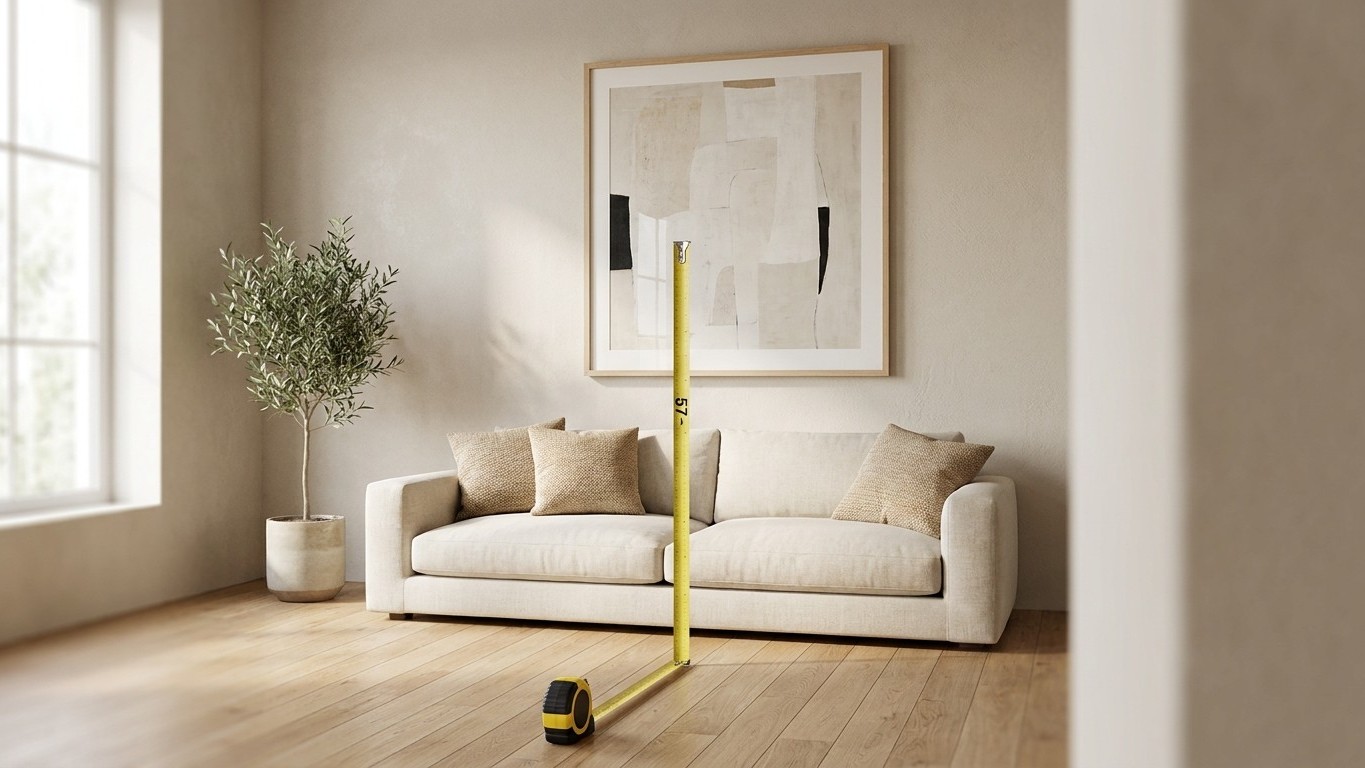
I’ve got great research. Now I’ll write the article incorporating the 57-inch rule, why it beats centering on furniture or wall midpoint, and how to apply it above a sofa.
Fifty-seven inches. That’s the one number curators, framers, and design pros return to again and again when a wall of art suddenly feels off. Not the top of the sofa. Not the middle of the wall. The center of the artwork should sit 57 inches from the floor, aligning with the average eye level, and this standard helps create a cohesive look whether you’re hanging a single piece or arranging a gallery wall. It’s the quiet math behind every museum room that feels calm instead of cluttered.
Most people never learn this number. They hang a frame level with the sofa back, or smack in the geometric middle of a blank wall, and then wonder why the room still feels unfinished. It usually isn’t the art. It’s the placement.
Key takeaways
- Professional framers and curators use one exact measurement—57 inches from the floor—yet most people have never heard of it
- Hanging art at ‘eye level’ or centered on furniture creates visual chaos; the real secret involves measuring the frame’s center, not its top
- Even museums adjust this golden rule for high ceilings, oversized pieces, and gallery walls—but there’s a pattern to how
Why 57 Inches Beats Guessing
The “museum standard” of 57 inches is not random. It represents a practical average human eye level, and while everyone is a different height, galleries need one consistent standard that works for most standing adults. That’s the trick, actually, it’s not about your eye level, or your partner’s, or whoever happens to be the tallest person in the house. A lot of people are told to hang art at “eye level,” but that can be misleading — if you’re tall or have high ceilings, you’ll likely hang everything too high, so it’s better to use a consistent measurement.
The physics of it are fairly simple. Most adults stand between 5’4″ and 6’2″, and eye level for this range falls around 57 to 65 inches, so 57 inches hits the sweet spot where most people will naturally look. Walk into a room and your gaze drifts to that band automatically, no craning, no tilting. Hanging art too high creates eye and neck strain, while museum height keeps the art in your relaxed, natural line of sight.
Here’s the detail that trips almost everyone up, though: 57 inches marks the center of the piece, not the nail, not the wire, not the top of the frame. The 57 inches marks the center of the art, not where you drive the hook, to place the hook correctly, first find the top of the frame by adding half the frame’s height to 57. A 30-inch-tall frame, for example, has its top at 57 plus 15, or 72 inches, and then you subtract the drop, the distance from the top of the frame down to the taut hanging wire or hook point, to get your hook height. Skip that step and you’ll systematically hang everything a few inches too high — which, incidentally, is the single most common decorating mistake in American living rooms.
Forget the Sofa Top, Forget the Wall’s Middle
Centering a frame on the sofa’s top edge feels intuitive. It’s also, more often than not, wrong. Furniture height varies wildly, a low-slung modern sectional sits nowhere near the same line as a tufted Chesterfield — and if you chase the furniture’s silhouette, you inherit its randomness instead of a fixed, calibrated point.
Centering on the wall’s vertical middle is worse. Blank wall space above and below a frame rarely divides evenly once you factor in baseboards, crown molding, or a nearby doorway, so a “middle of the wall” frame often reads as slightly too high, floating disconnected from the seating below. Hanging art higher to fill the empty wall space can make it feel disconnected from you and your furniture.
The fix, when there’s a sofa or console involved, is a hybrid approach. You should never measure from the ceiling unless you’re planning to suspend a piece from it, as a general rule, hang your art so the bottom of the frame hangs 8 to 10 inches above the back of the sofa. Several designers land in a slightly wider window: when hanging art above furniture such as a sofa, bed, or dining buffet, keep the bottom edge of the artwork 6–10 inches above the furniture. Above a console with objects already sitting on it, the reference point simply moves up. Anywhere between 6 and 12 inches above the tallest decor piece on the console or table is a good sweet spot, according to one designer quoted by AOL. In practice, for a standard-height sofa, the furniture gap and the 57-inch center often land in nearly the same place anyway. Museums figured this out decades ago: the center of any artwork should sit at roughly 57 to 60 inches from the floor, and this rule works in tandem with the 6–8 inch guideline — for most standard sofas, around 30–36 inches tall, following both rules will land you in the same happy place, with the center ending up right around eye level and the bottom edge sitting comfortably above the couch.
Adjusting the Formula for Real Rooms
The number isn’t fixed in concrete, and treating it as gospel regardless of ceiling height is its own trap. If a room has very high ceilings, hanging art at 57 inches can make it feel too low within the vertical space, so in those cases, aim for the center of the artwork to sit around 60–62 inches from the floor. Some framers go even further for volume-heavy rooms, nudging the center to 58 or 60 inches so the proportions still read as balanced against soaring walls.
Oversized pieces need their own math, too. For exceptionally large pieces over 60 inches tall, you can raise the center point to 60-65 inches to maintain visual balance. And when doubt creeps in mid-installation, there’s a reassuring bit of folk wisdom nearly every source repeats in some form: it’s always better to hang a picture slightly too low than too high. A frame sitting a touch low still reads as intentional. One floating near the crown molding just reads as a mistake nobody caught.
Gallery walls follow the same logic, scaled up. Think of a gallery wall as one single artwork, measure the entire arrangement and ensure the center of the whole display sits at 57 inches from the floor, keeping pieces evenly spaced, typically 2-3 inches apart, for a polished look. Tribeca Printworks’ framers go slightly tighter still, recommending gaps between frame edges span no more than 1.5 to 2.5 inches for that dense, curated museum wall effect.
One more wrinkle worth knowing before you pick up the hammer: designers don’t treat sofas and beds the same way they treat open hallway walls. You may need to hang art a little higher when placing it above sofas and beds because you don’t want people’s heads to make contact with your pieces, and if there are kids with curious hands at home, it may be worth going a bit higher still, then re-hanging once they’re older. The 57-inch rule, is a starting line, not a finish line, and the best-looking rooms are the ones where someone actually measured before they drilled.
Sources : jjonesdesignco.com | aol.com