
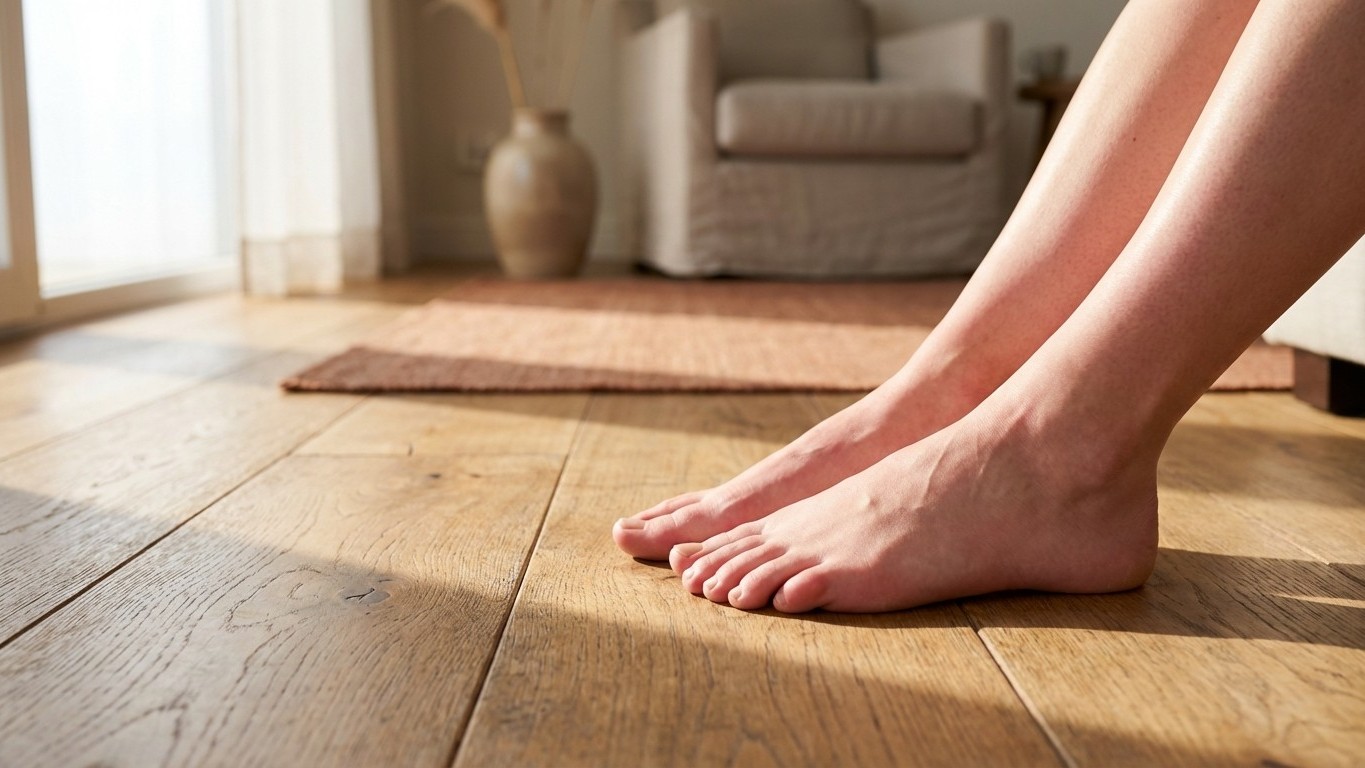
When I decided to ditch my cozy slippers for two weeks and go completely barefoot at home, I expected nothing more than cold feet and perhaps some interesting sensations. What I discovered about my legs and overall wellbeing has completely Changed how I think about footwear inside the house.
The decision came after reading recent research from Harvard Medical School suggesting that our modern obsession with cushioned footwear might be doing more harm than good. Dr. Daniel Lieberman’s studies on barefoot walking have shown that our feet are incredibly sophisticated structures designed to function optimally Without artificial support. Intrigued by these findings, I embarked on my own personal experiment.
The First Week: Unexpected Awakening
Within just three days, I noticed something remarkable happening to my calves. The constant micro-adjustments required for balance on different surfaces had activated muscles I hadn’t felt in years. According to podiatrist Dr. Emily Splichal, author of “Barefoot Strong,” this phenomenon occurs because barefoot walking engages proprioceptors – specialized nerve endings in our feet that communicate with our brain about body position and movement.
By day five, my legs felt more alive than they had in months. The subtle engagement of my intrinsic foot muscles was creating a ripple effect up through my entire kinetic chain. Recent studies published in the Journal of Foot and Ankle Research confirm that barefoot walking strengthens the small muscles in our feet by up to 60% compared to wearing shoes, even supportive ones.
The most surprising discovery was how my posture began shifting naturally. Without the artificial elevation of heel cushioning, my pelvis tilted into a more neutral position, reducing the chronic tension I’d been carrying in my hip flexors. Physical-therapists-say-this-everyday-object-relieves-lower-back-pain-better-than-medication”>Physical therapist Kelly Starrett explains this as the body’s natural response to ground feedback – something we lose entirely when we’re constantly cushioned from real sensory input.
Week Two: Circulation Revolution
The second week brought even more dramatic changes-everything”>changes-everything”>Changes, particularly in my circulation. My feet, which had Always run cold, began maintaining a healthier temperature throughout the day. This improvement aligns with findings Making-a-major-comeback-and-dermatologists-actually-approve”>From the American Podiatric Medical Association, which notes that barefoot walking promotes better blood flow by allowing the foot’s natural pump mechanism to function optimally.
The venous return in my legs improved significantly. That heavy, tired feeling I’d grown accustomed to after long days of working from home virtually disappeared. Vascular specialist Dr. Mark Adelman explains that when we walk barefoot, the engagement of our foot muscles acts as a secondary heart, helping pump blood back up from our extremities more efficiently than when we’re wearing cushioned footwear.
My ankle mobility increased dramatically during this period. Years of wearing supportive slippers had created a subtle stiffness I hadn’t even realized was there. The constant micro-movements required for barefoot balance had restored a range of motion I Thought was lost to age and sedentary work habits.
The Science Behind the Transformation
Research from the University of Virginia’s biomechanics lab reveals that barefoot walking reduces impact forces on joints while simultaneously strengthening the muscles that support our entire skeletal structure. When we wear cushioned footwear consistently, we develop what researchers call “sensory atrophy” – a gradual decline in our foot’s ability to sense and respond to environmental feedback.
The neurological benefits extend far beyond the feet themselves. Studies published in Frontiers in Psychology show that barefoot contact with the ground creates measurable changes in our nervous system, reducing stress hormones and promoting better sleep quality. During my experiment, I noticed falling asleep more easily and waking up feeling more refreshed – benefits I hadn’t anticipated but that science now supports.
Balance and proprioception improvements were perhaps the most practical gains. By week two, I could navigate my home in complete darkness with confidence, something that would have been impossible Before. This enhanced spatial awareness translates to reduced fall risk and better overall coordination in daily activities.
Making the Transition Sustainable
The key to successful barefoot living lies in gradual adaptation. Starting with just a few hours daily and progressively increasing exposure allows the feet to strengthen naturally without strain. I began on carpeted surfaces before transitioning to hardwood and tile, giving my feet time to develop their natural padding.
For those concerned about hygiene or cold floors, the solution isn’t necessarily returning to traditional slippers. Minimalist options like toe socks or thin-soled house shoes can provide protection while maintaining ground contact and sensory feedback. The goal is connection with your environment, not complete exposure to harsh conditions.
Temperature regulation improved naturally as my circulation enhanced, but I kept a pair of wool socks nearby for particularly cold mornings. The beauty of this approach is its flexibility – you’re retraining your body’s natural systems rather than fighting them.
After two weeks of this experiment, I’ve gained more than just stronger legs and better circulation. I’ve rediscovered the sophisticated intelligence of my own body and learned-what-french-grandmothers-actually-do-with-it”>learned-these-5-ways-to-tie-a-simple-scarf”>Learned that sometimes the most profound wellness improvements come not from adding something new, but from removing what we never needed in the first place. Your feet, and Your Entire body, might be more capable than you ever imagined.