
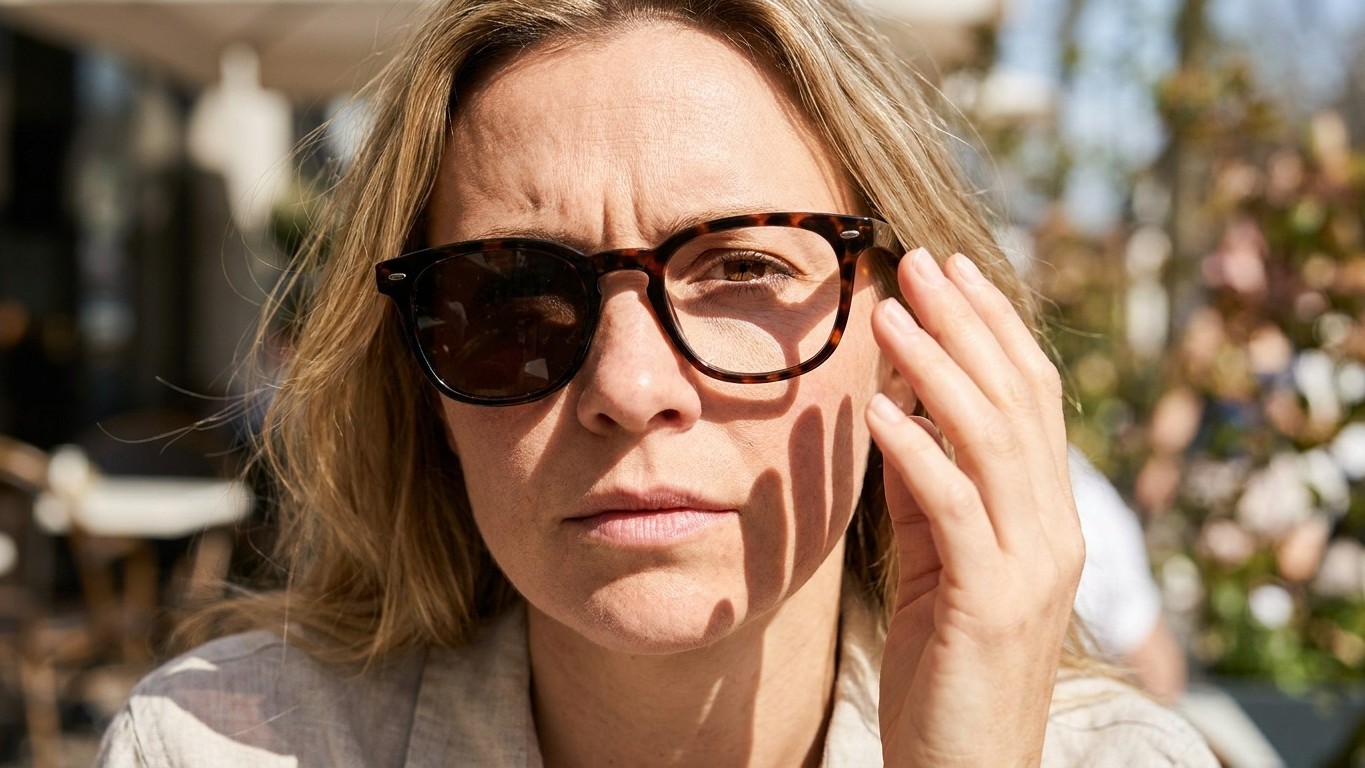
Every summer, millions of women slide on a pair of dark sunglasses and feel virtuous. Protected. Prepared. The lenses are deep brown, the tint is generous, the style is flawless. What they don’t feel, and this is the problem, is that behind those dark lenses, their pupils are quietly opening wide, like a door left unlocked during a storm.
Eyes adapt to ambient light, and pupils dilate when light is dim or when you’re wearing dark sunglasses. That creates a bigger area for UV to access the eye, and if the lenses are simply colored and do not block UV, you’re opened up to eye damage. The dark tint fools your biology without doing anything to stop the radiation. Your eyes think they’re safe. They’re not. That gap between perception and reality is where the damage accumulates, quietly, over years.
Key takeaways
- Dark tinted lenses trigger your pupils to dilate, exposing your eyes to MORE harmful UV rays than if you wore no sunglasses at all
- The field of view matters more than pupil size—you stop squinting and open up, letting UV radiation flood in from wider angles
- Most sunglasses labeled ‘100% UV’ are actually incomplete; only UV400 lenses truly protect against the full spectrum of harmful rays
The Mechanism Your Eyes Can’t Override
The pupil’s job is elegant in its simplicity: constrict in bright light to limit incoming radiation, dilate in darkness to let more in. When you’re out in bright sun, you unconsciously squint, which constricts your pupils and reduces the amount of sunlight that gets into your eyes. That reflex is ancient, automatic, and effective, until you interfere with it.
When you wear sunglasses, the shade reduces the brightness of the sun and your eyes react the same way they would if you entered a dark room. Your pupils dilate, letting in more light. With quality, properly rated lenses, that’s fine, the UV is filtered before it ever reaches the ocular tissue. Good sunglasses reduce the visible light and filter off the UV light. Fake or unprotected sunglasses reduce the visible light but do not adequately filter off the UV light. The result is a biological trap: you’ve disabled your natural defense and offered nothing in return.
A 2024 study published in Scientific Reports added a nuance that most eye care discussions miss entirely. A set of 214 sunglass lenses were tested and the results show that pupil dilation does not play the most important role in UV influx throughout the pupil. The field of view is the main player, surpassing the pupil size contribution by up to 314.3%. The real culprit is that the field of view is small in a bright outdoor environment due to the involuntary squint response, posing natural attenuation of the solar radiation influx into the eye. Sunglasses provide a darker environment, hampering natural involuntary lid responses and therefore increasing the field of view. You stop squinting. You open up. More UV pours in from a wider angle, not just straight ahead.
Worse Than Wearing Nothing At All
This is the part that stops most people cold. Wearing dark lenses without UV protection is more dangerous than wearing no sunglasses at all. The pupils dilate in darkness or dim lighting, allowing more light to enter the eyes than would occur without the sunglasses. The dark frames aren’t neutral. They’re actively setting up a worse scenario.
Because sunglasses artificially darken the environment and allow your pupils to dilate, even more harmful UV rays can reach the back of the eye than they normally would if you were not wearing sunglasses. MD Anderson Cancer Center makes this point directly. The institution that treats ocular melanoma at the highest level is unambiguous about it.
The consequences aren’t abstract. UV light increases your risks of developing pterygium, a growth on the surface of the eye, cataracts, photokeratitis (inflammation of the cornea due to sunburn), age-related macular degeneration, and even cancer in the eye or on the skin around the eyes. Because most of the UV damage is cumulative, it’s important to protect your eyes at every age. Nothing announces itself. No pain, no warning, no visible signal, just decades of exposure quietly compounding into a diagnosis.
Children are disproportionately at risk. Children and adolescents are particularly vulnerable. Their wider pupils and clearer lenses allow more radiation to penetrate deeper into the eye. The sunglasses you pick up for your daughter at a tourist shop are not a negligible choice.
What The Labels Actually Mean (And What They’re Hiding)
The labeling issue is where the conversation gets genuinely murky. Not all lenses claiming to absorb 100% of UV can block all UV wavelengths. In the United States, manufacturers are allowed to claim 100% UV protection for lenses that absorb ultraviolet rays with wavelengths up to 380nm, even though the range of ultraviolet rays extends up to 400nm. A pair of sunglasses can technically wear a “100% UV” sticker while still letting in a slice of the spectrum that matters. That’s not a loophole at the fringe, it’s a standard industry practice.
The label to look for is UV400, full stop. The highest UV protection in sunglasses is UV 400, which blocks 99% to 100% of the sun’s UVA and UVB rays and screens out 75% to 90% of the sun’s light. Anything less, and you are in legally compliant but biologically risky territory. Polarized lenses reduce glare, and polarization is ideal for enhancing visibility on reflective surfaces such as water, roads, or snow. However, polarization is a glare-reduction feature, not a UV blocker. Those gorgeous polarized lenses that cut the glare on the water? They may or may not protect your eyes. The two features are entirely independent.
Frame shape matters more than most people realize. About 20% of UV enters the eye from reflective light that comes in from the side, wraparound designs or side shields are recommended, especially with darker shades. Small, fashion-forward frames let radiation in from angles the lens never covers. Up to 50% of ocular UV exposure can come from reflected or peripheral light, bypassing the front of the lenses entirely. The most expensive pair of aviators on the market, if small-framed, may be doing half the job you assume.
The Practical Fix (No Compromise Required)
The good news, and this genuinely surprises people, is that price is not the determining factor. You don’t have to buy expensive sunglasses to get good UV protection. A $15 pair labeled UV400 with adequate frame coverage outperforms a $200 fashion pair with a vague “UV protective” claim and a small lens profile. The filter is a coating, not a luxury material. What you’re paying for with designer frames is branding, fit, and optics quality, not necessarily eye safety.
The verification is simple: look for UV400 on the label or tag, check that the frame covers your eyes laterally, and skip antireflective coatings unless your optician confirms they won’t increase back-reflection. Antireflective coatings can increase UV exposure by causing back reflection of the UV rays into the eye. An overlooked detail, but a real one.
Another concern related to sunglass lenses is the degradation of their UV protection after long-term irradiation, posing an additional risk to the wearer. That pair you’ve been wearing faithfully for six summers may have lost a portion of its filtering capacity, without looking any different. UV protection in lenses isn’t permanent. It degrades. Most people replace their sunglasses for aesthetic reasons long before this becomes an issue, but if you have a pair you’ve held onto for years, it’s worth revisiting.
The research from Scientific Reports closes with a pointed recommendation: manufacturers should strive to not simply meet minimum standards but to achieve UV400 properties for all sunglass lenses to mitigate any risk of unnecessary UV radiation exposure. Until that’s the baseline, the burden stays with us, the people buying, wearing, and trusting these lenses every single day without asking nearly enough questions about what’s actually behind the tint.
Sources : nature.com | pubmed.ncbi.nlm.nih.gov