
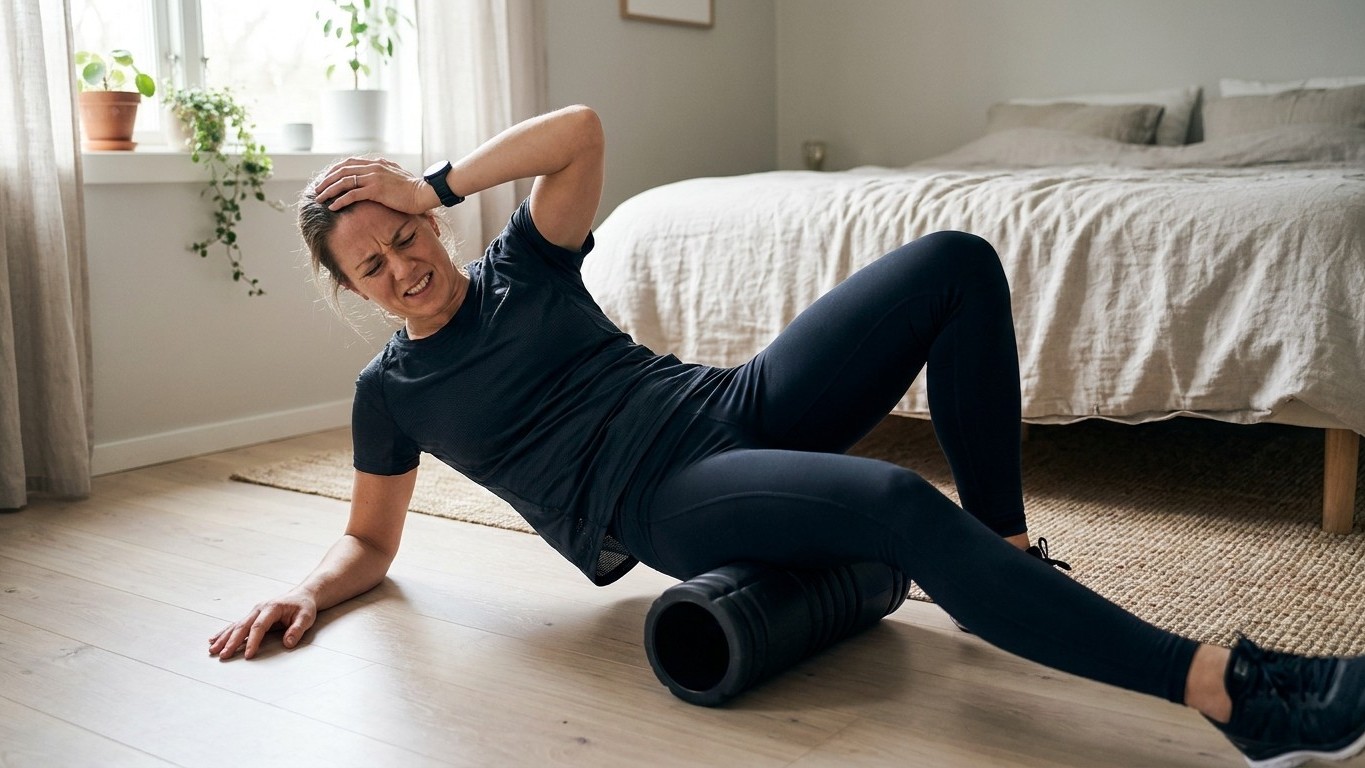
Every runner has a foam roller moment. That excruciating ritual on the bedroom floor, side-lying, teeth clenched, rolling slowly over the outer thigh while wondering if this is what physical therapy actually feels like. For years, millions of us performed this ceremony with religious discipline. After every long run. After every race. After every hint of tightness on the lateral knee. The physio’s verdict, when it finally came, was unambiguous: stop.
Not “ease up.” Not “try a gentler technique.” Stop entirely. Here’s why that advice is backed by solid anatomy, and what you should be doing instead.
Key takeaways
- Your IT band isn’t a muscle—it’s a tough connective tissue that foam rolling literally cannot change
- Rolling directly on an irritated IT band can actually make pain worse by increasing inflammation
- The real culprit behind IT band pain is hip weakness, and one study showed 92% of runners became pain-free with targeted gluteus medius strengthening
The IT Band Is Not a Muscle. That Changes Everything.
The IT band is a thick fibrous connective tissue that isn’t muscle or bone, think of it as a seat-belt-like tissue running along your thigh muscles, extending from the top of your pelvis down to the top of your knee. You can compare its consistency to burlap: very stable and inflexible. That texture matters enormously when you reach for a foam roller.
Foam rolling works by applying pressure to muscle tissue, promoting blood flow and helping fibers release tension. The IT band is a strip of fascia, not packed with blood vessels, muscle tissue, or soreness-causing agents like lactic acid. If those things aren’t present, the supposed benefits of foam rolling don’t make sense. You are, quite literally, rolling something that cannot respond the way you want it to.
Research published in the Journal of Biomechanics found that it would take roughly 9,000 newtons of force, about 2,000 pounds, to produce even a 1% change in IT band length. Your body weight on a foam roller does not come close. One physical therapist puts it this way: “Think of the IT band like a ratchet strap on a truck. You would not try to stretch a ratchet strap. You would adjust what is pulling on it.” The analogy is crude but the biology is accurate.
A 2021 study published in the International Journal of Sports Physical Therapy found that a single session of foam rolling does not affect short-term IT band stiffness. Foam rolling doesn’t stretch or change the IT band’s flexibility because it’s not a muscle; it’s a tough, non-contractile tissue. The perceived relief? Largely neurological, you’re overriding the pain signal momentarily, not fixing anything structural.
When Foam Rolling Actively Makes Things Worse
This is the part most runners don’t hear until they’re already injured. IT band syndrome is caused by excessive compression between the IT band and the thigh bone, and rolling directly on it can make that worse by adding more squashing to an already-compressed area. The logic of “it hurts, so I’ll roll it harder” is the exact inverse of what your body needs.
Aggressive foam rolling directly on an irritated IT band can increase inflammation at the friction point near the knee. Fluid-filled sacs beneath the IT band called bursae act as cushions between the knee bone and the band. The area around the hip is naturally sensitive, and rolling on it can irritate and cause inflammation around those bursae. What you think is a deep tissue treatment can actually be triggering a secondary injury.
Attempting to roll out the IT band with a foam roller is comparable to trying to soften a steel cable with a wooden rolling pin, basically impossible, and a waste of time. A waste of time that, for many runners, comes packaged with real pain.
There is one narrow exception worth mentioning. Foam rolling can help reduce pain and tightness in the short term when you have IT band syndrome, but this relief is transient, to get rid of it permanently, you have to address the underlying cause. Temporary comfort is not the same as treatment. Confusing the two is exactly how people spend years foam rolling without ever solving anything.
What’s Actually Causing the Pain (And What to Do About It)
In the vast majority of cases, the root cause of IT band pain is hip weakness and instability, specifically, the gluteus medius, the muscle on the side of your hip responsible for stabilizing your pelvis when you stand on one leg, which happens with every single step while running. A dysfunctional gluteus medius can lead to increased hip adduction and internal rotation, which exacerbates friction and compression of the IT band at the lateral knee.
The research on this is fairly consistent. Runners enrolled in a six-week standardized rehabilitation protocol focused on gluteus medius strengthening demonstrated significant increases in hip abductor torque, and after six weeks, 22 of 24 athletes were pain-free and able to return to running, with no reports of recurrence at the six-month follow-up. Ninety-two percent pain-free. Not from rolling. From building the right muscles.
Strengthening the gluteus medius helps improve the functional state of the IT band, facilitating a comprehensive enhancement of neuromuscular function and muscular strength in individuals experiencing IT band-related dysfunction. Across multiple studies, intervention effects on pain reduction from hip abductor strengthening ranged from 27% to 100% over just 2 to 8 weeks. Those are numbers no foam roller has ever matched.
So what about the foam roller you already own? Don’t throw it away. While foam rolling the IT band itself is ineffective, rolling out the quadriceps, hamstrings, or gluteal muscles may improve overall muscle pliability, which can indirectly reduce perceived tightness in the IT band. The muscles worth targeting include the gluteus maximus, tensor fasciae latae, vastus lateralis, and biceps femoris. Same tool, completely different location.
The Real Recovery Protocol
Gait also matters more than most runners expect. Running with a crossover pattern puts excess stress on the IT band; adjusting form, increasing cadence to around 170-180 steps per minute, engaging the core and glutes to stabilize the hips, and avoiding crossing the feet over the midline during your stride can meaningfully relieve that strain.
The actual exercises that physios prescribe for IT band recovery look nothing like foam rolling. A progressive gluteus medius strengthening program typically begins with side-lying leg raises, clamshells with hips and knees flexed, and side planks, then advances to unilateral bridges, quadruped hip extensions targeting the affected limb, and single-leg Romanian deadlifts. Boring-looking exercises. Genuinely effective results.
A 2019 meta-analysis of 21 studies on foam rolling published in the journal Frontiers in Physiology concluded that the evidence seems to justify the use of foam rolling as a warm-up activity rather than a recovery tool, producing small improvements in sprint Performance and flexibility before exercise, but not reliably after it. That reframe alone should shift how every runner builds their pre-run routine. The foam roller stays, but it moves to before the miles — and stays far, far away from the outer thigh.
Sources : sspc.physio | cohenhp.com