
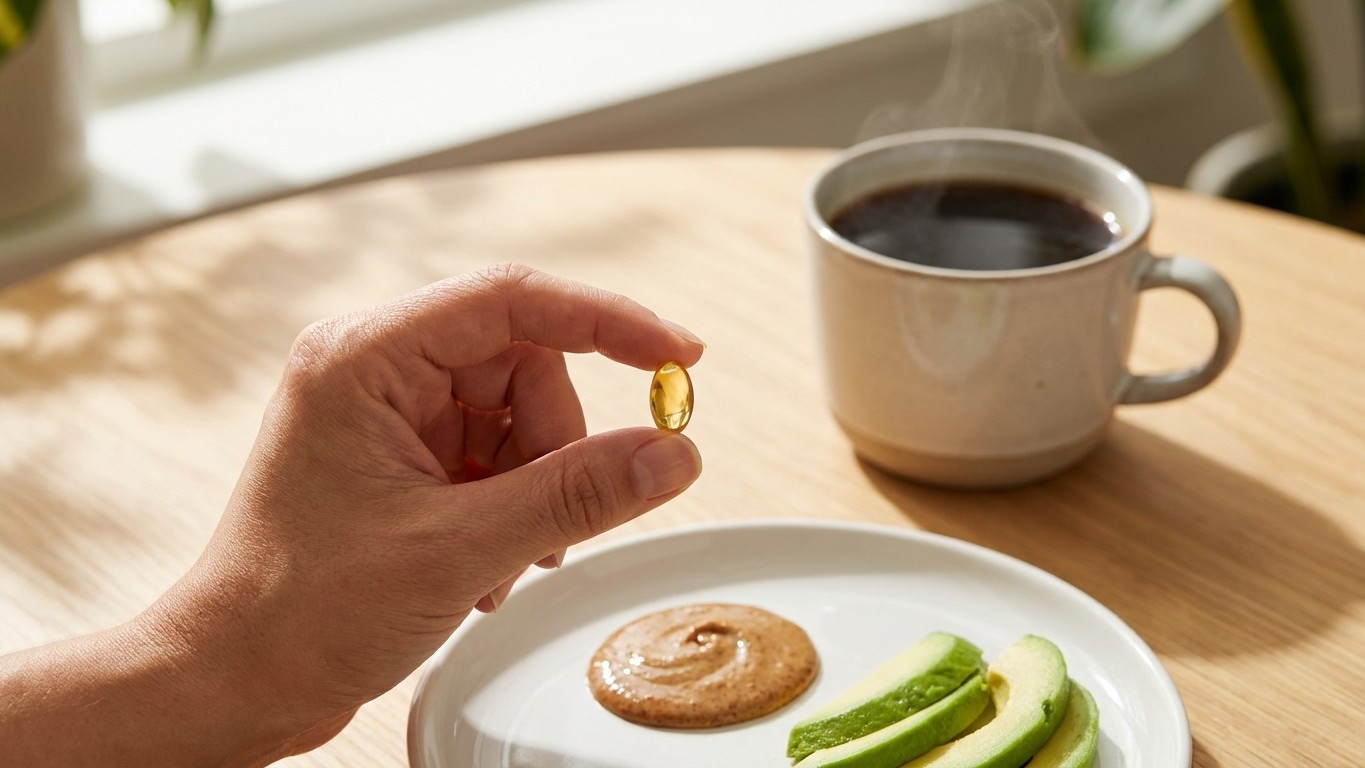
The blood work came back and the number was low. Not catastrophically low, but low enough for the doctor to pause and ask: are you actually taking that supplement every day? The answer was yes, every single morning, for years. The pill placed next to the coffee maker, washed down with a black cup before breakfast. Efficient, consistent, and, as it turns out, almost entirely counterproductive.
This story is more common than most people realize. About 42% of adults in the United States are deficient in vitamin D, and a significant portion of them are actively supplementing. The gap between taking a pill and actually absorbing what’s in it is where the problem lives, and coffee is a bigger part of that story than almost anyone has been told.
Key takeaways
- Your body absorbs vitamin D 50% better when taken with fat—and black coffee has zero fat
- Caffeine suppresses the vitamin D receptors your cells need to actually use the nutrient
- A decades-old study of 13,000+ Americans proves high coffee drinkers have significantly lower vitamin D levels
- The fix isn’t giving up coffee—it’s shifting when you drink it by just 30 minutes
What Black Coffee Actually Does to Vitamin D
Vitamin D is a fat-soluble vitamin, meaning that it does not dissolve in water and is absorbed best in your bloodstream when paired with high fat foods. A black coffee, stripped of any fat, offers zero of that. The supplement hits an empty digestive tract, finds nothing to bind to, and a large portion of it simply moves through unused. Vitamin D supplements need dietary fat for proper absorption. Without fat, much of the vitamin D passes through your body unused.
But the fat problem is only half of it. Caffeine adds a second layer of interference that operates through an entirely different mechanism. Research found that caffeine lessened the expression of vitamin D receptors on the body’s osteoblasts, which are the cells that secrete the substance of bone. When those receptors are suppressed, even the vitamin D that does get absorbed has fewer places to dock and do its work. Emerging evidence suggests that habitual coffee intake may alter vitamin D status through several biological pathways. Caffeine has been proven in vitro to decrease the expression of vitamin D receptor (VDR) protein in osteoblast cells, and when VDR expression falls, cells become less responsive to the active form of vitamin D, causing potential downstream effects on calcium and vitamin D pathways.
There’s a third mechanism that rarely comes up in wellness circles. Caffeine has a diuretic effect and can increase urinary excretion of some minerals like calcium. Since vitamin D plays a role in calcium absorption, increased calcium loss may put extra demand on the vitamin D pathway. Your body ends up burning through whatever vitamin D resources it has just to compensate for what the caffeine is flushing out.
The Data Is Hard to Ignore
This isn’t fringe wellness theory. Using data collected from the 2005–2006 National Health and Nutrition Examination Survey (NHANES), 25(OH)D levels and dietary caffeine intake were extracted from 13,134 individuals. A large U.S. cross-sectional study using NHANES data found participants in the highest quartile of dietary caffeine intake had significantly higher rates of 25(OH)D deficiency (defined as below 20 ng/mL) than those in the lowest quartile. That’s not a modest association buried in a footnote.
More recent work reinforces the pattern. A cross-sectional study that examined associations between coffee consumption and serum 25-hydroxyvitamin D in 387 adults recruited in Saudi Arabia classified participants as normal (3 cups per day or fewer) or high (more than 3 cups per day) coffee consumers. Compared with normal coffee consumers, high coffee consumers had lower serum 25(OH)D levels. The researchers did note that a causal threshold can’t yet be pinpointed, and perhaps screening for vitamin D deficiency in heavy coffee drinkers could be appropriate in clinical practice.
The bone health angle adds urgency, especially for women. This interference can lead to decreased bone mineral density, particularly in postmenopausal women who face a higher osteoporosis risk. In one study, intake of caffeine in amounts above 300 mg per day, which is roughly more than 3 cups of coffee, was shown to accelerate bone loss at the spine in elderly women. The supplement you’re faithfully taking to protect your bones may be delivering far less than you think.
The Fix Is Simpler Than You’d Expect
Here’s the counter-intuitive part: you don’t need to give up coffee. The research is not a case against your morning ritual, it’s a case against the order of your morning ritual. The effect of coffee on vitamin and mineral bioavailability is more a question of when you consume coffee as opposed to whether you consume coffee.
According to one study involving 17 people, taking vitamin D with the main meal of the day increased blood levels of vitamin D by about 50% after 2 months. In another study with 50 older adults, consuming vitamin D with a high-fat meal resulted in a 32% increase in blood levels of vitamin D after 12 hours, compared to a meal without fat. The difference between a suboptimal result and an optimal one comes down to whether there’s fat present, and whether caffeine is competing for the same receptor space.
To make the most of your vitamin routine without skipping your morning coffee, it’s all about timing. Check your Supplement labels for those nutrients where coffee components are most likely to interfere, and take these vitamins at least one hour from the time of your cup of coffee. The practical version: drink your coffee first, eat a real breakfast with some fat (eggs, avocado, nut butter, anything), then take the supplement. Butter, nuts, seeds, full-fat dairy products, and eggs are sources of fat that help enhance vitamin D absorption.
Research studies show that moderate amounts of fat, about 11 grams, might be more favorable for vitamin D absorption compared to no fat or high-fat amounts. This equates to about a tablespoon of butter. The bar is genuinely low. You don’t need a full sit-down meal, just something with a bit of fat to activate absorption. Even a small amount of fat, such as a tablespoon of nut butter or a few avocado slices, is enough.
What Your Lab Results Are Actually Measuring
The evaluation of vitamin D deficiency involves measuring serum levels of the 25-hydroxy form, with values below 20 ng/mL indicating deficiency and levels between 20 and 30 ng/mL suggesting insufficiency. Many people fall into that gray zone of insufficiency and are told their levels are “a little low” without anyone connecting the dots back to how they’ve been taking the supplement. The supplement gets blamed. Or sunlight. Or diet. Rarely the coffee ritual that’s been silently blunting the whole effort.
Subclinical vitamin D deficiency remains prevalent worldwide, affecting up to 1 billion people in both developed and developing countries. A fraction of that number is surely the result of poor absorption habits rather than poor supplementation itself. If you are taking vitamin D to improve a deficiency, it will likely take longer to resolve due to suboptimal absorption. Months of faithfully opening that pill bottle, with almost nothing to show for it on the bloodwork, just because the timing was off by 30 minutes and the coffee cup was empty of everything that matters.
One detail worth sitting with: women with one particular variant of the vitamin D receptor gene are at greater risk for the deleterious effect of caffeine on bone. Genetics, may determine just how much your morning cup is working against you, which means a blood test combined with a honest conversation about your supplement habits is worth far more than any generic recommendation on the back of a pill bottle.
Sources : econtent.hogrefe.com | sciencedirect.com