
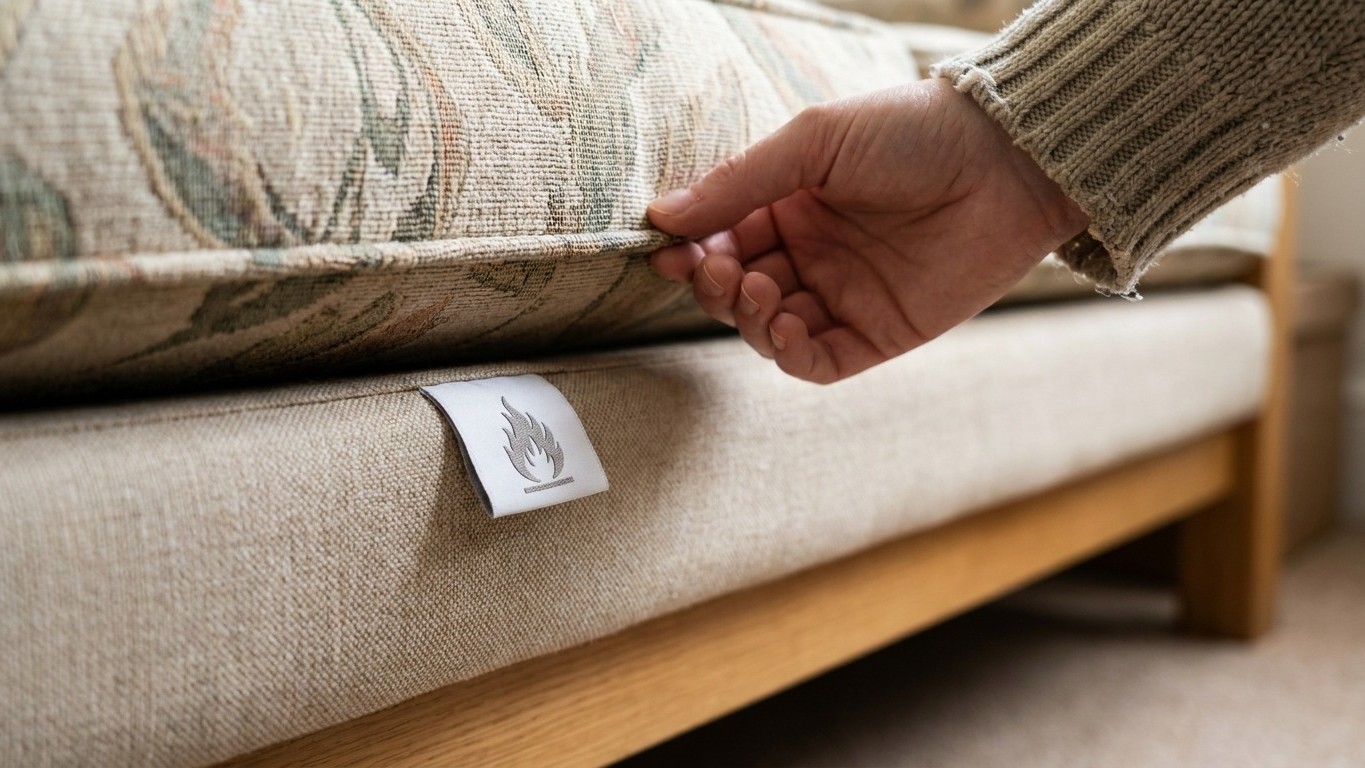
Under nearly every donated sofa in a British charity shop lies a small woven tag, no bigger than a bookmark, that volunteers have learned to hunt for before anything else. Flip the cushions, run a hand along the underside, and there it is (or isn’t). That single strip of fabric determines whether the sofa goes on the shop floor with a price tag or gets wheeled straight to the skip.
It sounds almost absurdly small stakes for something so decisive. But this is exactly why volunteers keep repeating the same instruction to new recruits: check the label first, before you even look at the fabric or the springs.
Key takeaways
- A small fabric label hidden under sofa cushions determines everything—but most people who bought their sofas new never knew it existed
- Selling a secondhand sofa without this label is illegal in the UK and increasingly enforced in the US, with real fines for violations
- One piece of missing paperwork can transform a gorgeous mid-century armchair into unsellable waste—no exceptions, no appeals
What that tiny tag actually proves
In 1988, the U.K. government introduced the Furniture and Furnishings (Fire) (Safety) Regulations to make domestic upholstered furniture safer from fires, reduce house fires caused by furniture and save lives. The rule was born from a grim reality: foam fillings and certain fabrics could turn a dropped cigarette or a stray match into a fast-moving house fire. Many upholstered pieces of furniture are composed of foam, fillings and other potentially flammable fillings. So regulators demanded proof, in the form of a permanent label, that every stitch of a sofa’s construction had been tested against ignition.
The label isn’t decorative and it isn’t optional paperwork. The permanent label may be located under a loose seat cushion or if the upholstery is fixed, secured to the base of the item or located at the junction between the seat and back. Most people who bought their sofa new never noticed it, tucked away where no eye would ever land unless someone went looking. Which, as it turns out, is precisely what charity shop staff are trained to do the moment a donation truck pulls up.
No label, no sale, no exceptions
Here’s the part that surprises most donors: it isn’t the charity being fussy. It’s the law. In the Furniture and Furnishings (Fire Safety) Regulations 1988, it states that it is actually illegal to supply second-hand sofas “in the course of business or trade” that don’t have the fire safety label attached. A charity shop selling furniture to raise funds counts as trade in the eyes of the regulation, no matter how good the cause.
The consequences of getting this wrong aren’t hypothetical. A UK sofa retailer was fined close to £20,000 in 2023 for labeling violations tied to these very rules, a reminder that regulators still enforce this decades-old requirement with real teeth. When you come to get a new sofa you will not be able to pass your old sofa to a charity for re-use facility without a permanent label, and without the label the sofa will need to go to a waste recycling centre. No amount of pristine upholstery, expensive fabric, or barely-used cushions changes that outcome. A gorgeous mid-century armchair with a missing tag is, legally speaking, indistinguishable from a battered thrift-store reject.
There’s one narrow exception, and it’s worth knowing if you’re trying to be resourceful rather than wasteful. The regulations state that the distribution of second-hand upholstered furniture by a charity in pursuance of its charitable objectives to needy persons, either free of charge or at a nominal amount only, does not constitute supply in the course of business and is therefore exempt. Give the sofa away for free through a community scheme, and the label technically doesn’t matter. Sell it in a shop window for even a few pounds, and it does.
America has its own version, and most people have never noticed it either
This isn’t purely a British quirk. The United States runs a parallel system, just under a different name and with different enforcement logic. Since 2021, federal regulators have folded California’s long-standing flammability rule into national law. 16 CFR part 1640 adopts flammability standard CA TB 117-2013 at the federal level and requires that the manufacturer certify and label each product with the statement “Complies with U.S. CPSC requirements for upholstered flammability.” Every sofa, sectional, and accent chair sold legally in the U.S. now carries some version of that tag, usually stitched beneath the cushions or zipped into the base, in the exact spirit of its British counterpart.
The reason regulators on both sides of the Atlantic care this much comes down to a statistic that should make anyone reconsider that stained secondhand loveseat on Craigslist. Research has consistently shown that upholstered furniture fires are low-frequency but high-fatality events, with fires in which residential upholstered furniture was the first item ignited accounting for 16% of US residential fire deaths. A sofa isn’t just a place to sit. It’s one of the largest, densest fuel sources in most living rooms.
American donation centers don’t operate under quite the same criminal liability as UK charity shops, and enforcement is patchier, but the practical effect is similar. Goodwill and Salvation Army locations increasingly turn away upholstered items that look tampered with, re-covered without documentation, or missing any trace of a compliance tag, partly for legal caution and partly because unlabeled furniture is genuinely harder to resell with confidence.
Before you drag that couch to the curb
If you’re clearing out a sofa this year, on either side of the Atlantic, the smart move is checking the label before you even call for a pickup. Lift every cushion, run your fingers along the base seam, and look at the back-to-seat junction if the upholstery is fixed rather than removable. A missing tag doesn’t necessarily mean your furniture is unsafe. It sometimes just means it predates modern labeling requirements entirely, which is common with genuinely old or antique pieces that were manufactured before these rules existed.
That’s the twist volunteers rarely mention out loud: the tag isn’t really a judgment on your sofa’s quality. It’s a paperwork trail, and paperwork trails get lost, cut off during reupholstery, or simply never printed on furniture made before the rule existed. So next time you’re donating, don’t just check whether the cushions still bounce back. Check underneath them first.
Sources : ecfr.gov | federalregister.gov | cpsc.gov