
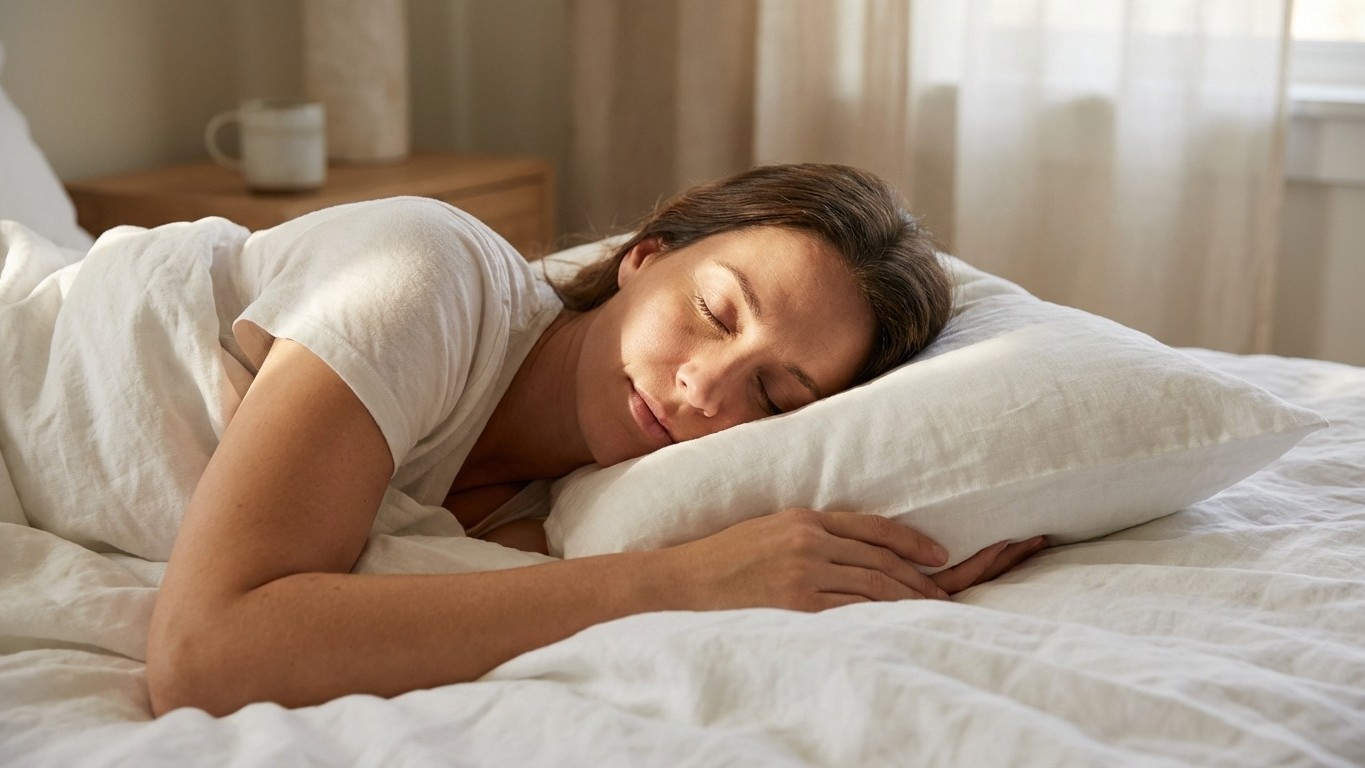
You spend a third of your life horizontal, unconscious, supposedly recovering. And yet, every single morning, something is quietly working against your skin, pressed into a pillow, creased under the weight of your own face, folding in ways no serum can fully undo by morning. Sleep is supposed to be beauty’s best friend. The reality is more complicated than that.
Dermatologists have been raising this conversation for years, but it keeps getting buried under the latest retinol launch or the newest peptide cream. The position you default to when you fall asleep, that reflexive, deeply habitual pose your body finds in the dark — may be doing more cumulative damage to your facial skin than almost any lifestyle factor you’d think to address first.
Key takeaways
- Side sleeping compresses facial skin against pillows for hours, creating permanent crease patterns that dermatologists call ‘sleep rhytids’
- Back sleeping is ideal but nearly impossible for most people to maintain—so dermatologists now recommend a layered approach instead
- Silk pillowcases, contoured pillows, and strategic hydration can reduce compression damage while you sleep tonight
The Mechanics of a Pillow’s Damage
Side sleeping is the most common position in the United States. Studies consistently show that somewhere between 57 and 74 percent of adults sleep on their side, often with a strong preference for one side over the other. For your spine, your airways, and your digestion, this can be great news. For your face, the math is less flattering.
When you sleep on your side, your cheek and the periorbital area around your eye are compressed against the pillow surface for hours at a stretch. Skin that would otherwise rest in its natural, relaxed position is instead folded, pushed, and held in place. Unlike the expressive lines formed by smiling or squinting, which relax when your face does, sleep compression lines are formed under static, sustained pressure. Over years, the collagen in those areas breaks down along those exact crease patterns. The lines start appearing overnight and disappearing by noon. Then one morning, they don’t disappear before noon. Then they stay all day.
Board-certified dermatologists describe this mechanism as “sleep rhytids”, wrinkles caused specifically by repeated mechanical compression rather than muscle movement or UV exposure. They tend to appear diagonally across the cheeks, vertically on the chin, and at the outer corners of the eyes, in patterns that have nothing to do with your natural facial expressions and everything to do with which side of your face meets the pillow every night.
Back Sleeping: The Gold Standard Nobody Actually Keeps
Ask any dermatologist what position they recommend, and you’ll get the same answer: sleep on your back. Gravity distributes evenly, no surface pressure is applied to the face, and the skin rests in its natural configuration for the entire night. The logic is airtight. The practice is, for most people, nearly impossible to maintain.
Habitual sleep positions are notoriously hard to change. Your body learned its preferred pose over decades, and it will return to it in the first deep sleep cycle before you even know it happened. Back sleeping can also worsen snoring, and for anyone dealing with acid reflux, it’s simply not always an option. So the conversation shouldn’t stop at “sleep on your back”, it needs to go further.
What dermatologists and sleep specialists increasingly Suggest is a layered approach. Repositioning is one tool among several, not a standalone fix that requires perfecting before anything else matters.
What You Can Actually Do Tonight
Silk and satin pillowcases have moved from luxury curiosity to near-mainstream recommendation in the past few years, and the reasoning holds up under scrutiny. The reduced friction means your skin glides rather than drags against the surface, which diminishes the tugging and pulling that compounds compression damage. Silk’s smooth weave also absorbs less of the moisturizers and treatments you apply before bed, so your products Actually stay on your face rather than transferring to the fabric by 3 a.m. It’s a modest investment with a solid rationale behind it.
Contoured or cervical pillows designed to cradle the head in a way that minimizes face contact have grown in popularity, and some people find them genuinely effective for training themselves toward a more back-adjacent position. Wedge pillows, which elevate the head at an angle, serve double duty: they reduce facial puffiness by improving drainage overnight and limit the degree to which your cheek presses flat against any surface.
There’s also the skin preparation angle. Applying a richer moisturizer or a facial oil before bed creates a more supple, pliable surface that’s slightly more resistant to compression creasing than dry, dehydrated skin. Hydrated skin doesn’t escape the mechanical forces at work, but it does recover better from them. Think of it less as prevention and more as resilience-building.
One thing that genuinely surprises people: switching which side you sleep on, even inconsistently, distributes the cumulative damage rather than concentrating it. If you’ve been a dedicated left-side sleeper for twenty years, the asymmetry in your facial aging can be visible, more pronounced lines, slightly more volume loss on that cheek, deeper nasolabial folding. Alternating sides doesn’t solve the problem, but it stops one half of your face from bearing the full burden.
The Bigger Picture Sleep Is Still Getting Right
None of this should eclipse what sleep itself does for your skin. The nighttime hours are when cell turnover accelerates, when cortisol levels drop and allow skin to repair itself, when the lymphatic system clears the inflammatory byproducts that accumulate through the day. A person sleeping eight hours on their side is, on balance, in far better skin shape than someone sleeping five hours flat on their back. The position matters, but it matters within a larger context of quality and duration.
The more useful reframe is to think of sleep not as a passive state but as an active environment, one you can actually optimize, at least at the margins. Your pillow, your position, your hydration levels, the temperature of your room: these are the things happening to your skin for seven or eight hours every night, largely unattended. The question worth sitting with is how much of that environment you’ve ever Thought to design deliberately.