
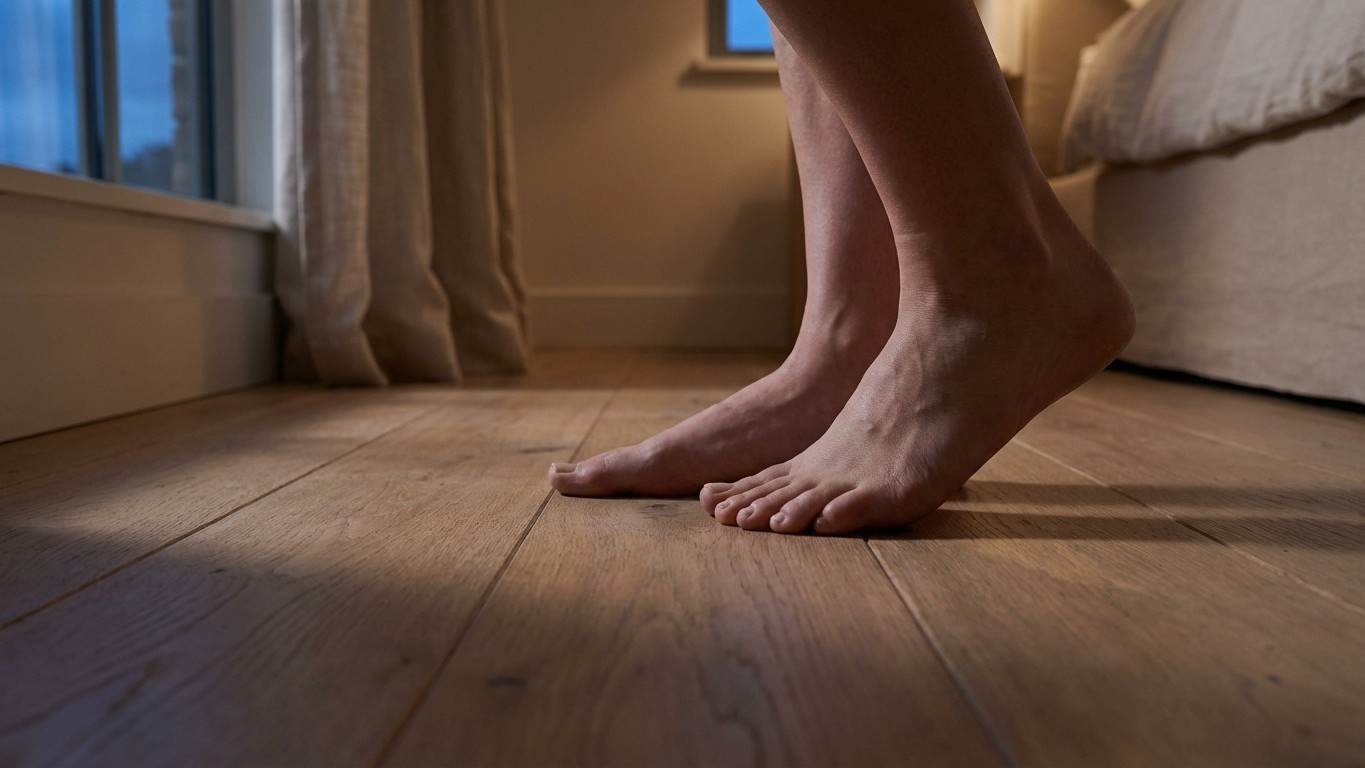
The floor was cold. That was the first thing I noticed, not unpleasantly, but sharply, the way a glass of water hits differently at 2 a.m. than it does at noon. Three months ago, I made what seemed like a trivial household decision: Stopped-wearing-slippers-at-home-what-i-noticed-about-my-legs-after-two-weeks”>I Stopped Wearing Slippers from the moment I woke up to the moment I got into bed. No foam soles, no sherpa lining, no cushioned buffer between my feet and whatever surface I was standing on. What followed surprised me in ways no wellness podcast had prepared me for.
Sleep was the last thing I expected to change.
Key takeaways
- A three-month experiment without slippers triggered measurable changes in sleep onset and nighttime restlessness
- Your feet contain dense sensory receptors that send signals your nervous system has been missing while cushioned
- Walking barefoot activates a chain reaction: feet → posture → tension release → deeper sleep readiness
The slippers habit we never questioned
Most of us inherit our indoor footwear habits without much reflection. Slippers are comfort, warmth, a signal that the day is winding down. In many households, putting on slippers is practically a ritual transition, shoes off, slippers on, mode switched to “home.” There’s nothing wrong with that. Except that somewhere along the way, our feet became permanently insulated from the world beneath them, and we Stopped thinking about what that actually means for the body.
The soles of your feet are among the most neurologically dense areas of the human body, packed with sensory receptors that communicate constantly with your nervous system. These receptors, called mechanoreceptors, respond to texture, temperature, and pressure. When you walk barefoot on a cool hardwood floor, that information travels fast. The nervous system registers it, processes it, and responds. Slippers, by contrast, create a kind of sensory silence, soft, uniform, neutral. Convenient, yes. But also a form of deprivation that compounds quietly over time.
What barefoot living actually does to the body
Going barefoot indoors activates proprioception, your body’s sense of its own position in space. The small muscles in the feet and ankles that tend to go dormant inside cushioned footwear start working again. Over weeks, the effects travel upward: better posture, less tension in the calves, and, this part caught me off guard, a measurable reduction in that low-grade physical restlessness that makes it hard to settle into sleep.
The sleep connection isn’t as mysterious as it sounds once you follow the logic. Chronic tension in the feet and lower legs is common, especially for people who sit at desks for long hours or who wear structured footwear all day. That tension doesn’t dissolve the moment you put on slippers, it just gets cushioned. Walking barefoot on varied surfaces activates and then releases muscle groups that rarely get the chance to fully cycle through tension and relaxation. By bedtime, the body has done more of that work. The result is a physical readiness for rest that’s qualitatively different from just being tired.
There’s also the temperature angle, and this one has genuine science behind it. Body temperature naturally drops in the hours before sleep, it’s part of the circadian signal that tells the brain night is coming. Research on thermoregulation and sleep consistently shows that the extremities, hands and feet, play a disproportionate role in this cooling process. Walking barefoot on cool floors in the Evening hours can actually assist that temperature drop, nudging the body gently in the direction of sleep rather than keeping it in a thermally neutral, ambiguous zone.
The counter-intuitive part
Here’s where most people push back: “But cold feet keep me awake.” And they’re not wrong, extreme cold is counterproductive. There’s a real difference between a cool tile floor in autumn and a freezing kitchen in January. The sweet spot is mild coolness, the kind that feels bracing for a moment and then normalizes. Think of it the way a chef thinks about contrast: a pinch of salt doesn’t make something salty, it makes everything else more defined.
The other objection is hygiene, which is fair, especially in households with pets or kids. A simple habit of sweeping floors more regularly solves most of that. Some barefoot advocates suggest transitional surfaces, a natural fiber rug by the bed, a cork bathmat, that offer sensory engagement without the hard-floor chill. The goal isn’t masochism, it’s stimulation. Small, daily doses of sensory contact that the feet were designed to receive.
Spending time barefoot outdoors takes this further, and the practice sometimes called grounding (or earthing) has attracted both devoted followers and legitimate researchers. Some studies suggest direct contact with natural surfaces may influence cortisol rhythms and inflammatory markers. The science is still young and the effect sizes are modest, so let’s not overstate it. But the direction of the evidence is interesting enough to pay attention to.
What actually changed for me
After about three weeks without slippers, I noticed I was falling asleep faster. Not dramatically, not in a way that any sleep tracker could have predicted from my morning routines. It was subtler: less of that prolonged phase of lying there waiting for the body to downshift. My legs felt less jumpy at night. That restless, slightly electric feeling that I’d attributed to screen time or caffeine turned out to have a physical, muscular component I hadn’t identified before.
My feet also changed. The skin toughened slightly on the heels (nothing dramatic, just a normal adaptive response), and my arch awareness increased in a way I can only describe as waking up a sense I’d been muting for years. A podiatrist I spoke to mentioned that habitual slipper-wearing can gradually weaken the intrinsic foot muscles, the small ones responsible for dynamic balance and shock absorption, not unlike how a wrist weakens when kept in a brace too long. The parallel felt uncomfortably accurate.
None of this means slippers are villains, or that you need to rethink your entire evening routine. Some people, particularly those with certain circulatory conditions or diabetes, genuinely need foot coverage indoors. But for many of us, slippers are a default comfort we’ve never questioned. And the most interesting wellness changes, in my experience, tend to come from exactly those unexamined defaults.
What else are you cushioning without realizing it?