
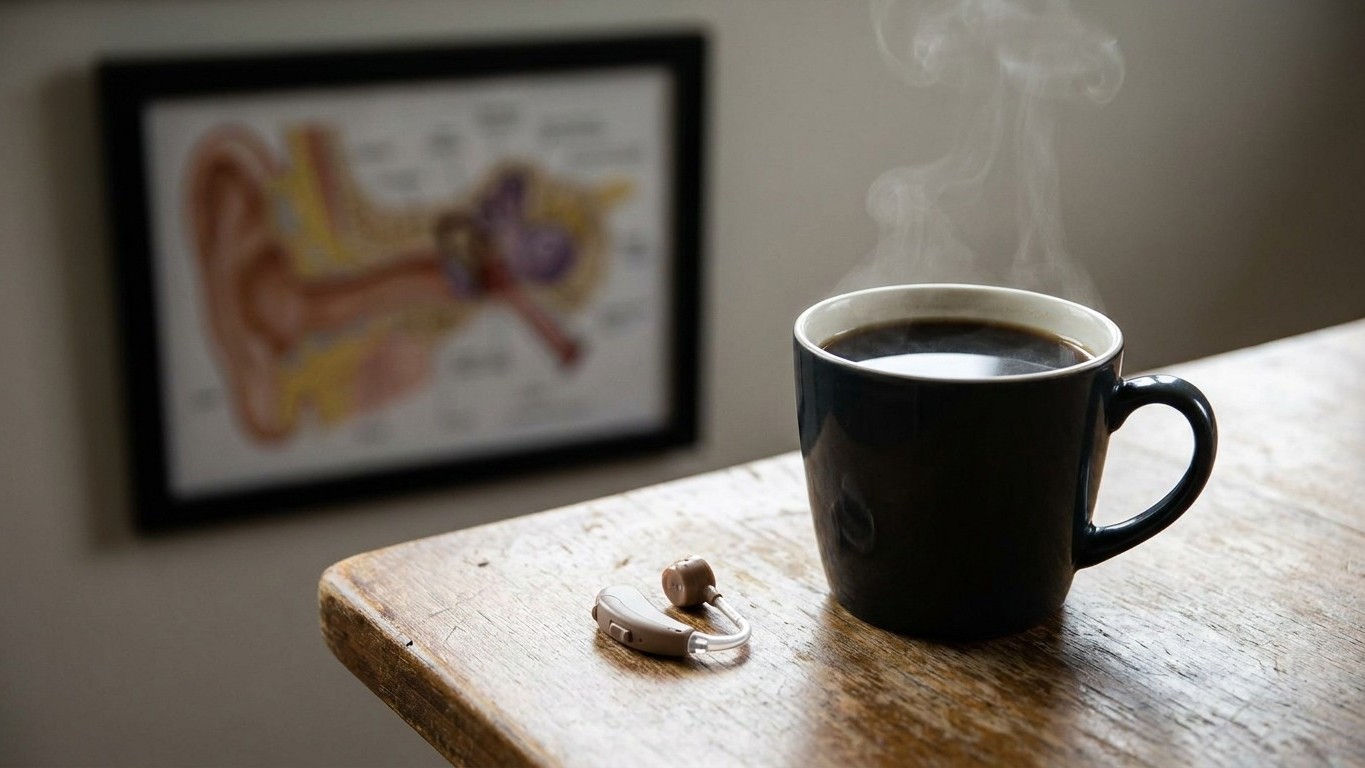
The ringing starts quietly. A faint hum behind the left ear, barely noticeable at first, easy to blame on a loud restaurant, a stressful week, the natural friction of getting older. Then one morning, sitting in an audiologist’s office for a routine check, you mention it almost as an aside. And that’s when the question comes: How much coffee do you drink?
For millions of Americans, that moment lands like a small earthquake. Around 25 million American adults report experiencing tinnitus, that persistent ringing, buzzing, or hissing in the ears, for five or more continuous minutes in the past year. A staggering number. And yet there are no documented cures for tinnitus, only treatments that can help manage it. So when an audiologist points at the most beloved morning ritual in the country and says that might be part of the problem, the reaction is, understandably, skepticism. Or grief.
The drink in question, of course, is coffee. Or : caffeine.
Key takeaways
- Caffeine blocks adenosine receptors and can starve inner ear cells of oxygen—but research shows a shocking contradiction
- A major study found heavy coffee drinkers were actually 15% LESS likely to have tinnitus symptoms
- The real risk depends on your age, consumption habits, and when you quit—withdrawal might make things worse first
What Caffeine Actually Does Inside Your Ears
Caffeine acts as a stimulant to the central nervous system, and its biological effects indicate that it affects both the peripheral and central auditory systems, including the inner ear directly. That’s not a minor footnote, that’s a direct line between your morning cup and the delicate architecture responsible for how you hear.
The mechanism is layered. The pathophysiology behind caffeine’s effect on tinnitus is probably related to the blockage of adenosine receptors by the action of caffeine on the central nervous system. Adenosine, under normal circumstances, acts as a natural brake on neural excitability. Block those receptors, and the auditory pathways can become overactive, amplifying phantom sounds that shouldn’t be there, or making existing ones louder.
There’s also a vascular dimension. Caffeine may affect tinnitus by stimulating your nervous system and triggering or worsening stress responses, such as raised blood pressure and constriction of the blood vessels. The inner ear is extraordinarily sensitive to changes in blood flow, it relies on a network of tiny capillaries that are among the most fragile in the body. Caffeine impedes cochlear blood reperfusion, increases oxidative stress, and heightens noise-induced cochlear hypoperfusion and ischemia by promoting the reduction of cerebral blood flow and arteriole diameter. Translation: your cup of coffee may be quietly starving the cells responsible for your hearing of the oxygen they need.
On top of that, caffeine can also cause dehydration, which is known to exacerbate tinnitus symptoms. A detail so obvious it gets overlooked constantly.
The Plot Twist the Research Reveals
Here is where things get genuinely complicated, and where the conventional wisdom starts to crack.
A study published in the American Journal of Medicine in 2014 indicated that participants with a higher caffeine intake actually had a lower risk of tinnitus. The 18-year study included 65,085 women between 30 and 44 years of age, and results showed that women who drank five cups of coffee a day were 15% less likely to report tinnitus symptoms than those who drank a cup and a half. That is a counterintuitive finding by any measure, and it’s not a small study.
There was a lack of high-quality evidence in the current literature evaluating the relationship between caffeine intake and tinnitus, making it impossible to establish a clear causal relationship. The science, in short, is genuinely unsettled. What is clear is that the relationship between caffeine and tinnitus is deeply individual.
And here’s the detail that surprises almost everyone: quitting cold turkey may make things worse before they get better. Withdrawal of caffeine could possibly worsen the symptoms of tinnitus. If you’re dependent on caffeine, cutting it out of your diet cold turkey may make your tinnitus symptoms worse before they get better. That spike in symptoms during withdrawal has led some people to falsely conclude that caffeine was never the problem, when in reality, they were experiencing the physiological rebound of a nervous system that had adapted to constant stimulation.
Who Is Actually Most at Risk
Not every coffee drinker with tinnitus is in the same situation. The research points to meaningful distinctions. Patients under 60 years of age with bilateral tinnitus and daily coffee consumption between 150 and 300 mL are more prone to benefit from consumption reduction. That’s roughly one to two small cups per day, a threshold many Americans surpass before 9 a.m.
People who suffer from tinnitus will notice that caffeine is a trigger and can increase the loudness of the noise in their ears and head. But the key word is trigger — not cause. Tinnitus typically originates from a prior injury: it often occurs because the tiny hair cells in the inner ear are damaged, producing constant stimulation of aural nerves, with many contributing factors including exposure to loud noise, aging, medications, hearing loss, allergies, and stress. Caffeine, then, functions less like an arsonist and more like gasoline on a fire that was already burning.
Other dietary triggers work through similar mechanisms. High-sodium foods cause the body to retain fluid, increasing pressure inside the ear, which leads to more noticeable tinnitus symptoms, especially for those who already have hearing challenges. With a sudden spike in blood sugar, the circulation in the inner ear can worsen the tinnitus condition — foods with a lot of sugar, including sweetened drinks, baked goods, and high-carb snacks, can all increase blood sugar levels. The picture becomes one of cumulative load: caffeine stacked on top of salt, stress, and sugar, all of it landing in the same delicate place.
What to Actually Do About It
The answer is not necessarily to abandon coffee. While there is no definitive evidence that caffeine worsens tinnitus, some individuals report that reducing their caffeine intake helps alleviate their symptoms, while others find no change at all, suggesting that caffeine’s effect on tinnitus may vary from person to person. The only way to know which camp you fall into is to test it methodically.
Audiologists typically recommend a structured approach. The most reliable method is an elimination diet: completely removing the suspected trigger from your diet for two to six weeks, then reintroducing it to see if your tinnitus is affected. Tracking both caffeine intake and symptom intensity in a journal during this window gives you real data rather than guesswork.
Repeated caffeine intake can sustain nervous system stimulation, which may make tinnitus more noticeable in the evening, gradually reducing caffeine, spacing consumption earlier in the day, or choosing lower-caffeine alternatives can help identify whether it affects symptom intensity. Timing, it turns out, matters almost as much as quantity.
For those who want to keep some version of the ritual, herbal teas like chamomile, peppermint, and rooibos are naturally caffeine-free and can promote relaxation, while decaffeinated coffee and tea provide the flavor without the stimulant effect. Worth noting: research from 2014 shows no connection between decaf coffee and tinnitus, and suggests that caffeine, rather than another component of coffee, is what’s linked to changes in tinnitus perception. So the ritual itself doesn’t have to go. Just the molecule driving it.
What’s rarely discussed in these conversations is the role of sleep. In some people, caffeine makes it hard to get sufficient sleep, making tinnitus even harder to manage, a feedback loop that compounds nightly, eroding the very recovery time the auditory system needs to regulate itself. Twenty years of poor sleep quality, quietly Undermining the ears. That’s the part no one warns you about at the coffee shop.
Sources : pmc.ncbi.nlm.nih.gov | nychearing.com