
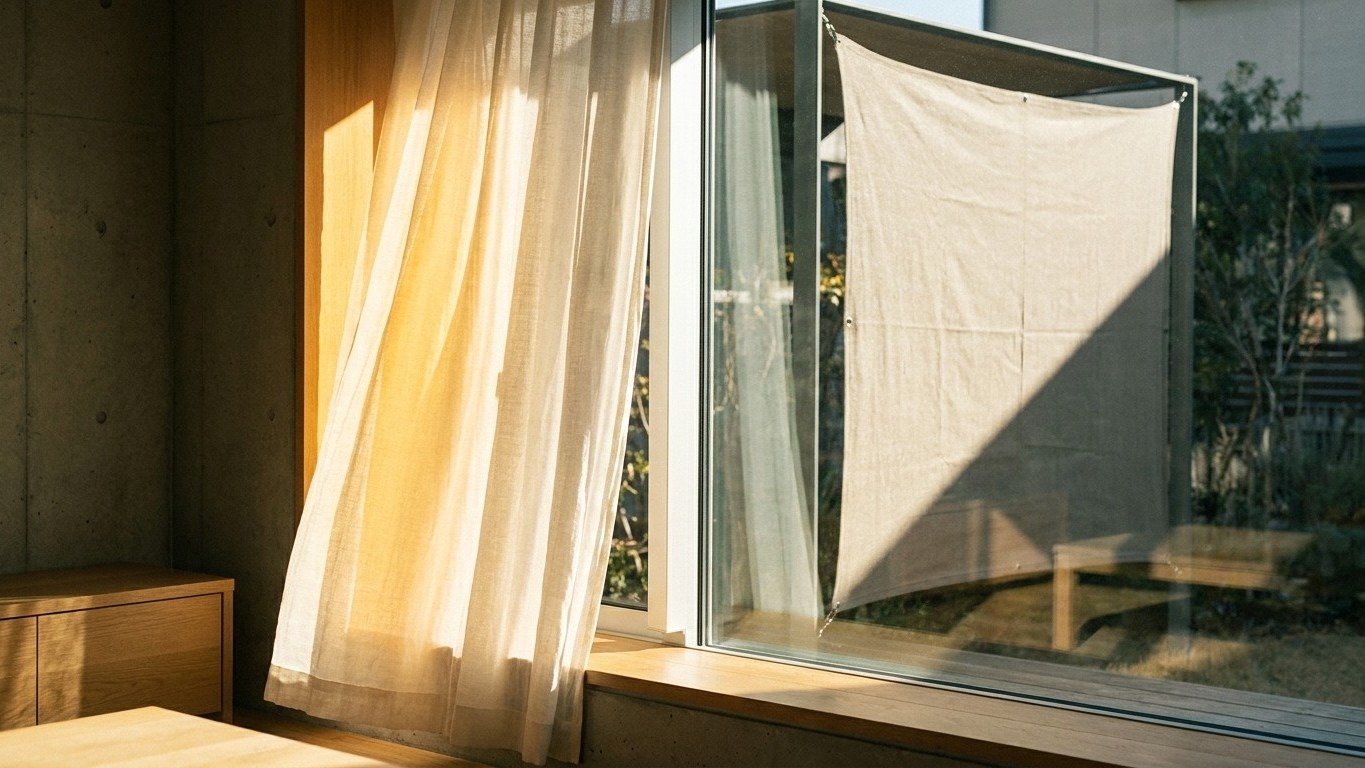
Every morning, same ritual: yank the curtains shut before the sun climbed high enough to turn my living room into a greenhouse. The window faced due south, floor to ceiling, and by 9 a.m. the light was already aggressive. I assumed the fabric was doing its job, holding the heat at bay. Then I clipped a canvas drop cloth to the outside of the frame, just to test something, and within an hour the room stayed cool in a way it never had with the curtains alone. That’s when it clicked: the curtains weren’t blocking heat. They were trapping it.
Key takeaways
- A canvas clipped outside the window kept the room cooler than years of daily curtain-closing ever did
- Interior window treatments only block 30-40% of solar heat gain, while exterior solutions block 65-77%
- The sun’s rays convert to heat the moment they hit glass—interior curtains absorb and re-radiate that warmth back into the room
What Curtains Actually Do to Sunlight (and Why It’s Not Enough)
Glass isn’t a passive barrier. When sunlight hits a windowpane, a chunk of that solar energy converts to heat the instant it enters the room, and standard double-pane glass creates a significant portion of that energy converting to heat immediately upon entering the room, creating a greenhouse effect where the heat is trapped inside. By the time light reaches an interior curtain or blind, the damage is already done, at least thermally.
Standard interior window treatments help manage the light that enters a room, but by the time sunlight reaches an interior shade or blind, much of the solar energy has already passed through the glass. Interior treatments can dim a room, sure, but heat is a different animal. Once the heat has passed through the glazing, it is already inside the building envelope, and interior treatments can only reflect a portion of that heat back out, while the rest is absorbed by the curtain material and radiated into the room. Which is exactly what I’d been unknowingly engineering every morning: a curtain absorbing sun, warming up, then slowly releasing that heat right back into my living space, hours after I thought I’d “blocked” it.
The numbers back this up more starkly than I expected. Exterior shades can block up to 80% of solar heat while interior options only cut it by about 30 to 40%. That’s not a marginal difference, it’s a completely different category of performance. Even the best-case interior scenario, reflective blinds closed tight, tops out modestly: when completely closed, highly reflective blinds can reduce heat gain by around 45 percent, says the DOE.
The Physics Behind the Canvas Trick
Here’s the part that reframes everything: shading has to happen outside the glass to actually work. The most effective way to manage solar heat gain is to stop the sun’s rays before they even hit the window glass. An opaque canvas, an awning, a solar screen mounted on the exterior, any of these intercept the radiation before it ever gets the chance to convert into heat against your glazing.
This isn’t a fringe theory from a home blog. It’s Department of Energy data, repeated across nearly every serious source on window efficiency. Window awnings can reduce solar heat gain by up to 65 percent on south-facing windows and 77 percent on west-facing windows, according to the DOE. Compare that to drapery, which even at its best barely breaks a third: something as simple as a set of medium-colored drapes backed with white plastic reduces solar heat gain by as much as 33 percent.
Why such a gap? Because exterior coverings attack the problem at its source. Exterior window coverings intercept solar energy before it reaches the glass, preventing the glass from absorbing and transmitting heat into the home. My canvas wasn’t decorative. It was doing thermodynamic work that a yard of linen inside the room could never replicate, no matter how thick or how tightly I drew it.
Making It Work Without Renovating the Facade
Not everyone can bolt an awning to their building or is allowed to under a co-op board or HOA. But the fix doesn’t require construction. Exterior solar screens, retractable shade panels, even a simple canvas or shade cloth clipped to a tension rod outside the frame, all exploit the same principle: block it before it’s glass-warmed.
For south-facing rooms specifically, where the sun tracks high and constant through the day, the priority list looks something like this:
- Exterior solar screens or awnings first, since the Department of Energy reports that awnings can reduce solar heat gain by up to 65% on south-facing windows and 77% on west-facing windows
- Cellular (honeycomb) shades as the strongest interior backup, since their trapped air layer adds real insulation rather than just blocking light
- Curtains reserved for what they’re genuinely good at: softening light, adding privacy, finishing a room aesthetically
None of this means curtains are useless. They still matter for glare, for the way morning light bounces off a wall, for privacy after dark. But the honest answer, the one my canvas experiment forced me to accept, is that interior window treatments, such as blinds, shutters, or curtains, are excellent for privacy, brightness, or glare control but do very little to combat solar heat gain. Pairing both layers tends to be the smartest move rather than picking one camp entirely. They can supplement exterior shading approaches to improve performance and flexibility throughout the day or year, and to provide privacy at night.
What surprised me most wasn’t the temperature difference, though that was real and immediate. It was realizing how confidently I’d misread the whole mechanism for years, treating a symptom (glare) as if it were the cause (heat). The canvas outside my window didn’t just cool the room. It exposed a small, very common misunderstanding about how sunlight actually behaves once it crosses a pane of glass, one that a surprising number of us are still drawing curtains against every single morning without realizing the heat got in long before the fabric ever moved.
Sources : hartleywindowcoverings.com | basc.pnnl.gov