
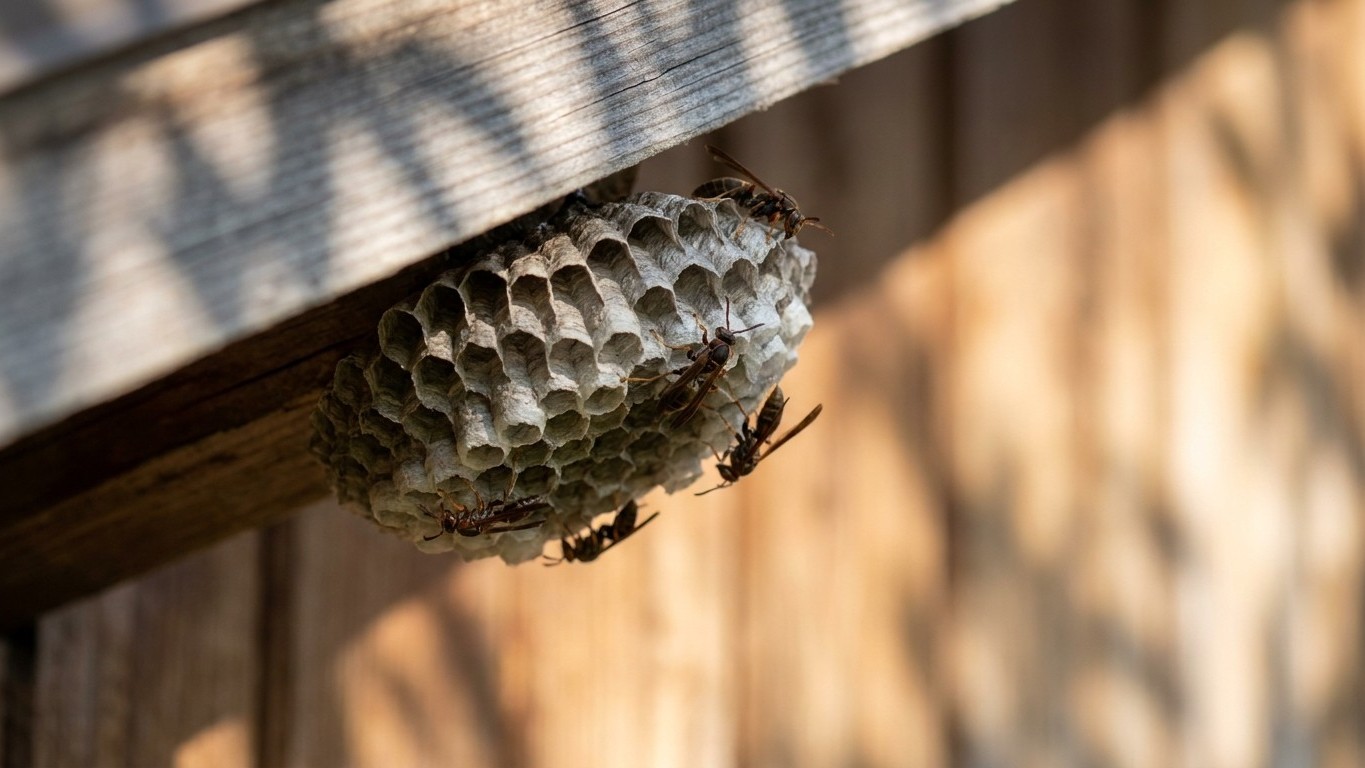
Three days. That’s all it took for the wasps to rebuild, in the exact same spot, right where I’d doused everything with an entire can of spray in the middle of the afternoon. I stood there under my own eaves, can still in hand from days earlier, staring at a fresh gray paper structure taking shape exactly where the old one had been. I hadn’t imagined the wasps disappearing. I’d watched them scatter, watched the frenzy die down. What I hadn’t understood, until I started digging into why this happens, is that I’d never actually touched the part of the colony that mattered most.
Key takeaways
- Most wasps are away from the nest during peak daylight hours—you’re only hitting the guards
- The queen and developing larvae are protected deep inside, insulated by layers of wood pulp
- The pheromone signature on the attachment point kept calling new wasps back to rebuild in the exact same spot
The Daylight Mistake Almost Everyone Makes
Spraying at 2 p.m. felt logical. Good visibility, no need for a flashlight, wasps visibly present on the nest surface. Except that’s precisely the problem: at that hour, only a fraction of the colony is even home. Wasps are most active during the daytime, especially in the warmer hours between late morning and late afternoon, and they leave the nest during the day to hunt for food and materials, meaning many of them are away from the colony during those times. I’d hit the ones guarding the surface. The foragers, the ones out collecting insects and building material, came back later to a damaged but not destroyed structure, and simply picked up where the others left off.
There’s also a mechanical limit to what a can of aerosol can actually do. Aerosol sprays provide a quick knockdown effect, but their reach is limited, often failing to penetrate the core of a large or covered nest. My spray killed what it touched on the outside. It never reached the interior galleries where the queen and the developing larvae were sitting, protected by layers of chewed wood pulp acting like insulation. And when a colony isn’t fully wiped out, biology does the rest of the work for it. That really depends on the species of wasp, but in many instances, they will simply choose a new queen and proceed with their efforts in the nest.
What I Actually Never Touched
Here’s the part that surprised me most. Even in nests that get fully knocked down, wasps don’t come back at random. They can return because of the pheromones left behind, and these signals tell other wasps that your yard is a good place to build a new nest. My spray had done nothing to erase that chemical signature clinging to the wood siding, the paint, the little wooden stem that anchors the whole structure to the eave.
One detail nobody mentions on the can: with paper wasps specifically, the attachment point matters as much as the nest itself. If these are the wasps that build a paper nest, you have to remove the nest. Also, the stem that holds the nest, because spray alone won’t work for long as the odor of the stem attracts new wasps back to rebuild. I had sprayed the papery dome and called it done. I had never scraped, washed, or removed the little wooden peduncle underneath, the actual signature that kept saying, to any scout wasp flying past, “build here.”
And frankly, my eaves were never a bad choice to begin with, which is exactly why the location kept getting reclaimed. Paper wasps prefer to build their nests in eaves, crevices, and overhangs because these spots offer shelter from wind and rain, and if your yard has plenty of these protected areas, this flying insect will see it as prime real estate. Killing the residents doesn’t demolish the real estate. Something else will always be tempted to move in, spray or no spray.
Doing It Right the Second Time
The fix wasn’t a stronger chemical. It was timing, and finishing the job. The best time to spray a wasp nest is after dark or before dawn when wasps are inside and least active. At night, the whole colony is clustered together instead of scattered between the nest and their foraging routes, which changes everything about how effective a single treatment can be. At night, almost the entire colony is clustered inside the nest, the wasps are cool, slow to react, and far less likely to mount a coordinated defense, and treating the nest when everyone is home means the insecticide reaches the maximum number of wasps at once, including the queen.
This time I aimed directly into the entrance rather than misting the outer shell, waited the full 48 hours pest professionals recommend before declaring victory, then went after the stem with a scraper and warm soapy water. No shortcuts, no daylight bravado. And crucially, I checked the calendar too, since chasing a nest in October is a very different job than in July. As temperatures begin to drop, wasp activity slows, and many nests will naturally die off after the first frost.
What still gets me is how confidently wrong my first instinct was, can in hand, sunlight on my face, thinking speed and daylight equaled control. It’s worth remembering, before reaching for that can again, that wasps are, for the most part, harmless, and of the 18,000 or so species in North America, only a few present a risk to humans, while the rest help keep insect populations like aphids and spiders in check and are important pollinators. Mine happened to be building right where my kids walk to the back door, so removal made sense. But the next nest I find somewhere quieter in the yard, I might just let it finish its season on its own.
Sources : ratpackpestcontrol.com | proofpest.com