
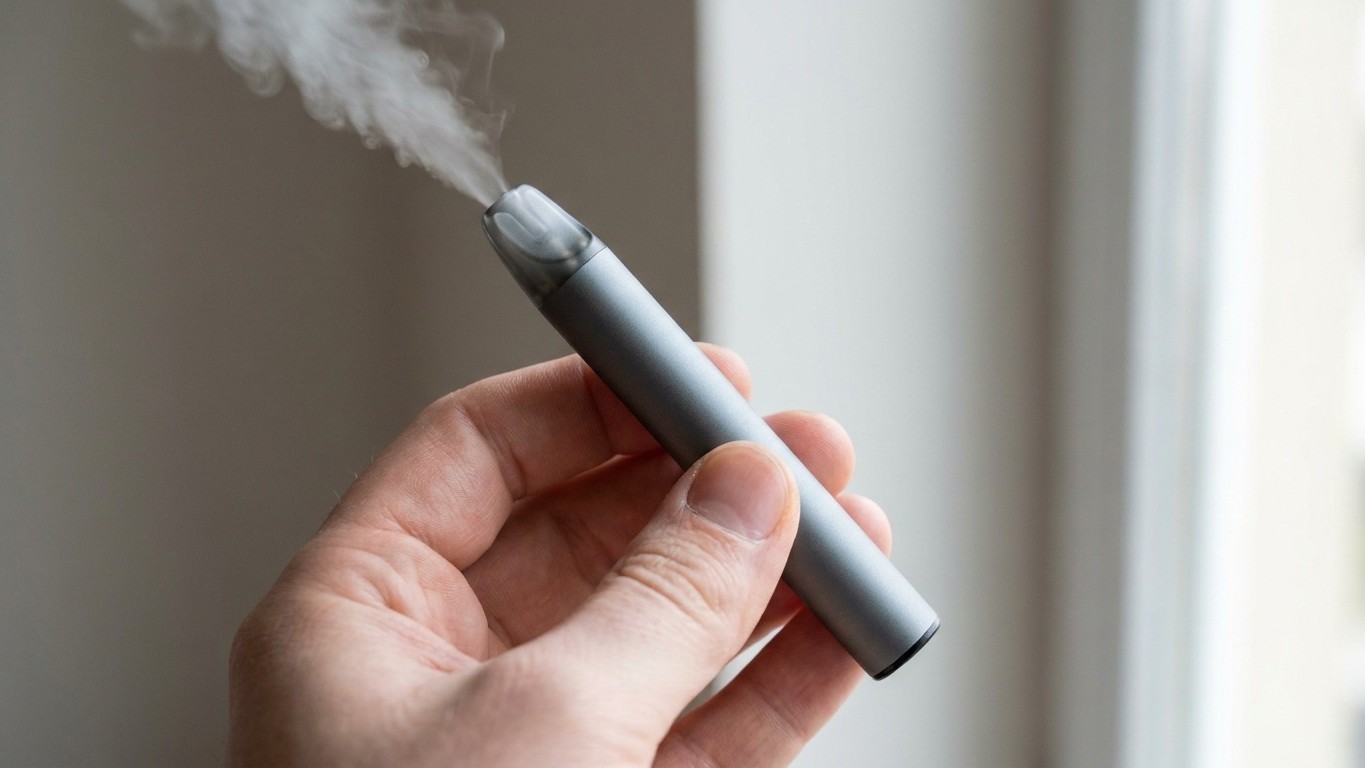
Cough during a first puff on a vape and most people relax: no cough, no problem, right? That instinct is exactly backwards. The tickle in your throat is not the warning sign to fear. What should worry you is the chemical trick that erases it, because that single modification is what lets a fourteen-year-old go from curious to dependent in a matter of weeks.
The compound responsible is benzoic acid, and it does something deceptively simple to nicotine. In nicotine salt, freebase nicotine is mixed with an acid, usually benzoic acid, which lowers the pH level, and the result is less throat irritation. Freebase nicotine, the form used in most cigarettes and early e-liquids, sits at a pH of roughly 7 to 8, which is why it makes nicotine more volatile and easier to vaporise, but it also makes the vapour harsher on the throat at higher concentrations. That harshness is not a flaw. It is the body’s alarm system, the same reflex that makes a first cigarette taste awful to almost everyone.
Key takeaways
- One acid removes the throat sensation that naturally stops people from inhaling dangerous nicotine levels
- Nicotine now hits the teenage brain as fast as an injection, but feels completely harmless
- Teens report feeling in control right up until they’re spending $150 a week on pods
The Chemistry That Silences the Alarm
Benzoic acid disables that alarm without touching the nicotine dose itself. The acid molecules donate a hydrogen ion to the alkaline nicotine molecules, which alters the electrical charge of the nicotine and drops the overall pH level of the e-liquid down to a biocompatible range. Translated out of the lab: the vapor now feels neutral against the throat, almost like nothing happened at all, even when the nicotine concentration inside it has actually gone up.
That combination, more nicotine plus less sensation, is precisely what makes nicotine salts different from anything smokers dealt with before. It makes the nicotine much smoother to inhale even at high concentrations, and it allows the nicotine to cross into the bloodstream more quickly, reaching the brain in as little as 6 to 10 seconds after inhalation. Six to ten seconds. That’s roughly the time it takes to read this sentence aloud. A teenager pulling on a disposable vape between classes gets a brain-level nicotine hit almost as fast as an injection, without a single cough to signal that something intense just happened.
This is not an accident of formulation. A startup patented a way to make protonated nicotine with carboxylic acids, and Juul listed benzoic acid on its pod ingredients, a small tweak that no doubt helped make e-cigarettes more appealing to all vapers, including young users. The founders reportedly knew about the technique years before launching their product, according to reporting that traced Juul founders caught wind of the nicotine salt trick as early as 2013, two years before they started selling their e-cigarettes. Before that shift, most e-cigarettes contained around 36 milligrams of nicotine per milliliter, while Juul pods advertised about 59 mg/mL, a jump made tolerable only because the harsh edge had been chemically filed off.
Why Speed Matters More Than Strength
Here’s the part parents underestimate: teenage brains are uniquely bad at noticing dependence forming, even as it happens quickly. A Stanford study on adolescent Juul users found teens and young adults who use Juul are failing to recognize the product’s addictive potential, despite using it more often than their peers who smoke conventional cigarettes. Researchers described asking teens directly whether they felt hooked. They say no, but a series of questions on a validated scale for assessing loss of autonomy over nicotine show that they’re dependent. The absence of coughing, of visible discomfort, convinces teens they’re in control right up until they’re not.
The lived version of that gap looks like What Happened to one North Carolina teenager, who went from occasional use to spending real money fast. When I started spending $17 every four days or every day it was getting to a problem, he said. I realized I was spending $150 on pods in a week, and I noticed this was getting out of control. Grades slid, behavior changed, and it took a medical emergency, not a bad cough, to force the issue into the open.
Adolescent bodies also react to nicotine differently than adult ones. Research on high-nicotine pod devices found that Juul and similar pod devices contain high concentrations of nicotine salts, and urinary cotinine in adolescent pod users was higher than cotinine levels previously reported among adolescent smokers of conventional cigarettes. Combine faster brain delivery, a smoother sensory experience, and a developing prefrontal cortex that already struggles with impulse control, and you get a dependency curve that outpaces anything a pack of cigarettes could produce.
The Numbers Are Better, But the Trick Hasn’t Disappeared
The good news, and there is some, is that overall youth vaping rates have fallen sharply from their peak. Current e-cigarette use among U.S. middle and high schoolers dropped from 2.13 million youth in 2023 to 1.63 million in 2024. Federal survey data for 2025 shows the decline continuing, with 7.1% of high school students and 2.6% of middle school students reporting current use of e-cigarettes. Regulation has tightened too: as of September 2025, there were only 39 FDA authorized e-cigarette products for sale to persons over the age of 21.
But the underlying chemistry hasn’t gone anywhere, and it’s already migrating into new formats. Manufacturers are now experimenting with softer acids like salicylic acid, marketed explicitly on the promise of an even gentler inhale than benzoic acid delivers, producing a gentler, softer inhale, strong and fast-acting but without the harshness that can come with benzoic formulations. Every refinement chases the same goal: make the dose bigger while making the sensation smaller. The cough was never the danger. It was the last honest signal the body had left, and it’s been engineered out on purpose.
Sources : thevapemall.com | nbcnews.com