
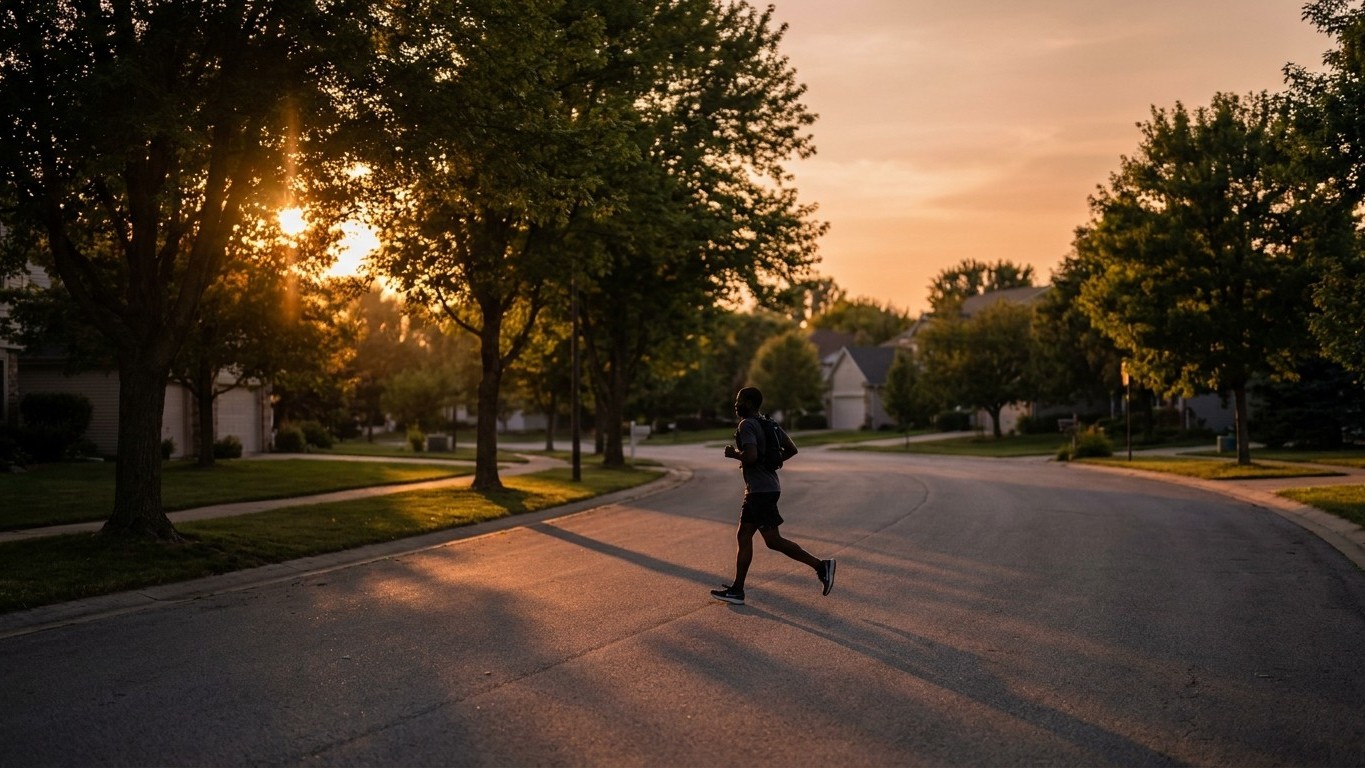
Six p.m. felt like the smart move. The worst of the afternoon heat had supposedly broken, the sun sat lower in the sky, and the sidewalk had stopped radiating like a skillet. So the logic seemed airtight: skip the midday blaze, lace up in the early evening, and call it a win for both performance and safety. Except the burning eyes, the raw throat, and the cough that lingered for hours afterward told a different story, and the doctor who finally explained it wasn’t talking about cardio fitness at all. She was talking about ozone.
Ground-level ozone, the invisible gas that forms when heat and sunlight cook up a chemical reaction between vehicle exhaust and industrial emissions, doesn’t peak at noon like most people assume. It builds through the day and often lingers well into the evening. Ground-level ozone levels are usually highest between noon and 7 or 8 p.m. in the summer months. A 6 p.m. jog, lands smack in the middle of the danger window, not after it.
Key takeaways
- Ground-level ozone peaks in early evening, not midday—exactly when most runners think they’re avoiding pollution
- Your fitness level offers zero protection; heavy breathing during exercise pulls ozone deeper into your lungs
- Morning workouts and real-time air quality apps are your actual defense against invisible chemical damage
Why the Air Gets Worse, Not Better, at Dusk
The mechanism behind this is almost counterintuitive once you understand it. Ozone isn’t emitted directly from a tailpipe or a smokestack. Most ground-level ozone forms in the air from chemical reactions involving nitrogen oxides (NOx), volatile organic compounds (VOCs), and sunlight. That reaction takes hours to fully develop, which means the pollution released by morning traffic doesn’t finish “cooking” until well into the afternoon, sometimes drifting for miles before it settles over a neighborhood that felt perfectly clear at breakfast.
The New York State Department of Health puts it plainly: ozone levels are most likely to be unhealthy in the afternoon through early evening on hot, sunny days, especially during episodes of stagnant air. Heatwaves, with their windless, high-pressure systems, are essentially a recipe for trapping that ozone close to the ground instead of letting it disperse. The very conditions that make a heatwave brutal are the same conditions that make evening air quality worse.
Some regional health agencies have started publishing timing guidance for exactly this reason. Colorado’s air quality outreach program is refreshingly specific about it: this invisible pollutant accumulates the most on hot and sunny summer days, reaching its highest levels in the afternoon and early evening. The same source recommends athletes exercise outdoors in the morning hours, instead of after work or in the early evening. If runners want to wait for a lull, sunset itself, not 6 p.m., is closer to the real turning point, since ozone levels decrease after 7 or 8 p.m.
What’s Actually Happening to Your Eyes and Lungs
The burning eyes and the cough aren’t a fluke, and they’re certainly not a sign of poor conditioning. They’re a textbook physiological response. Ozone has the greatest impact on the respiratory system, where it irritates the mucous membranes of the nose, throat and airways, and symptoms associated with exposure include cough, chest pain, and throat and eye irritation. The EPA describes the underlying chemistry too: ozone reacts with chemical constituents of airway lining fluid throughout the respiratory tract, producing very reactive chemical intermediates, and ozone or its reactive products stimulate airway neural receptors, resulting in respiratory symptoms and decreases in lung function.
There’s a comparison that sticks with people once they hear it. Ozone’s effect on the lining of the lung is similar to that of a sunburn on the skin, damaging the cells that line the air spaces in the lung. Just like a sunburn, the damage is usually temporary. Effects are reversible, with improvement and recovery to baseline varying from a few hours to 48 hours after an elevated ozone exposure. But repeated exposure, jog after jog through an entire heatwave, adds up in a way a single bad run doesn’t.
Here’s the part that surprises most runners: fitness level offers almost no protection. Healthy adults of all ages who exercise or work vigorously outdoors are considered a “sensitive group” because they have a higher level of exposure to ozone than people who are less active outdoors. Heavy breathing during a run pulls ozone deeper into the lungs and in greater volume than casual breathing does. Marathon training, in this narrow context, can actually work against you.
Timing the Run Around the Chemistry, Not the Thermometer
The instinct to avoid direct sun is not wrong, it’s just aimed at the wrong villain. Heat exhaustion and ozone exposure are two separate threats that happen to peak at overlapping times, and treating them as the same problem is where the 6 p.m. strategy falls apart. Sunlight, and the hours immediately following peak sunlight, are precisely what fuels ozone formation, so early evening During a Heatwave can carry a heavier chemical load than a sweaty 7 a.m. run ever would.
Morning remains the more defensible window, and not marginally so. People who must work or exercise outdoors should do so in the morning when levels are usually lower and take frequent breaks. Overnight hours allow ozone to disperse and break down without fresh sunlight to regenerate it, which is why concentrations tend to bottom out before traffic and heat build back up. Checking a local air quality index before heading out, rather than relying on how hot the pavement feels underfoot, turns out to be the more reliable signal.
None of this means canceling a summer training plan. It means shifting the clock, and paying attention to a number most runners have never bothered to check. Air quality apps now report ozone-specific readings in real time, broken down by hour, in most U.S. metro areas, which makes the old guessing game about “safe” times largely unnecessary.
Sources : health.ny.gov | cdn.clinicaltrials.gov