
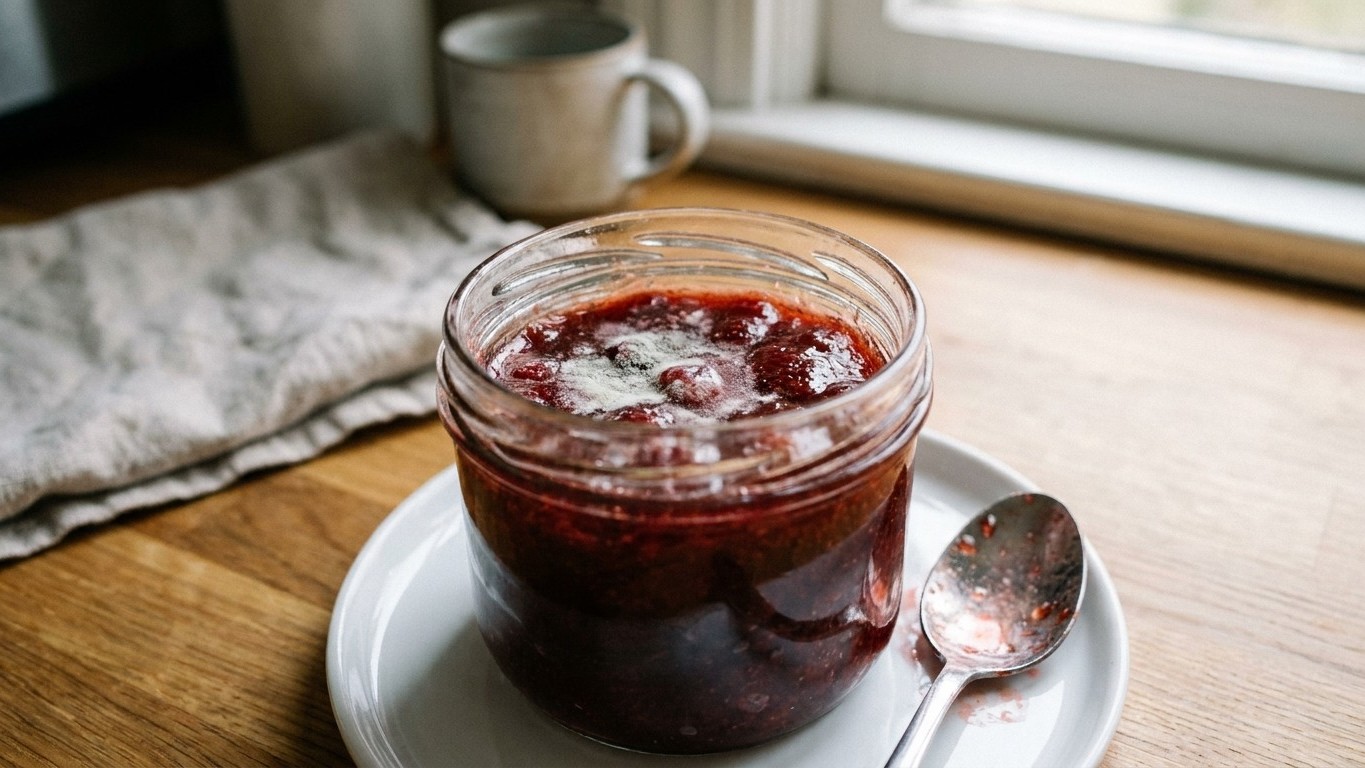
Two days after I scooped that pale fuzz off the surface of my homemade strawberry jam and spread the “rescued” spoonful on toast, I finally looked up what mold actually does once it lands in a sugar-preserved fruit. The short answer, according to food safety agencies: scraping doesn’t save the jar, because mold doesn’t stay where you can see it.
I’d made three jars of strawberry jam in June, the kind of small-batch afternoon project that feels almost virtuous until you forget one jar in the back of the fridge for a month. When I pulled it out, there was a thin, pale carpet across the top. My first instinct, honestly, was denial. My second was the classic move: spoon out the moldy layer, wipe the rim, and pretend the rest of the jar was untouched. It looked fine underneath. It smelled fine. I ate it that afternoon and again two days later before the second helping made me pause and actually research what I’d done.
Key takeaways
- Visible mold on jam is just the surface—toxic root threads and compounds penetrate up to 4cm into the jar
- The pH shift caused by mold can transform high-acid jam into a botulism risk zone
- Three simple prevention steps make mold almost entirely avoidable in homemade preserves
Why the surface mold was never the whole story
USDA and microbiologists now recommend against even scooping out the mold on jams and jelly products and using the remaining jam or jelly, even though that used to be suggested. That “used to be suggested” part stung a little, because it confirmed I wasn’t inventing a bad habit, I was following outdated advice that plenty of home cooks (and apparently at least one British Prime Minister) grew up trusting.
The mechanism is less about the visible fuzz and more about what’s underneath it. You only see part of the mold on the surface of food, and when a food shows heavy mold growth, root threads have invaded it deeply, with poisonous substances often contained in and around those threads. In something as viscous as jam, those threadlike roots have an easy path to travel through. Given the viscous nature of jam and jelly, even if you are incredibly precise when removing mold from a jar, it’s likely there are still spores hiding out and waiting to make you sick.
There’s also a chemistry problem I hadn’t considered at all. Mold growth in foods can raise the pH of the food, and in home canned products, this could mean that the high acid products could become low acid and therefore run the risk of botulism or other bacterial spoilage. A jar of jam isn’t just a static block of preserved fruit sitting quietly on a shelf. Mold actively changes its environment, and that shift can open the door to far nastier organisms than the fuzz you can actually see.
How far the danger really travels
This is where it gets genuinely interesting, and where the folklore about “just cut around it” turns out to be partly, but only partly, defensible. A recent review of the limited scientific literature on the subject found that the few existing studies have largely focused on mycotoxin migration in apple jam, with findings indicating that toxins such as patulin can diffuse up to 4cm into the product. Four centimeters. In a standard jam jar, that’s not a superficial skim, that’s potentially most of what’s left after you scrape the top.
The same analysis didn’t give a free pass to scraping either. The safest recommendation remains to discard the entire jar if mould is observed, though the data suggest that the old scrape-and-eat approach may not have been entirely misguided for the specific case of a very thin surface layer removed generously and immediately. The nuance matters, but it cuts both ways: researchers aren’t saying it’s safe, they’re saying the picture is more complicated than “one spore equals instant poisoning,” and also more complicated than “scrape a centimeter and you’re fine.”
Mycotoxins themselves are the real concern, not the mold spores directly. Research now indicates that the mold which people usually scrape off the surface of jellies may not be as harmless as it seems, since mycotoxins have been found in some jars of jelly having surface mold growth, and these compounds are known to cause cancer in animals, with their effects on humans still being researched. That last part is the uncomfortable truth nobody likes admitting: we don’t have a clean, reassuring answer about long-term human exposure, because nobody is ethically allowed to run that experiment on people.
What actually protects a jar of jam before it ever molds
The frustrating irony is that most home jam mold is preventable, and the fixes are almost boringly simple compared to the anxiety of discovering fuzz on your toast. Improperly processed jars, contaminated utensils, and inconsistent refrigeration are the usual culprits, not some inevitable fate of homemade preserves.
- Process jars in a proper boiling water bath rather than relying on the sugar content alone to seal them.
- Always use a clean spoon, never the one that just touched buttered toast or peanut butter.
- Store opened jars in the refrigerator and use them within a few weeks rather than letting them linger.
Even though sugar has a preservative action in jams and jellies, molds can still grow and spoil these products, so USDA and Cooperative Extension endorse a boiling water canning process for jams and jellies, which will make the potential for mold spoilage as small as possible. Paraffin wax seals, the old-fashioned method plenty of grandmothers swore by, have fallen out of favor entirely because they create exactly the kind of sealed, humid pocket mold loves.
My verdict, after doing the reading I should have done before breakfast that day: the jar went in the trash, lid and all, the moment I understood the science. Not because one spoonful was guaranteed to make me sick (it likely didn’t, statistically), but because the four-centimeter migration figure changed how I think about “underneath” entirely. The next batch I make will get a proper water bath, a dedicated spoon, and a spot in the fridge door where I actually see it every morning, because the cheapest food safety tool in my kitchen turns out to be simply not forgetting the jar exists.
Sources : healthycanning.com | quora.com