
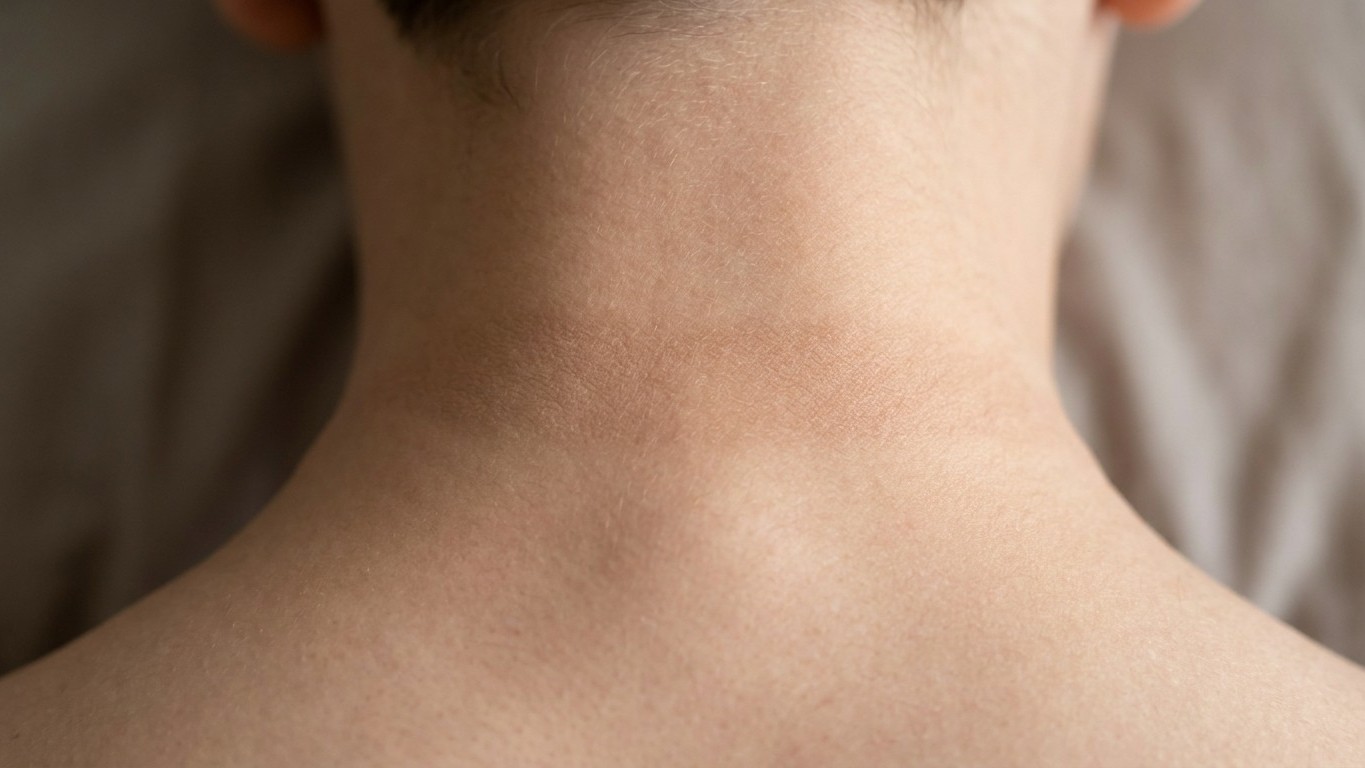
That dark band circling the back of a teenager’s neck isn’t dirt. It’s not sweat residue, not a tan line, not a hygiene failure no matter how many nights you’ve gone at it with a washcloth. What parents often scrub for weeks is a skin condition called acanthosis nigricans, and it’s the body’s way of flagging something happening well beneath the surface.
Acanthosis nigricans is a cutaneous finding characterized by brown-to-black, velvety hyperpigmentation of the skin, most often affecting body folds such as the posterior neck, axillae, groin and umbilicus, and it is strongly associated with insulin resistance and hyperinsulinaemia, including in type 2 diabetes and metabolic syndrome. Translation for the exhausted parent standing in the bathroom with a flannel at 9pm: this ring isn’t grime sitting on top of the skin. It’s the skin itself, thickened and darkened from the inside.
Skin areas with acanthosis nigricans can look dirty, but they’re not. Scrubbing the skin does not help and can irritate it. Some families even reach for bleach in frustration. Some people call it “dirty neck” and try scrubbing it or even using bleach to get rid of it. These don’t work, though, so spare yourself the bleaching. Three weeks of nightly effort, was never going to change a thing. The relief that comes with figuring that out is real, but so is the follow-up question every parent should be asking a pediatrician.
Key takeaways
- A dark, velvety ring on the neck that won’t wash away is your child’s skin sending a biological signal—not a hygiene issue
- This marker appears in about 14% of screened children and points to insulin resistance, a step toward metabolic concerns
- The path forward isn’t creams or scrubbing—it’s understanding what’s happening inside the body and working with a pediatrician on sustainable changes
What’s actually happening under the skin
The mechanism is more biological than cosmetic. Excess insulin activates insulin and insulin-like growth factor signalling pathways, stimulating proliferation of keratinocytes and fibroblasts and producing the characteristic plaques. In plain terms, when a body starts needing more and more insulin to move sugar out of the bloodstream, that excess hormone doesn’t just sit around quietly. It starts telling skin cells to multiply faster than usual, and the result is that thickened, velvety texture that no amount of exfoliating will smooth out.
For teenagers specifically, this isn’t a rare curiosity. In children and adolescents, acanthosis nigricans commonly co-occurs with overweight and obesity and functions as a clinical marker of insulin resistance and increased cardiometabolic risk. One patent screening effort put real numbers behind it: data reported on 102,733 screened children aged 8 to 15 showed 14.4% had acanthosis nigricans. That’s not a fringe finding tucked into a dermatology textbook. That’s roughly one in seven kids in a large screened population carrying this exact marker on their skin.
The location matters too, and it’s rarely random. This hyperpigmentation has poorly defined borders, usually occurs in skin fold areas, such as the back of the neck, axilla, and groin, and may include thickening of the skin. The neck tends to be where parents notice it first, simply because it’s visible above a collar, but a quick check under the arms or in skin folds often reveals the same pattern.
Not always a diabetes diagnosis, but a signal worth heeding
Here’s where I’ll push back on the panic that tends to follow a dermatology appointment. Insulin resistance is a step on a path, not a verdict. Insulin resistance is a step towards developing type 2 diabetes. However, remember that not everyone with insulin resistance will develop diabetes. That distinction gets lost in translation far too often, and it shouldn’t. A dark neck ring is a prompt to investigate, not a life sentence.
Skin tone changes the picture in ways that surprised even me while researching this. People with skin phototypes IV, V, and VI have a higher frequency of acanthosis nigricans on the neck compared to those with skin phototypes I, II, and III, and facial acanthosis nigricans is almost exclusive to those with darker skin types. There is a very high prevalence of insulin resistance in those with light skin who have acanthosis nigricans. However, in darker skinned individuals, acanthosis nigricans may present without concurrent insulin resistance. Thus, skin phototype influences the likelihood of acanthosis nigricans being a predictor of insulin resistance. A dermatologist or pediatrician factoring this in isn’t being dismissive. They’re reading the sign correctly for the specific patient in front of them.
There’s also a much rarer scenario worth naming so it doesn’t get lost in the noise: a sudden, aggressive version of this darkening in someone without obesity or other risk factors can, in uncommon cases, point toward an internal condition rather than insulin resistance. Acanthosis nigricans is most commonly associated with diabetes and insulin resistance, but rarely it can be a sign of internal malignancy. This is the exception, not the rule, but it’s the reason a doctor’s visit beats another week of scrubbing every single time.
What actually moves the needle
Skin lightening creams exist and dermatologists do sometimes prescribe them, but they’re treating the symptom, not the cause. Treating the underlying cause of acanthosis nigricans can make the dark patches of skin fade or even disappear. This can mean stopping any medicine that’s causing the problem or treating diabetes and other health conditions. For most teens, the underlying cause traces back to insulin sensitivity, and the fix is frustratingly unglamorous: sustainable changes to eating patterns and movement, introduced with care rather than crash-diet urgency.
Losing weight will help acanthosis nigricans fade. If you’re concerned about your weight, talk to your doctor before going on a diet. That last part is non-negotiable for a 14-year-old still growing. This is a conversation for a pediatrician or a pediatric endocrinologist, not a family group chat comparing diets, and definitely not a solo project involving a washcloth.
What struck me most while digging into this wasn’t the condition itself, but how often it gets caught first by a parent’s hand rather than a blood test. That neck ring showed up before any lab work flagged glucose or insulin levels, which means the skin, in its own strange velvety way, was doing diagnostic work weeks before a doctor’s office could. Worth remembering next time something on a child’s body looks “off” in a way soap simply won’t fix.
Sources : ncbi.nlm.nih.gov | acibademinternational.com