
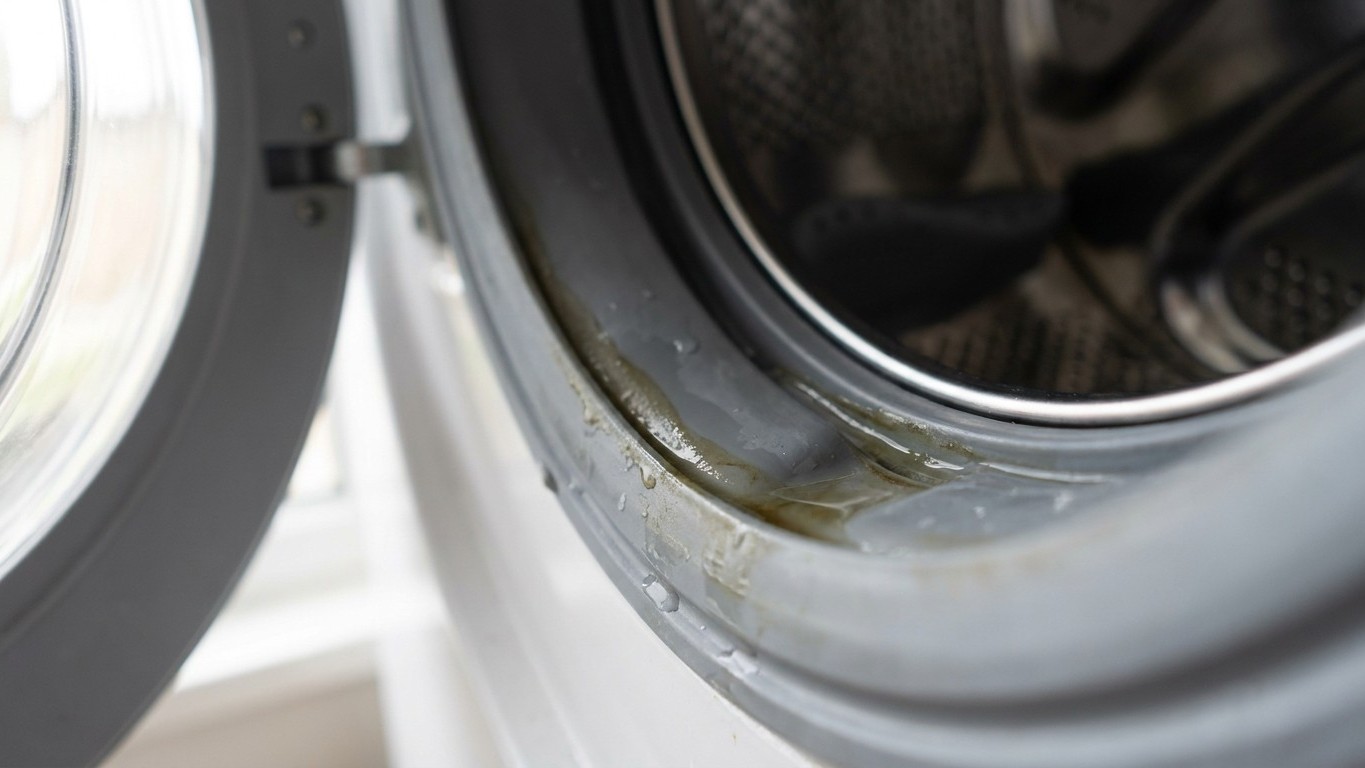
Three scrubs. Three rounds of hot water, baking soda, a toothbrush attack on every visible crevice. And the smell is still there, waiting behind the door the second it swings shut. If this sounds familiar, the drum was never the problem. Almost every washing machine odor originates somewhere you can’t reach with a sponge.
The rubber gasket ringing a front-loader’s door is the usual suspect, and for good reason. Both front-load washers and top-load machines can develop unpleasant odors, but front-loaders are especially prone because their rubber gasket traps extra moisture. But even people who dutifully wipe that seal after every load keep smelling something. That’s because the fold you’re wiping isn’t the fold that’s colonized. After the cycle ends, water pools in its folds. Lint, detergent, and skin cells settle in there too. Close the door, and now it’s dark, warm, and wet. A biofilm, a thin, slimy layer of organic matter, starts forming almost immediately. By the time you notice it, the colony has had weeks to establish itself in a pocket you’ve never actually seen.
Key takeaways
- The drum isn’t the problem—biofilm is building in places your sponge will never reach
- Bacteria like Pseudomonas and Moraxella are colonizing your machine and potentially contaminating your clothes
- Cold-water washing and hard water make biofilm thicker, but one simple habit stops it from forming at all
The real address: a slime you can’t scrub off
Biofilm isn’t dirt. It’s an engineered survival structure, and that distinction matters more than most cleaning guides admit. It builds a slimy layer that sticks to the inside of the drum, the outer tub you cannot see, the sump, the drain hose and the detergent drawer. Biofilm is stubborn, it is not loose dirt that rinses away, it is a structure that holds onto surfaces and shrugs off a short cold cycle. Once it is established, every wash pushes water through it, and your clothes come out carrying some of what is in there. That last part is the uncomfortable truth nobody wants to hear at 7 a.m. while folding towels: the machine isn’t just failing to clean, it’s actively reseeding your laundry.
Researchers have gone looking for exactly what’s living in there, and the results read like a small microbiology exam. One European study found that 30–60% of the relatively most abundant sequence types were closely related to potentially pathogenic bacteria, such as Brevundimonas vesicularis or Pseudomonas aeruginosa inside the detergent drawer, and Moraxella osloensis or Acinetobacter parvus inside the door seal. Moraxella osloensis, for the record, is the bacterium most often blamed for that specific sour, locker-room note people describe in towels. A separate case went further: an antibiotic resistant Klebsiella oxytoca strain was recently isolated from biofilms of the detergent drawer and door seal of a domestic washing machine used for the woollen laundry of a paediatric hospital ward, from which it probably had colonized newborns. A hospital-grade cautionary tale, sure, but it makes the point: what’s growing in a washer isn’t cosmetic.
A metabarcoding study of household machines in Shanghai found a similarly consistent cast of characters, with bacteria mainly including Pseudomonas, Enhydrobacter, Brevibacterium, and Acinetobacter turning up across units. And a more recent survey pushed the finding somewhere unexpected. A recent survey of household washing machines found that the main contributors to microbial communities were the users and not the water source. In plain terms: it’s less about your tap water and more about the sweat, skin cells, and residue your own laundry deposits, cycle after cycle, in spots the wash program never fully flushes.
Why hot water and vinegar alone don’t finish the job
Cold-wash habits, the ones we’ve all adopted to save on energy bills, quietly make things worse. A 2024 review of washing machine microbiology found that machines run mostly on low-temperature cycles build up a wider mix of microbes and thicker biofilm on the drum, the gasket, and the detergent drawer than machines that see a regular hot cycle. Washing at 86°F feels virtuous until you realize the machine itself never gets hot enough to knock back what’s colonizing its own hardware.
Hard water adds another layer entirely, one that has nothing to do with cleanliness and everything to do with chemistry. If you are in a hard water area, limescale builds on the heating element and inside the drum. Scale is rough and porous, which can give biofilm somewhere to anchor. It also means your detergent works less efficiently, because some of it is busy dealing with the minerals in the water instead of your kit. So the biofilm isn’t just sitting on a smooth rubber surface, it’s gripping a textured mineral crust that a quick vinegar rinse barely touches.
The fix nobody skips on purpose, but everyone skips anyway
The EPA’s framing on indoor mold is refreshingly blunt and applies directly here: the key to mold control is moisture control. If water sits in the drum, the drain hose, or the gasket folds after a wash, you get that wet-towel smell. That means the single most effective habit is also the least glamorous one: leave the door and detergent drawer cracked open after every load instead of sealing the machine shut.
Beyond that, appliance manufacturers themselves flag the maintenance step most owners never touch. Whirlpool and LG both call for emptying and rinsing the drain pump filter monthly, and it is the step almost everyone skips. That filter, tucked behind a small panel near the base of the machine, catches hair, coins, tissue fragments and lint, all of it sitting in standing water between cycles. It’s a more consistent odor source than the gasket, if less obvious.
Running a monthly hot maintenance cycle helps too, and not as a suggestion dreamed up by cleaning-product marketing. LG puts Tub Clean on a monthly schedule, and the washing machine microbiology research says the same thing: a monthly high-temperature maintenance wash is what stops biofilm from establishing. The distinction matters: this isn’t about removing existing buildup, it’s about preventing the colony from ever taking hold in the first place.
None of which means the drum scrubbing was pointless, exactly. It just means the smell was never really coming from where the sponge could reach, and no amount of elbow grease changes what’s sitting behind a rubber fold, inside a filter housing, or clinging to limescale you can’t see.
Sources : indoordoctor.com | tomsguide.com