
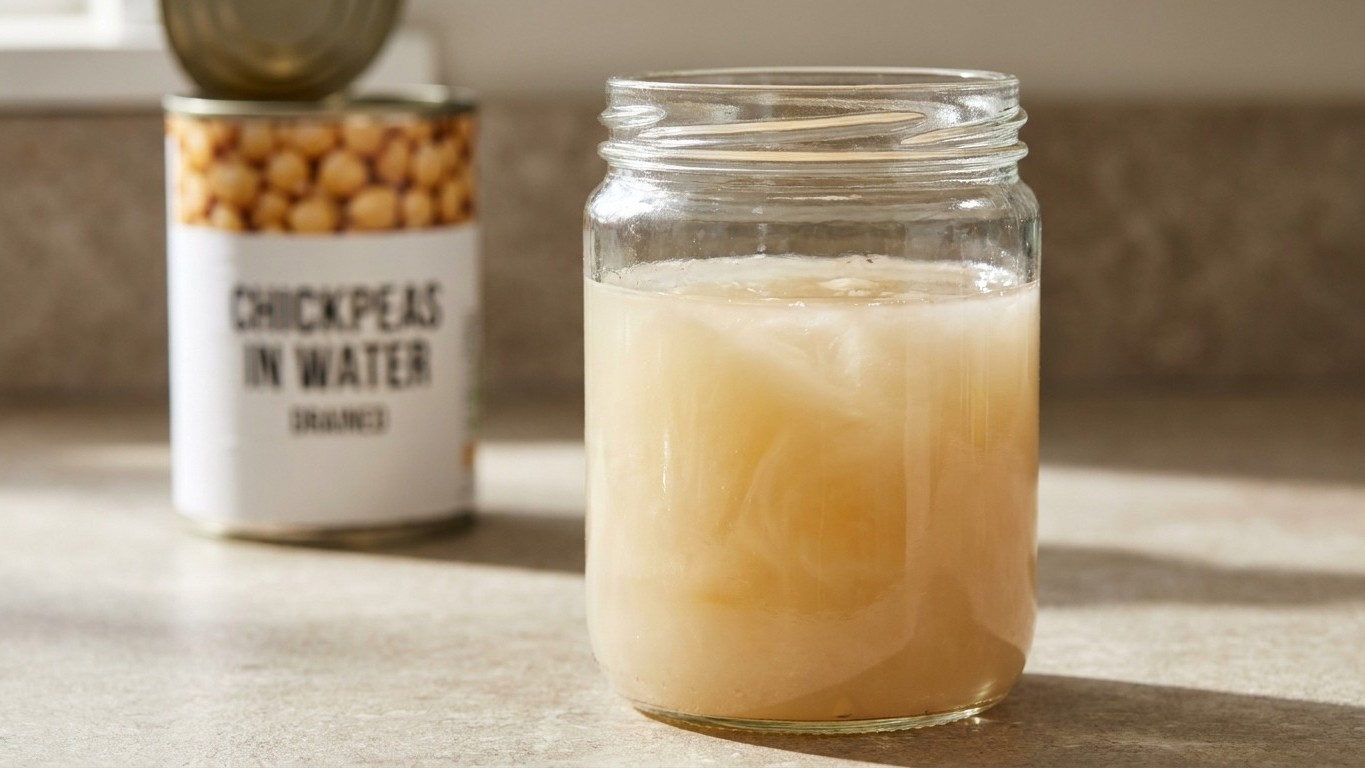
Ask a home cook what happens to the liquid in a can of chickpeas and the answer is almost always the same: down the sink. Ask a pastry chef the same question, and you’ll get a wince, followed by a lecture on wasted gold. Yes, the dregs you usually pour down the drain when you open a can of chickpeas are actually magical. That thick, slightly cloudy liquid has a name now, and a fan base that borders on obsessive.
It’s called aquafaba, the viscous liquid left over when you drain a can of chickpeas. The story of its discovery is oddly recent for something that’s been sitting in every pantry for decades. Using chickpea liquid as an egg substitute in recipes kicked off in 2014, when Joël Roessel shared on his vegan blog that the liquid from the chickpea can can form foam, and around that time, Goose Wohlt found that aquafaba could also be used as a stabilizer and shared a meringue recipe that used just aquafaba and sugar in 2015. A Facebook group formed almost overnight. Within a couple of years, it attracted more than 11,000 members to the Facebook group “Vegan Meringue – Hits and Misses!”, all swapping notes on a substance nobody had thought twice about before.
Key takeaways
- A substance discarded for decades is now the obsession of professional pastry chefs worldwide
- The science behind aquafaba’s magic is more complex than anyone first thought
- It has real limitations that most enthusiastic blog posts conveniently forget to mention
What’s Actually Happening in That Can
The trick isn’t folklore, it’s chemistry, and it comes down to what chickpeas leach into their cooking water as they soften. Aquafaba has various nutrients including protein, simple sugars, polysaccharides, minerals, and phytochemical compounds, and consists of water (92–95%) and dry matter (5–8%) which includes carbohydrates, low molecular weight proteins, saponins, and some Maillard reaction products. Put plainly: it’s mostly water, but the small fraction that isn’t water happens to be exactly the kind of stuff that traps air and holds a foam together.
For a while, saponins got all the credit, since some of the compounds most important for aquafaba’s foaming ability are saponins, which are characterized by the soap-like foam they produce when shaken. But newer analysis has complicated that story. One breakdown of the actual liquid found that a typical 180g serving of aquafaba contains less than three hundredths of a percent of saponins, which implies that the foaming action of aquafaba is only partially influenced by saponins, if at all. The proteins seem to be doing more of the heavy lifting than anyone assumed a decade ago. Either way, the effect is measurable in the lab, not just anecdotal: several studies have reported that aquafaba exhibited similar foaming capacity as egg white protein.
From Meringue to Whiskey Sour
Pastry professionals didn’t wait for the mechanism to be fully settled before putting the liquid to work. Whipped correctly, it behaves with a texture close enough to egg white that it’s now standard in certain vegan kitchens for the trickiest classic in the repertoire. Aquafaba makes the same kind of crispy, crunchy, sweet meringue you would expect from regular egg whites. Macarons, marshmallows, mousse, even the foam crown on a cocktail have all become fair game. Fancy vegan restaurants even use it in place of egg whites in classic cocktails like a whiskey sour or gin fizz, and it even works in cappuccinos.
The ratios are almost embarrassingly simple to remember. Three tablespoons of aquafaba is equivalent to about one whole egg, while two tablespoons of aquafaba is equivalent to about one egg white. A single standard can doesn’t leave much room for waste, either, since a can of chickpeas yields about 1/2 to 3/4 cup of this liquid, so about eight to 12 tablespoons, which works out to a couple of egg’s worth of substitute per can. Whip it the way you’d whip egg whites and the timeline is close, if a touch slower: expect between 10 to 15 minutes to reach full peaks, with a stabilizer like cream of tartar helping it get there faster and hold its shape once baked.
Where it genuinely struggles is anywhere eggs need to do more than aerate. Aquafaba replaces egg whites in meringues, mousse, and macarons, but fails in angel food cake and custards. That’s not a minor caveat. Structure, richness, binding, those jobs still belong to the actual egg, and no amount of whipping chickpea liquid changes that. Frankly, this is the part most enthusiastic blog posts gloss over. Try it in a quiche and the result is a wet, sad disappointment, not a revelation.
The Slightly Less Glamorous Kitchen Chemistry
Restaurant test kitchens have poked at aquafaba enough to find its rough edges. America’s Test Kitchen, testing it head-to-head against real egg whites in a classic cookie recipe, discovered that granulated sugar doesn’t dissolve in aquafaba the way it does in egg whites, which meant heating the liquid first to get the sugar to fully incorporate before proceeding. It’s a small fix, but it’s the kind of detail that separates a meringue that holds its shine from one that weeps and collapses on the tray.
Food scientists have also confirmed something bakers had already noticed by feel: not all aquafaba behaves the same. Cooking method, bean variety, and even brand of canned chickpeas change the outcome, since chickpea aquafaba’s emulsifying, foaming, and gelling properties are influenced by factors such as legume composition, genotype, cooking time, pressure, temperature, and the ratio of water to seeds. That’s why the same recipe can whip beautifully with one can and refuse to cooperate with the next. Canned is generally the safer bet for consistency over homemade cooking liquid, if reliability matters more to you than DIY purity.
Industrial food researchers have taken things well past dessert. Recent published work has tested aquafaba as a partial fat replacer in ice cream, aiming for a low-fat ice cream that closely mimics the conventional full-fat counterpart by combining whipped aquafaba with whey protein. Other labs are folding it into muffin batters after breaking its proteins down further, chasing better texture and antioxidant content in the finished bake. None of that changes what happens in a home kitchen this weekend, but it says something about how far a can of chickpea runoff has traveled since 2015, from a Facebook hobby group to peer-reviewed food science.
Next time a recipe calls for draining a can of chickpeas, pour that liquid into a jar before it hits the sink. It keeps in the refrigerator for several days, freezes in ice cube trays for longer storage, and costs exactly nothing extra. The chickpeas were always the headline ingredient. It turns out the runoff was the more interesting one.
Sources : slate.com | glueandglitter.com