
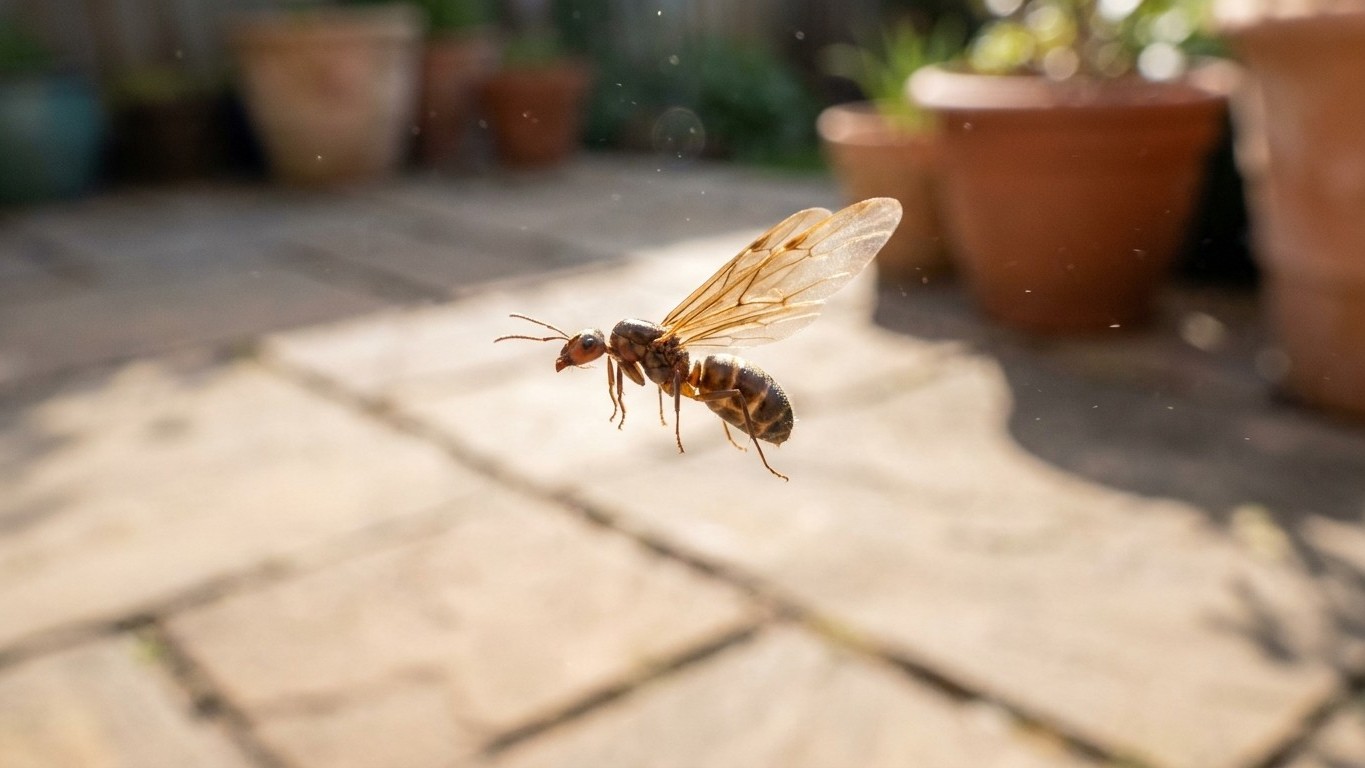
For years, the ritual was the same: the first truly warm, muggy afternoon of summer would arrive, and within minutes my patio would be a churning haze of winged ants. I’d grab the insecticide spray, empty half the can into the air, and feel briefly victorious watching them drop. The following week, they’d be back. An exterminator finally set me straight: I’d been aiming at the one thing in that whole scene that didn’t matter.
Key takeaways
- What you’re spraying at isn’t even the problem—flying ants are just passing through on their way to start new colonies elsewhere
- The actual nest could be hiding just meters away, completely untouched by all that aerosol, thriving under your patio for years
- One critical mistake could cost you thousands: confusing garden ants with termites looks almost identical, but the consequences are wildly different
The swarm you’re spraying isn’t the problem
What I was blasting with insecticide were alates, the winged reproductive ants whose entire job is to leave the colony, mate mid-air, and found a new nest somewhere else. Flying ants only come out to mate. They don’t go back to the nest, so that wouldn’t solve the problem. Killing them mid-swarm is a bit like arresting people at the airport departure gate and assuming you’ve shut down the city they came from.
The swarming itself is weather-triggered, not random. When the weather warms up, termite colonies often begin to release reproductive winged swarmers, also known as alates, whose main purpose is to fly away, mate, and find a place to start a new colony. Garden ants behave almost identically. Swarms of winged black garden ants, typically Lasius niger, erupt from their nests under lawns, flower beds, and stone patios to invade personal space, cling to laundry, and splatter against car windshields. In Britain, these mass flights are dense enough that their sheer numbers can be so immense that they have previously registered as drifting clouds on weather radars, with a Met Office forecaster noting distinguishing them from patches of showers can be difficult. That’s the scale of what’s actually flying over your barbecue.
Where the real colony is hiding
The nest itself, the part actually worth treating, is usually invisible and often unnervingly close. Pest professionals routinely find that the colony, sometimes 10 to 15 metres away from where you’re seeing activity, remains untouched no matter how much spray gets used on the visible cloud. On outdoor patios specifically, the location tells its own story: a nest beneath a south-facing patio suggests a colony that’s been there for multiple seasons. That warm, sun-baked slab isn’t just where ants happen to swarm from, it’s ideal nesting real estate they’ve likely occupied for years.
Garden ants aren’t shy about their address once you know what to look for. They usually nest outdoors in lawns, flower beds, beneath paving flags or at the base of walls. If you can actually trace the trail, the fix can be almost old-fashioned: if possible, trace the trail of worker ants to the nest, which can often be recognised by small piles of fine earth being brought up from underground, and if the nest can be exposed, pour boiling water into it. No spray can, no fumes, just gravity and heat doing the work an aerosol never could.
Ants or termites? Get this wrong and it’s expensive
Here’s the part that made my stomach drop a little during that consultation. Garden ants swarming off a patio are, frankly, cosmetic, annoying, but harmless to the structure. Termite swarmers look almost identical to the untrained eye and are decidedly not harmless. The real risk happens when termites are mistaken for ants and the problem is ignored, since a mature termite colony can contain hundreds of thousands of termites quietly feeding on structural wood.
The tells are subtle but learnable. The antennae of swarming termites are straight and beaded while swarming ants have antennae that are elbowed or bent. Body shape matters too, since unlike flying ants, termite swarmers have wide waists giving their bodies a somewhat uniform thickness, while flying ants have narrow, pinched waists that clearly separate their bodies into 3 segments. And check the wings: termite swarmers have 2 sets of wings equal in shape and size, while flying ants also have two sets but their front wings are much larger than their hind wings. If you find discarded wings scattered along a windowsill after the swarm has cleared, take that seriously; finding discarded wings, mud tubes, or damaged wood strongly suggests termites, while outdoor mating aggregations are more typical of flying ants. I genuinely hadn’t thought to check any of this before that visit : I’d just assumed “ant is ant.”
Treating the actual colony, not the show
Once you know it’s garden ants and not termites, the fix stops being about spray cans entirely. Slow-acting bait is the tool that actually reaches the nest, because worker ants will collect a bait mixed with something sweet, like honey mixed with borax, and take it back to the nest where it will kill the colony. Contact insecticide only ever kills what it touches directly; bait exploits the ants’ own foraging behavior to smuggle the poison home. For anything hidden inside wall cavities or under pipework, though, the case for calling in help is straightforward, since when ants are nesting inside the building structure, professionals have tools and access homeowners don’t.
My own patio nest, it turned out, sat directly under a corner slab that gets full afternoon sun, exactly the kind of spot that stays warm well into the evening. The exterminator lifted one paver, found the tunnel network in about ninety seconds, and treated it directly rather than touching a single one of the ants still circling overhead. They vanished within days, and unlike every previous summer, they haven’t reappeared since. The insecticide can is still in my garage, unopened, which might be the most satisfying part of the whole story.
Sources : gunterpest.com | tomsguide.com