
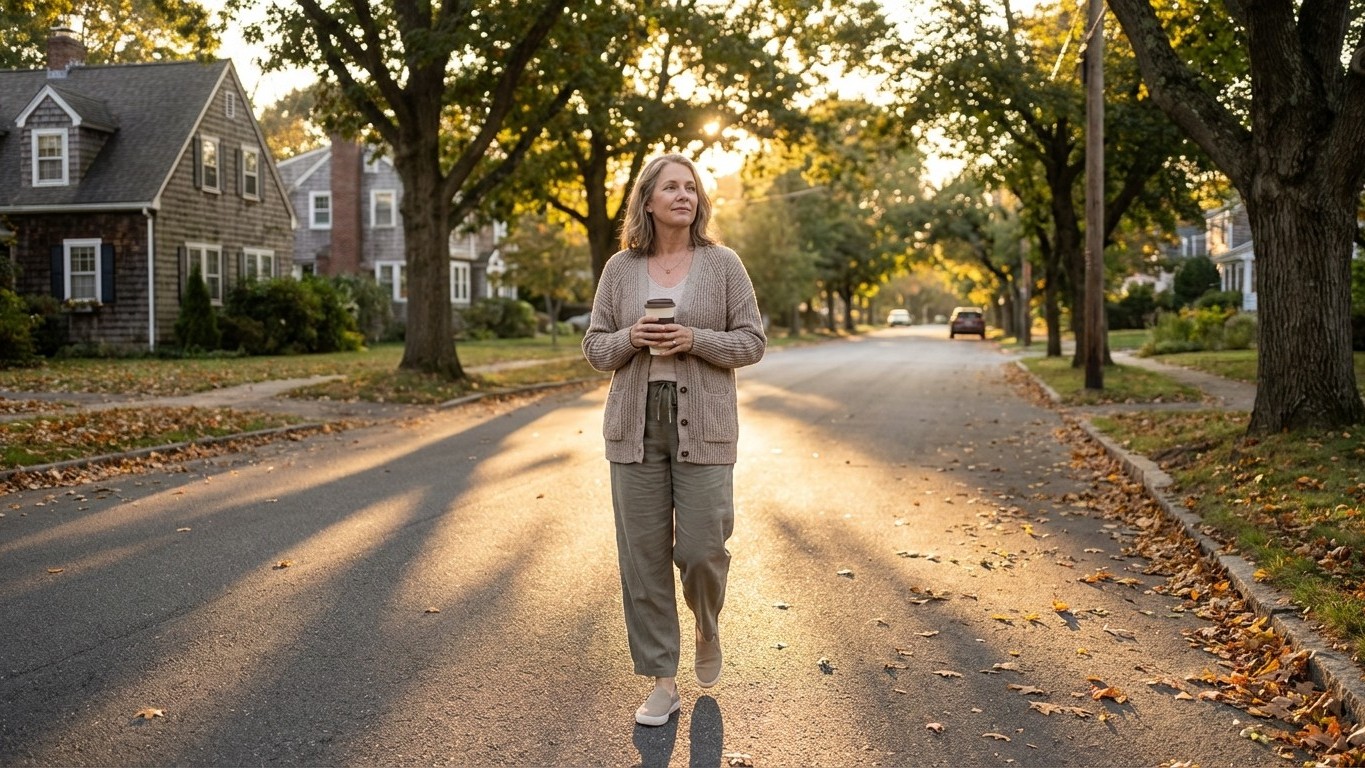
The air was still warm, the dishes were done, and instead of collapsing onto the couch with my phone, I stepped outside. Ten minutes, maybe fifteen. Nothing athletic about it, just a slow loop around the block, still Wearing my dinner socks. That one small shift, repeated night after night, quietly rewired two things I’d been struggling with for years: restless sleep and those sluggish, foggy mornings that I’d started blaming on “just getting older.”
What happened over the following weeks surprised me enough that I started digging into the research. Turns out, the post-dinner walk is one of those rare habits that sounds almost too modest to matter, and then absolutely does.
Key takeaways
- A 2-5 minute walk after eating reduces blood sugar spikes more effectively than longer workouts at other times
- Evening walks trigger natural melatonin production and body temperature shifts that deepen sleep—without the downsides of intense late-night exercise
- This ancient habit requires almost zero activation energy, yet delivers measurable improvements in metabolic health and sleep quality within two weeks
The Blood Sugar Connection Nobody Talks About at the Dinner Table
Here’s something worth understanding about how your body handles a meal: the hour or two after eating is when your blood glucose spikes the most. Your pancreas releases insulin, your cells scramble to absorb that sugar, and if you just sit still on the sofa, the whole process takes longer and works less efficiently. The glucose lingers. Over time, repeated post-meal spikes are linked to insulin resistance, energy crashes, and that dreaded 3 p.m. fog.
A short walk changes this equation in a way that’s almost elegant in its simplicity. When your leg muscles contract, they absorb glucose directly from the bloodstream, independent of insulin. A 2022 review published in Sports Medicine found that even a two-to-five minute walk after meals reduced blood sugar levels more effectively than a single longer walk taken at another point during the day. Two to five minutes. The bar is genuinely low.
For women especially, post-meal glucose regulation is worth paying attention to. Hormonal fluctuations across the menstrual cycle, perimenopause, and menopause all affect insulin sensitivity. The body becomes more reactive to dietary carbohydrates at certain phases, which explains why the same pasta dinner can leave you feeling completely different depending on the week. A gentle walk doesn’t replace medical guidance for anyone managing diabetes or prediabetes, but as a daily habit layered into an ordinary evening, the metabolic benefit is real and well-documented.
The unexpected part, for me, wasn’t the science. It was the felt experience of waking up the next morning without that thick, heavy sensation behind my eyes. Less inflammation-adjacent, somehow. Lighter.
What It Actually Does to Your Sleep (This Part Caught Me Off Guard)
Sleep researchers talk a lot about “sleep pressure”, the biological drive toward rest that builds throughout the day. Light exposure, body temperature, and physical activity all influence how quickly and deeply that pressure converts into actual sleep. A post-dinner walk, even a casual one, affects at least two of those variables simultaneously.
Walking outdoors in the early evening exposes you to the gradual dimming of daylight, which helps calibrate your circadian rhythm in a way that indoor lighting never quite manages. Your body reads the shift from golden hour to dusk as a cue to begin its wind-down sequence, nudging melatonin production earlier and more naturally. The mild physical exertion also causes a slight rise in core body temperature, followed by a gradual drop as you cool down, and that cooling curve is one of the strongest physiological Signals for sleep onset.
A counter-intuitive point that often gets lost: many people avoid evening exercise because they’ve heard it interferes with sleep. That’s true for vigorous, heart-pumping workouts done right before bed. A leisurely post-dinner stroll is the opposite. It’s closer in effect to a warm bath than a gym session, the body heats up gently, cools down gradually, and arrives at sleep with less residual tension. Multiple studies on older adults have shown that regular light walking in the evening improved both sleep quality and sleep duration, without any of the negative effects associated with intense late-night training.
My own experience tracked closely with this. Within about ten days of making the walk a consistent habit, I stopped waking at 2 or 3 a.m. with that wide-eyed, wired feeling. I wouldn’t call it magic. But it felt close.
Making It Stick Without Turning It Into a Chore
The reason most healthy habits evaporate within a month is that they require too much activation energy, special shoes, a specific playlist, a block of time that has to be scheduled. The post-dinner walk bypasses all of that. You’re already in your kitchen, already in your clothes, already standing up from the table. The transition cost is almost zero.
A few things that helped me stay consistent: keeping the walk genuinely short (ten to twenty minutes is plenty, and probably optimal), leaving before the cleanup is fully done so there’s no gravitational pull back to the couch, and going with whoever is available, a partner, a kid, a dog, or solo with a podcast. The social version has its own bonus effect; it extends the meal’s connective ritual rather than ending it abruptly with screen time.
Timing matters more than distance or pace. Research suggests the sweet spot is within sixty to ninety minutes after eating, before blood sugar has fully peaked and come back down. But even a walk thirty minutes after your last bite moves the needle. You’re not optimizing for athletic performance here. You’re just prompting your body to do more efficiently what it was already going to do.
There’s something almost old-fashioned about this habit, the Italian passeggiata, the after-dinner constitutional that used to be a cultural norm before television and then smartphones consumed the evening hours. Cultures with some of the lowest rates of metabolic disease have long built movement into the hour after eating, not as exercise, but as part of the rhythm of the day.
Which raises a question worth sitting with: how many other things we’ve filed under “quaint tradition” were Actually doing quiet, powerful work all along?