
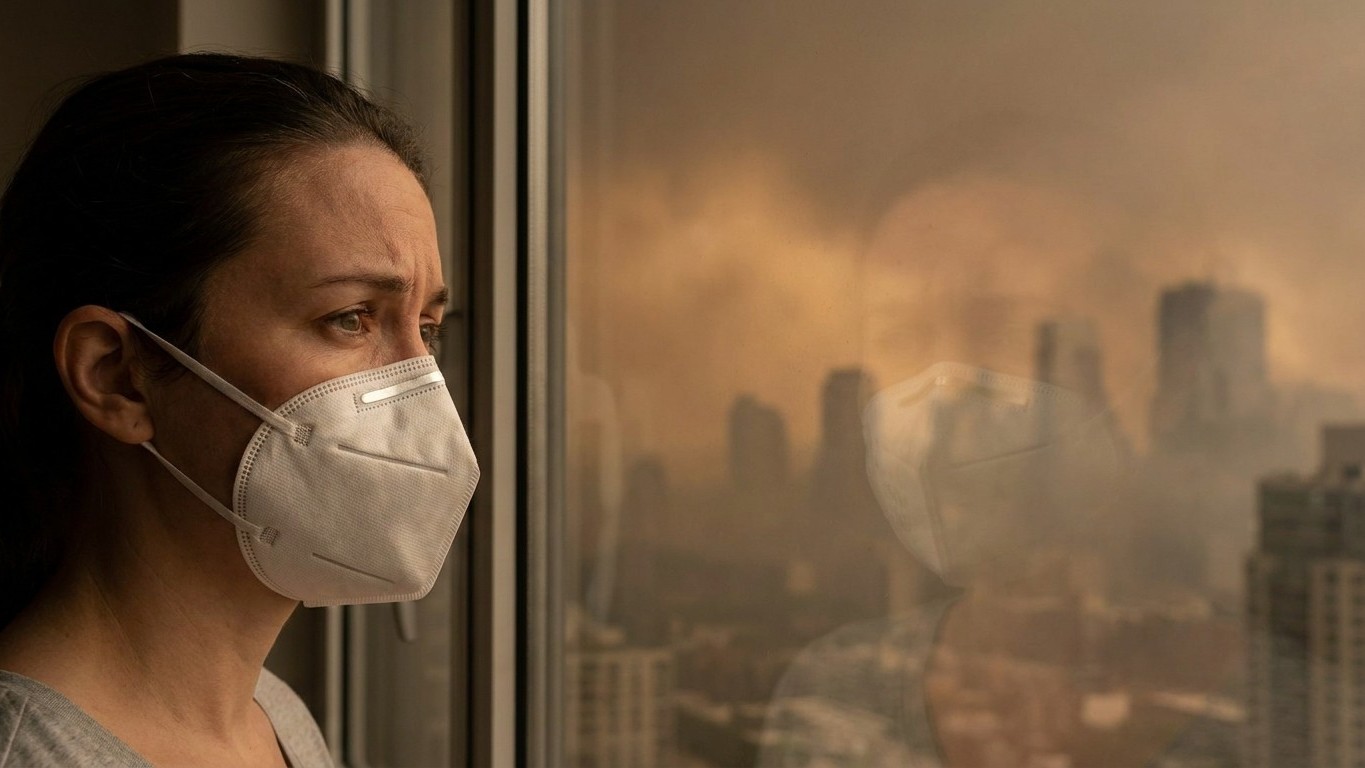
Three weeks ago, the sky over Chicago and Detroit turned the color of weak tea, and residents in cities from Minnesota to Maine reached for whatever face covering was closest to the door. Air quality alerts spanned Minnesota, Michigan, Indiana, Ohio, West Virginia, Virginia, Maryland, Delaware, New Jersey, New York, Connecticut, Rhode Island, Massachusetts, Vermont, New Hampshire and Maine as smoke continued to affect New York City. Chicago, Detroit, New York and Washington D.C. even ranked among the world’s most polluted major cities. And that’s exactly the problem with grabbing “any mask”: the fabric one you wore during flu season, the disposable surgical mask from the bottom of your bag — they were never built for this particular enemy.
Wildfire particulate matter isn’t ordinary dust. It’s fine particulate matter smaller than 2.5 microns, mixed with carbon monoxide, volatile organic compounds, and ash. To put that in perspective, a human hair is roughly 70 microns wide. These particles are so small they don’t get trapped in your nose or throat the way pollen does : PM2.5 penetrates deep into the lungs and bloodstream, and it’s the component linked to respiratory distress, cardiovascular strain, and long-term health damage. Franchement, that’s the part most people miss: the danger isn’t the smell of smoke, it’s the fraction you can’t smell or see, drifting straight past your body’s usual defenses.
Key takeaways
- Your cotton mask and surgical mask are letting 79-91% of wildfire smoke slip straight through
- The tiniest particles that reach your alveoli aren’t the hard ones to filter—poor mask fit is the real culprit
- Real-world N95 use cuts wildfire-related hospital visits by up to 39%, while cloth masks manage only 2-11%
The math behind why cotton and bandanas fail
Here’s where the “better than nothing” instinct falls apart. A 2021 laboratory study run out of Colorado State University tested how well different coverings actually block wildfire-sized particles, and the gap wasn’t subtle. In a zero-bypass lab test, a natural material mask, a surgical mask and an N95 respirator blocked 21, 91, and 97 percent of test aerosol particles respectively. Another modeling analysis found similarly stark numbers: N95, P95, and P100 respirators were 98–99.5% efficient, while surgical masks were 81% efficient and cloth bandanas were only 9% efficient at filtering particulate matter from wildland fire smoke.
Nine percent. That’s not “some protection.” That’s a bandana doing almost nothing while you feel reassured wearing it.
The real-world numbers get worse once you account for how masks actually sit on a human face rather than in a lab clamp. A modelling study estimated mask collection efficiencies accounting for both filtration and fit at 0.33, 0.68 and 0.9 for cloth masks, surgical masks and respirators, respectively. The gap-around-the-edges problem is the culprit: surgical masks and cloth masks are largely ineffective because contaminated air bypasses the filter through the gaps around the edges without ever passing through it. A researcher from Colorado State’s engineering team put it plainly: cloth masks don’t filter wildfire smoke-sized particles very well, while surgical masks tend to let air bypass the filtering part of the mask.
The counterintuitive part: smaller isn’t always harder to filter
Here’s where most people’s mental model goes sideways. You’d assume the tinier the particle, the easier it slips through any filter, full stop. Not quite. Mechanical filters actually have a weak spot in the middle of the size spectrum, not at the extremes. The filtration efficiency for mechanical-filtering masks reaches a minima around 0.5–0.6 micrometers, which happens to be near the peak size in the aerosol mass distribution for wildfire smoke. Below that “most penetrating particle size,” diffusion effects actually help capture ultra-fine particles more efficiently. It’s one of those facts that flips intuition: the smoke particles small enough to reach your alveoli aren’t necessarily the ones a good respirator struggles with most — but a mask that’s already leaking air around a poor seal makes the whole calculation irrelevant, since none of that filtration matters if the air is sneaking around the sides instead of through the fabric.
That fit issue is why health authorities keep repeating the same instruction. If fitted and worn correctly, the N95 mask filters out 95% of particles larger than 0.3 microns, making it very efficient at keeping out the 2.5-micron particles found in wildfire smoke, according to William Lang, MD, former director of the White House Medical Unit. The population-level payoff is measurable, too. Real N95 use, when actually adopted, cuts hospital visits: N95 respirators offer protection against wildfire PM2.5, reducing exposure by more than a factor of 14 and hospitalizations by 22%–39%. Compare that to the cloth-mask scenario in the same body of research, where natural cloth masks, surgical masks or N95 respirators used at a two-thirds compliance rate were estimated to have reduced wildfire smoke-attributable respiratory hospitalizations by 2 to 11, 9 to 24, and 22 to 39 percent, respectively.
What actually earns its place on your face
The takeaway isn’t complicated, even if the aerosol physics behind it is. A few things matter more than anything printed on the packaging:
- Look for NIOSH-approved N95 or KN95, not a generic “dust mask” or fashion covering.
- If the mask is starting to develop cracks or looks wrinkly, it’s no good anymore.
- A clean-shaven face and a snug seal across the nose bridge matter almost as much as the filter rating itself.
- Ditch it after heavy use rather than trying to disinfect and reuse it repeatedly.
If an N95 isn’t available, KN95 masks work just as well and are very efficient at filtering out particulate matter. The one thing you shouldn’t do is treat a cotton scarf or a leftover COVID-era cloth mask as an acceptable stand-in when your local air quality index tips into the red or purple zone. Air quality apps and NWS alerts update fast during these events, and honestly, checking one before you walk the dog now feels as routine as checking the weather itself, especially with fire seasons stretching longer than they did even a decade ago. Research shows fire seasons in some areas are now more than a month longer than they were 35 years ago, and those larger fires produce more smoke that can travel hundreds or even thousands of miles. Your junk drawer probably still has last year’s N95s in it. Check the straps before you count on them.
Sources : engr.source.colostate.edu | news.agu.org